 Society

Vietnamese Prime Minister meets Cambodian National Assembly President
1.
|
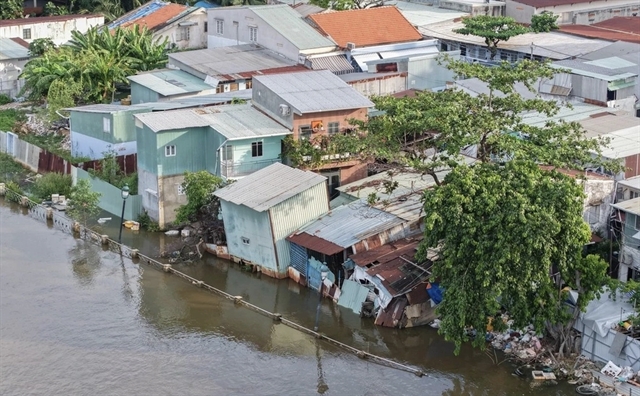
| Residential areas on Thanh Đa Peninsula are flooded by high tides. — Photo dantri.com |
HCM CITY — The People’s Committee of HCM City has released a list of dangerous and extremely dangerous riverbank and canal erosion hotspots, highlighting growing risks to residents as the rainy season approaches.
According to the announcement, the city currently has 43 erosion sites affecting the daily lives of around 555 households across 18 wards and communes. Of these sites, 32 are located within HCM City, while 10 fall in Bình Dương Province and one in Bà Rịa–Vũng Tàu Province, based on former administrative boundaries.
Among the 43 locations, 21 have been included in embankment construction projects, with a combined length of more than 17.9 kilometres and total investment exceeding VNĐ3.95 trillion (US$150 million).
However, authorities have raised concerns over eight sites classified as extremely dangerous, many of which have been flagged repeatedly over the years. These include two locations along Giồng Ông Tố Canal in Bình Trưng Ward, one site on Thanh Đa Canal in Thạnh Mỹ Tây Ward, and others in Nhà Bè, Hiệp Phước, Bình Hưng, Tân Nhựt and An Thới Đông communes.
Officials warned that erosion risks across the southeastern region are likely to intensify in the coming months due to the onset of the rainy season and expected peaks in high tides. Vulnerable areas include riverbanks along major waterways such as the Đồng Nai, Sài Gòn, and Thị Tính rivers, coastal zones, and residential areas located on steep slopes or at the foot of hills.
The primary causes of erosion have been identified as illegal sand mining, constantly changing water flows influenced by tidal patterns, encroachment on riverbanks for housing and construction, and increasingly erratic heavy rainfall.
Authorities have urged relevant agencies and local administrations to promptly implement temporary reinforcement measures in areas where land clearance has been completed but construction has yet to begin, particularly in high-risk zones such as Thanh Đa Peninsula.
At the same time, they stressed the need to accelerate the preparation, appraisal and approval of anti-erosion projects to enable timely construction. Ongoing projects must address bottlenecks to ensure completion and operation as soon as possible, while completed works should be handed over to capable and reputable management units to maximise effectiveness.
For locations already identified but not yet backed by investment plans, local authorities have been instructed to strengthen public communication and warnings so that residents can take proactive measures to prevent and respond to risks.
Local governments are also required to closely monitor erosion developments, prepare response plans under the “four on-the-spot” principle, and encourage residents to limit additional loads along riverbanks to reduce potential hazards.
Meanwhile, relevant agencies, including police, construction and environmental authorities, have been tasked with intensifying patrols and strictly handling illegal sand mining and transport activities along key rivers such as the Sài Gòn, Đồng Nai, Lòng Tàu and Soài Rạp, as well as in coastal areas.
They must also strictly deal with violations involving encroachment on protected riverbank corridors, dykes and embankments, while reviewing transport infrastructure along rivers and coastal areas to ensure public safety.
All measures are aimed at safeguarding the lives and property of local residents. — VNS
Society
 Society
 Society
 Society
 Society
 Society
 Society
 Society
 Society
 Society
 Society
 Society
 Society
 Society
 Society