 Society

Sơn La holds second coffee festival, targeting stronger businesses in future
1.
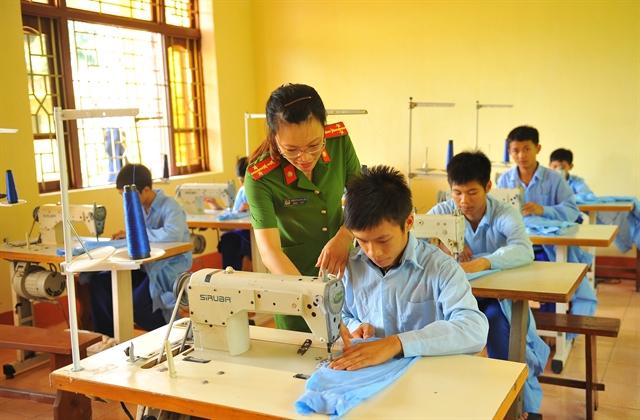 |
| An instructor at Rehabilitation School 2 guides students in shirt-making. — VNA/VNS Photo |
HÀ NỘI — Each year, thousands of Vietnamese teenagers break the law. But inside juvenile rehabilitation schools, the harder question is no longer what they did, but why — as increasingly serious offences reveal deeper fractures in family life, education and social support.
Most are 15, 16 or 17, old enough to understand their actions, yet often unable to explain the decisions behind them.
When they begin to speak, their voices are quiet and hesitant, their sentences fragmented, as if they are still trying to make sense of their own stories.
At Rehabilitation School 2 in the northern province of Ninh Bình, 197 students aged 12 to under 18 are currently serving time for offences ranging from 12 to 24 months. During their stay they are given junior secondary education up to grade 9, and vocational training.
“For children here, the only thing we don’t see is corruption,” one official told a Lao Động newspaper reporter.
“Everything else — murder, drugs, robbery, street motorbike racing, fatal traffic accidents — it’s all here.”
Across Việt Nam, around 13,000 adolescents are recorded as breaking the law each year, according to preliminary figures from the Ministry of Public Security.
Most are older adolescents, with more than 70 per cent aged between 16 and under 18. However, those working closely with them say the concern is not only the number of cases but the growing seriousness of the crimes.
Paths to crime
Lê Minh Quang (not his real name) was 15 when he killed someone.
He did not describe it in those terms. Instead, he spoke about speed, the thrill of riding fast and the rush of racing through the streets at night with friends.
On October 11, 2024, he was driving. The crash happened within moments. When it ended, the victim lay motionless on the road.
“I was scared. I was worried the victim’s family would blame me,” Quang said.
When asked whether he thought about the life he took, he fell silent.
Quang’s father died at work on a construction site when he was eight. His mother sold cosmetics to raise him and his older brother alone.
His brother left school early. Quang soon drifted away from the classroom, spending his time smoking, gaming, doing odd jobs and staying out with friends.
Now, what lingers is not only the crash but its aftermath.
“My mother cried so much. She had to borrow money everywhere to compensate the victim’s family,” he said.
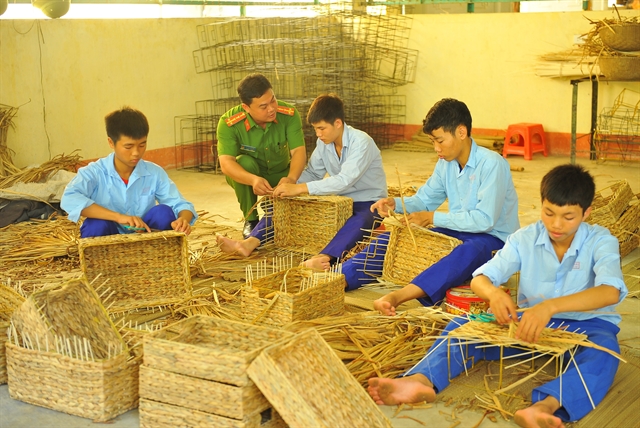 |
| Students learn basket weaving at the rehabilitation school. — VNA/VNS Photo |
At one point, he overheard his mother on the phone, calling relatives and asking for help. He stood by the door and cried. Months later, in May 2025, he was sent to the rehabilitation school.
For Bùi Xuân Đăng (not his real name), the decline was quieter.
He spoke calmly, almost matter-of-factly, about his drug use, as if it were something that simply happened rather than a series of choices.
By the time he was discovered, he was using drugs once or twice a day. He and his friends gathered in rented rooms to take synthetic drugs together. He dropped out of school and took a job in a restaurant to fund the habit.
Buying drugs, he said, was easy. There were online groups, people sharing contacts and deliveries that arrived at the door. His mother knew something was wrong. She tried to stop him, but he did not listen.
“I knew I was wrong, but I couldn’t get out,” he said.
Without drugs, his body reacted with insomnia, nausea and a restless, crawling discomfort he struggled to describe. At the rehabilitation school, teachers supported him through detoxification.
His father died when he was a baby. He was raised by his mother and grandmother. When he spoke about them, his tone barely changed. Yet when he paused, searching for words, something closer to regret surfaced.
“I’ve lost a lot of things,” Đăng said.
"What made you this way?" a reporter asked.
“I don’t know,” he said.
Hidden pressures
Among teachers and staff, some cases remain particularly troubling.
One involved a boy who killed his grandmother after being scolded. Others involve sudden acts of violence that appear to erupt without warning, impulsive, disproportionate and difficult to explain even in hindsight.
“Why?” is the question that runs through nearly every conversation with these children. The answers, when they come, are rarely complete.
Vũ Ngọc Minh (not his real name) grew up in a well-off family in Hà Nội. His father is a company executive. On the surface, there was little to suggest problems.
Inside the home, he said, it was different.
His parents argued frequently. By primary school, he had already witnessed confrontations that turned physical. They later separated and both formed new relationships. Trust broke down.
“I hated being at home,” he said.
At times, he felt nothing at all — no interest in school, no sense of purpose and no enjoyment in daily life. He began leaving home, staying with friends and spending nights in internet cafés.
The only moments that cut through that numbness were moments of intensity.
“Only when I was riding fast did I feel anything. Everything else felt empty,” Minh said.
Ask enough of these teenagers what led them here and certain phrases recur.
“I didn’t want to be worse than my friends.”
“My friends invited me.”
“I wanted to be cool.”
Behind these answers lies a more complex picture.
Nguyễn Tùng Lâm, a psychologist and deputy director of the Vietnam Association of Psychology and Education, said adolescence is a period marked by imbalance.
 |
| Nguyễn Tùng Lâm, deputy director of the Vietnam Association of Psychology and Education. — Photo tienphong.vn |
The part of the brain responsible for judgment and self-control is still developing during adolescence, while emotions and impulses remain strong.
“Some young people come to see law-breaking as cool or heroic, influenced by online gangster content and harmful material on social media, and do not fully anticipate the legal consequences,” he said.
Breaking the cycle
At the same time, teenagers are navigating pressure — from friends, from expectations and from a need to belong. Increasingly, those peers are not only people they meet in person but also those they encounter online.
A familiar pattern emerges. A first connection to the internet. A chat group. A game. A bet. A dare. What begins as seemingly harmless behaviour can escalate as the stakes rise.
One boy described starting with bets of just a few dozen thousand đồng. At one point, he won millions. Then he lost it all — and more. At his lowest, he was down VNĐ200 million (US$7,600) and borrowing money to pay debts.
Others spoke about motorbike racing groups, drug networks and online communities where older members encouraged younger ones to take risks.
Within these spaces, values can shift. Behaviour discouraged at home may be admired. Risk can become a source of pride. Gradually, the distance between children and their parents widens.
“They can’t talk to each other anymore,” said Lê Văn Thế, a vice-principal at the special education school IVS.
“They don’t understand each other anymore.”
For many families, sending a child to a correctional facility is a last resort.
At the boarding school for children with behavioural issues in Bắc Ninh, teachers said some children arrive angry, resistant and at times desperate to leave. Some shout at their parents. Some threaten self-harm.
“I’ve seen parents stand there and cry without making a sound,” one teacher said.
The school has more than 400 students. About half are there due to gaming or online gambling addiction. Others were involved in racing, truancy or running away from home.
In recent years, teachers said such problems appeared at younger ages, including among children as young as 11.
For many teenagers, change only begins after they are separated from their previous environment — their smartphones, their friends and their routines.
They described the first weeks as marked by silence, unfamiliar structure and long days. They spoke of missing home. Then they spoke of parents' visits.
“When did you cry the most?” a reporter asked.
The answer is often the same.
“The first time my parents came to see me.”
That is when the reality of separation becomes clear.
Lê Lưu Sơn (not his real name) is counting down the days.
He has a few months remaining at the correctional facility after being involved in the snatching of a woman's necklace. He said he only drove the motorbike and did not know whether his friend sitting behind had done the act. However, he was still held accountable for the offence.
When he spoke about his mother, he paused.
“She cried so much because of me. Every time she visits, she still cries,” Sơn said.
He wants to return home, sit down and share a meal with his family again.
There is no single story here.
 |
| Two teenagers performing a wheelie while street racing in Hà Nội. — Photo kinhtedothi.vn |
Some of these children come from difficult homes. Others do not. Some experienced neglect. Others say they were closely cared for but did not listen.
Some were influenced by friends. Others point to less tangible factors: boredom, anger or a sense of emptiness.
Yet, in many accounts, there is a turning point — often small and seemingly ordinary — when circumstances begin to shift. A race. A bet. A message in a group chat.
From there, events can escalate, sometimes without clear awareness, until they find themselves in situations they had not anticipated.
Now they sit across from a reporter, searching for an answer to a question that sounds simple but rarely is: why did you do it? For many, the silence that follows speaks louder than any explanation.— VNS
Society
 Society
 Society
 Society
 Society
 Society
 Society
 Society
 Society
 Society
 Society
 Society
 Society
 Society
 Society