 Society
Vietnamese scientist wins ASEAN-US Science Prize for Women
1.
|
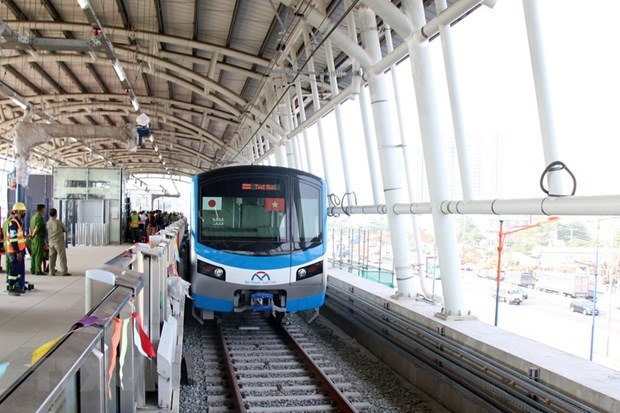
| A metro train at Bình Thái Station on HCM City’s Metro Line No. 1. The city has approved Trường Hải Group (Thaco) to study the Bến Thành-Thủ Thiêm section of Metro Line No. 2. — VNA/VNS Photo |
HCM CITY — Việt Nam is accelerating both intercity and urban rail development as private firms propose new projects linking HCM City with the Mekong Delta and expanding the city’s metro network.
Vietnamese conglomerate CT Group has proposed investing in a new railway connecting HCM City with Cần Thơ and Cà Mau, according to a submission to the Ministry of Construction.
The proposed line would span about 280 km and be designed for mixed passenger and freight transport, strengthening connectivity between the country’s largest economic hub and its key agricultural region.
Under the proposal, the railway would be built as a double-track, electrified line using standard gauge (1,435 mm), with a design speed of 200-250 km per hour. CT Group has also suggested studying a higher-speed option of 300-350 km per hour.
The line would start at Thủ Thiêm Station in HCM City, connect with the North-South railway, and end at Đất Mũi Station in Cà Mau, passing through six localities, including Đồng Tháp, Vĩnh Long, Cần Thơ and An Giang.
CT Group said the 200-250 km/h option would best balance efficiency and economic viability for mixed passenger and freight operations, particularly to support logistics and agricultural transport in the Mekong Delta.
Responding to the proposal, the ministry said the project aligns with Việt Nam’s national railway network planning, which aims to shorten travel times and strengthen regional economic integration.
It noted the HCM City-Cần Thơ section is classified as a new national railway project with a large scale and high capital requirement.
It has tasked the Mỹ Thuận Project Management Board with preparing a pre-feasibility study, with initial assessments indicating that total investment would be substantial and would require mobilisation from multiple funding sources.
Land clearance, compensation and resettlement costs alone are estimated at around VNĐ45.7 trillion (US$1.8 billion), according to the ministry.
Bến Thành-Thủ Thiêm metro
At the same time, HCM City authorities are advancing urban rail planning, with the city’s People’s Committee recently approving a proposal allowing Trường Hải Group (Thaco) to conduct a feasibility study for the Bến Thành-Thủ Thiêm section of Metro Line No. 2.
As approved, Thaco, a major private bussiness in Việt Nam, has been granted four months to prepare the feasibility report in compliance with current regulations.
The city stressed that the decision only permits research and proposal development and does not constitute approval of an investment model, appointment of an investor or a commitment to implement the project.
According to the proposal, the Bến Thành-Thủ Thiêm section would be about 5.58 km long, comprising six underground stations, with a preliminary total investment of around VNĐ33 trillion ($1.3 billion).
The line would start at Bến Thành Station and end at Thủ Thiêm Station.
The section is one of three segments of Metro Line No. 2, alongside the Bến Thành-Tham Lương and Tham Lương-Củ Chi sections, which together would form a line of more than 60 km across HCM City.
If the feasibility study is not approved, not completed on time, or if the city decides to pursue a different funding model due to urgent needs, Thaco will bear all related costs and will not be reimbursed, the city said.
Thaco is also required to hand over all research outputs to the Urban Railway Management Board for state management, reference and data use.
Officials said the metro study is expected to support better integration between HCM City’s urban rail network and future intercity railway connections, particularly those linking the city with surrounding regions.
The ministry said it is ready to coordinate with investors to further clarify technical standards and financing options for both intercity and urban rail projects as Việt Nam pushes ahead with its long-term transport infrastructure strategy. — VNS
Society
 Society
 Society
 Society
 Society
 Society
 Society
 Society
 Society
 Society
 Society
 Society
 Society
 Society
 Society