 Society

AIMCONNECT 2026 Held in Singapore, Bringing Global Automotive Leaders Together to Explore the Future of AI, Trust and Connected Mobility
1.
|
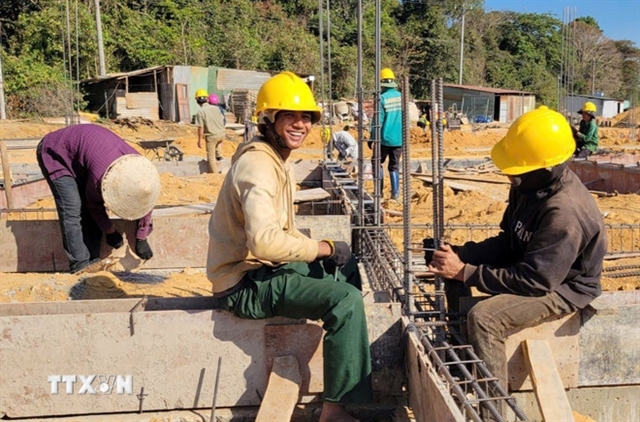
| Workers at a boarding school construction site in Ia Púch Commune, Gia Lai Province. VNA/VNS Photo |
HÀ NỘI — Hundreds of schools in border communes have been built at a rapid pace, opening up the prospect of a breakthrough for education in disadvantaged mountainous areas and among ethnic people.
The work aims to help achieve goals outlined by the Poliburo to boost investment in school construction for border communes.
These schools will be places to sow the seeds of knowledge, nurture dreams and realise aspirations. They are a symbol of the spirit of national unity, and the affection and responsibility of the Party, the State and the people towards the people in the border regions.
High expectations

|
| Primary students eat lunch at a boarding school. VNA/VNS Photo |
Last year, the Si Pa Phìn Primary and Secondary Boarding School in Điện Biên Province began construction fewer than 10 days after the Politburo of the Communist Party of Việt Nam announced its policy, the first of 248 schools in the land border communes to do so.
Now, after six months, the final stages of the project are completed and the school is ready for inauguration and operation.
Hoàng Tuyết Ban, director of the Department of Education and Training of Điện Biên Province, said that Si Pan Phìn School has 31 classrooms with more than 1,000 students, of whom 750 are boarding students.
The size of the school is suitable for local conditions, ensuring stable and effective teaching and boarding management from the first academic year. It will also contribute to reducing school dropout rates, especially at the lower secondary level, Ban said.
Along with Si Pa Phìn School, many other schools in remote border areas, such as Núa Ngam Commune in Điện Biên Province, Thượng Trạch Commune in Quảng Trị Province, and Đắk Wil Commune in Lâm Đồng Province have started construction.
After they are completed, the schools will fully meet students’ needs for learning, training and all-round development.
Makeshift classrooms
Despite a recent focus on investing in border area schools, facilities in these communes have remained seriously inadequate, particularly for boarding and semi-boarding education.
Current classrooms and other facilities meet only about 60 per cent of the minimum requirements, according to experts. Many of these schools and classrooms are makeshift, with bamboo roofing.
As a commune bordering Laos with a frontier of more than 45km, most of the residents of Thượng Thạch Commune are from the Bru, Vân Kiều and Chứt ethnic groups. The commune has five schools at all levels.
Getting to school can be very difficult for students and teachers, especially in the rainy season, due to the mountainous terrain and poor transportation infrastructure.
Chairman of the Thượng Trạch Commune People’s Committee Hồ Ngọc Thanh said that building the Thượng Trạch Primary and Secondary Boarding School will help overcome these difficulties.
“When students live and study together at the school, teaching becomes easier, reducing the rate of students absent from school or dropping out due to long commutes,” Thanh said.
“The boarding environment also creates opportunities for students from different ethnic groups to interact, bond and improve their life skills and social awareness,” he added.
Lục Hồn Commune, one the first border communes of Quảng Ninh Province, has invested in building the Đồng Tâm primary and secondary boarding school.
Vi Tiến Vượng, chairman of the Lục Hồn People’s Committee, said the commune has 29 villages and ethnic hamlets along a borderline of more than 10km.
According to the chairman, over 98 per cent of the population belongs to an ethnic group and live in poor conditions in mountainous terrain.
“The establishment of boarding school models in the area is an urgent requirement to ensure the right to education for students in border regions and to improve the quality of general education in the new era. The project has thus received strong support from the people,” Vượng said.
“The Đồng Tâm Boarding School has been built on an area of 7.7ha with 30 classes serving around 950 students. Newly constructed facilities include a multi-purpose hall, sports grounds, a sanitation system connected to the boarding area, learning spaces, auxiliary works and an experimental zone,” the chairman noted.
He added: “The commune has completed all investment procedures, and the construction site was carefully surveyed to ensure suitability."
Rapid, effective construction
Minister of Education and Training Nguyễn Kim Sơn said that along with personnel, physical infrastructure, school facilities and teaching equipment are critical for ensuring the quality of education.
In fact, the Party and the State have made these areas a focus of national target programmes centred on strengthening facilities, especially in disadvantaged areas, with the goal of ensuring the structural integrity of 100 per cent of school facilities by the year 2030.
By December 2025, the proportion of structurally sound school facilities in some areas had reached nearly 90 per cent.
This outcome reflects the combined efforts of society as a whole in mobilising and prioritising resources for education and training, including contributions from the State and the public.
Building 248 schools in border communes under combined boarding and semi-boarding models will help ensure adequate learning conditions for students, particularly by improving equipment for subject-based teaching, arts, STEM and physical education and sports.
By boosting investment in infrastructure and education in border areas, mountainous regions and ethnic communities will see significant improvements to their quality of life.
Sơn said that the initiative to build schools in border communes has been implemented rapidly, in a coordinated and effective manner by ministries, sectors and localities. It is expected to help bring about fundamental and comprehensive change in education in border areas, narrow regional disparities and ensure equity in access to education.
This year, the Ministry of Education and Training is working with relevant agencies to ensure sufficient investment capital.
Meanwhile, local authorities will focus on safe, high-quality construction, meeting schedules and preparing all necessary conditions in terms of teachers, facilities and student enrolment so that schools can be put into operation immediately, before the new school year.
Along with school construction, beneficial policies for students and teachers, regulations governing the operation of inter-level boarding schools, career guidance policies and the selection of local cadres from among students at inter-level boarding schools have been developed to institutionalise the Party’s and the State’s guidelines on investing in boarding schools, the minister said. VNS
Society
 Society
 Society
 Society
 Society
 Society
 Society
 Society
 Society
 Society
 Society
 Society
 Society
 Society
 Society