 Society

AITO Looks Ahead to Europe, Building a Thriving Automotive Ecosystem
1.
|
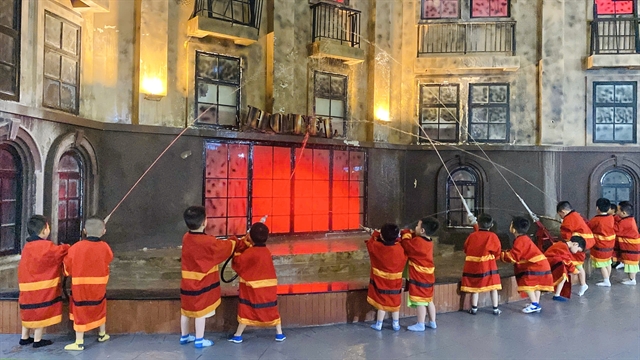
| Students of a HCM City preschool take part in an experiential learning field trip outside the classroom, as schools seek to combine hands-on education with strict safety measures. — VNS Photos Nguyễn Diệp |
HCM CITY — As HCM City accelerates education reform under the 2018 General Education Programme, schools are stepping up experiential learning activities beyond campus walls, while tightening safety measures to meet growing expectations from parents and education authorities.
Experiential and career-oriented education is now a compulsory component across all school levels, requiring institutions to integrate real-world learning into their teaching plans.
According to the city’s Department of Education and Training (DoET), such activities are intended to help students develop competencies, life skills and civic awareness, rather than relying solely on textbook-based instruction.
In recent years, schools across the city have increased field trips to historical sites, traditional craft villages, museums, vocational centres and community spaces.
However, the expansion has also brought renewed attention to student safety, supervision capacity and coordination with families, particularly for off-campus programmes involving travel.
Learning beyond the classroom
At Phước Hưng Secondary School in Bà Rịa Ward, experiential learning has become a regular part of the academic year.
Students take part in annual visits to historical landmarks such as the Long Phước Tunnels, the Võ Thị Sáu Monument and the Minh Đạm War Zone, while also exploring traditional livelihoods at An Ngãi rice paper-making village and vocational training centres.
The school further organises visits to Vietnamese Heroic Mothers and local orphanages, aiming to foster empathy, gratitude and social responsibility.
Phan Thị Hồng Cẩm, principal of the Phước Hưng Secondary School, said that although experiential activities are not listed as separate subjects, they are integrated across disciplines and play an important role in moral and character education.
“Lessons should not stop at textbooks. When students learn through real places, real people and real stories, knowledge becomes more vivid,” she said.
These activities help students mature emotionally, better understand history and develop values that cannot be taught through theory alone, she said.
The benefits of hands-on learning are also evident at the primary level.
Phan Thị Thu Nga, principal of Lê Thành Duy Primary School, recalled an incident during a field trip in which many students mistook a cassava field for a papaya plantation.
“The incident clearly showed the limits of theoretical learning. Students may memorise information, but without direct observation, they struggle to apply it correctly in real-life situations.”
|
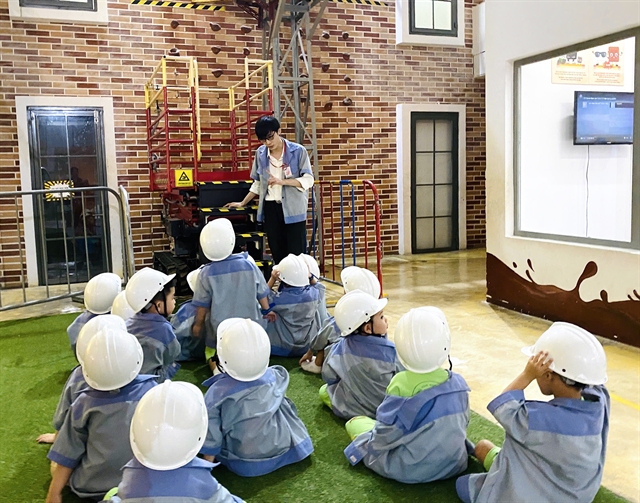
| Teachers accompany students of a HCM City preschool during an off-campus experiential learning activity, part of efforts to implement the 2018 General Education Programme while ensuring student safety. |
Phan Thị Mỹ Hạnh, vice principal of Trần Nguyên Hãn in Tam Thắng Ward, said experiential education is central to building a “happy school” environment.
Expanding learning spaces beyond classrooms, she noted, helps students feel more engaged and reduces academic pressure.
“Experiential activities also strengthen the connection between schools, families and the community. When students learn in real settings, they are more motivated and confident,” she said.
According to the DoET, all public schools in the city are required to incorporate experiential and career guidance activities into their annual education plans.
The department has encouraged schools to diversify formats, including project-based learning, community service and vocational exposure, provided that activities are aligned with students’ age and learning objectives.
Safety remains paramount
Despite widespread recognition of their educational value, off-campus activities continue to raise safety concerns.
School leaders acknowledge risks such as traffic accidents, injuries and inadequate supervision, while parental attitudes toward extracurricular learning vary.
“Some parents focus mainly on academic results, while others worry about safety and prefer their children to stay within the family’s protective environment,” Hạnh said.
To address these concerns, the DoET has repeatedly reminded schools to strictly comply with regulations on student safety during off-campus activities.
Requirements include risk assessments, detailed activity plans, written parental consent and clear assignment of responsibilities for teachers and staff.
Schools are also instructed to select transport providers that meet legal and safety standards and to ensure sufficient supervision ratios.
In practice, many schools have strengthened preparation and monitoring procedures.
Teachers conduct pre-trip briefings, maintain regular roll calls, follow detailed schedules and remain with students throughout activities.
Potential risks are identified in advance, with contingency plans prepared for emergencies.
Coordination with parents has also been intensified.
Schools consult families early, conduct surveys to gauge opinions, encourage voluntary participation and provide clear information on destinations, schedules and safety measures. Feedback is collected after each activity to improve future programmes.
According to the DoET, large-scale experiential events organised citywide have demonstrated that careful planning can ensure both safety and educational impact.
In recent years, thousands of students have taken part in department-supervised programmes such as traditional student camps, historical commemorations and civic education activities without major incidents.
Cẩm said effectiveness ultimately depends on thoughtful design and cooperation.
Age-appropriate destinations, thorough site surveys and early communication with all stakeholders are essential, she said.
“Proactive risk prevention and close coordination between schools, teachers and parents are the key to making experiential learning both safe and meaningful,” she said.
As the city continues to modernise its education system, experiential learning is expected to play an increasingly important role.
For schools, the challenge lies not in whether to take students beyond the classroom, but in how to do so responsibly, ensuring that real-world lessons enrich learning while keeping student safety firmly at the forefront. — VNS
Society
 Society
 Society
 Society
 Society
 Society
 Society
 Society
 Society
 Society
 Society
 Society
 Society
 Society
 Society