 Society

Việt Nam, Switzerland to turn education, sci-tech, innovation into cooperation focus
1.
|
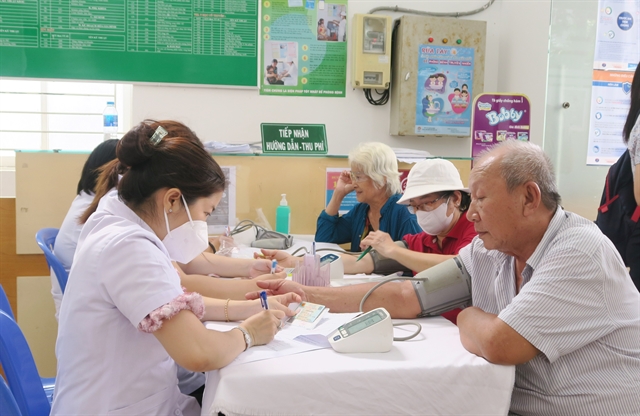
| Elderly residents receive free health check-ups in HCM City, as the city prepares to pilot Việt Nam’s first large-scale home-based primary healthcare model. — VNA/VNS Photo |
HCM CITY — HCM City residents will soon have their health monitored at home under a pilot programme that, for the first time in Việt Nam, will test a large-scale home-based primary healthcare model, city health officials said.
The scheme will be rolled out initially in selected wards and communes serving populations of around 30,000-40,000 people before being evaluated for wider expansion, according to the city’s Department of Health.
Under the model, local health stations will shift from a passive, clinic-based approach to proactively monitoring residents’ health in their homes, aiming to detect illness earlier, manage high-risk groups and reduce unnecessary hospital visits.
Tăng Chí Thượng, director of the municipal Department of Health, said this is a fundamental change in how grassroots healthcare operates.
“Instead of waiting for patients to come to us, healthcare workers will actively follow people’s health status in the community,” he said.
Each locality will be assigned a dedicated healthcare team led by a family doctor or general practitioner, supported by nurses, pharmacists, public health staff and between two and six community health collaborators.
These collaborators will be responsible for clusters of households, acting as a link between residents and local health stations.
Health stations currently function largely as extensions of hospitals, providing basic check-ups, limited diagnostic services and medication for chronic conditions covered by health insurance.
Patients requiring more complex care are typically referred to higher-level hospitals, contributing to overcrowding even for common illnesses.
City health authorities hope the new model will transform local health stations into “mini-hospitals” capable of delivering higher-quality primary care, particularly for older people and patients with chronic diseases who face difficulties travelling for treatment.
All patient information will be recorded in individual electronic health records, enabling continuous monitoring and long-term health management.
The pilot programme comes amid longstanding concerns over the weakness of Việt Nam’s grassroots healthcare system.
A 2023 Politburo resolution noted that primary healthcare services remain insufficient, disease screening and early detection are limited, and public trust in local health stations has yet to be firmly established.
As a result, patients often bypass lower-level facilities in favour of higher-tier hospitals, exacerbating overcrowding and driving up treatment costs.
From January 1, 2026, 168 ward- and commune-level health stations in HCM City will be placed directly under local authorities rather than district health centres, with expanded authority to provide insured medical services and manage primary healthcare in their communities.
The home-based model has been successfully implemented in countries such as Brazil, the United Kingdom, Thailand and Cuba, where proactive, community-level health management has helped reduce pressure on hospitals.
“This is an important step toward bringing healthcare closer to the people and building a proactive, sustainable primary healthcare system,” he said. — VNS
Society
 Society
 Society
 Society
 Society
 Society
 Society
 Society
 Society
 Society
 Society
 Society
 Society
 Society
 Society