 Society
NA President calls for high-quality legislation to drive national development
1.
|
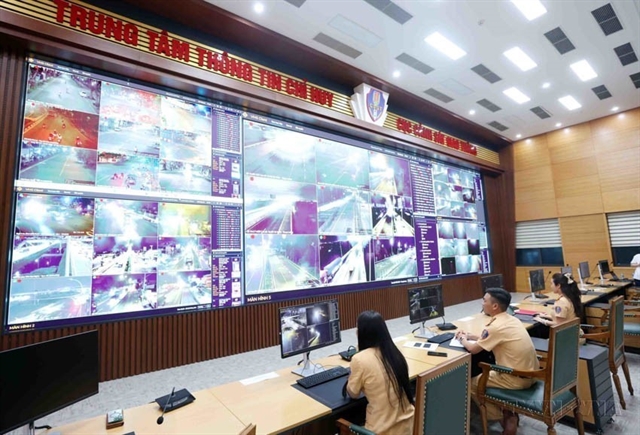
| Traffic police soldiers monitor traffic using AI cameras at the Command Information Centre under the Traffic Police Department, Ministry of Public Security. — VNA/VNS Photo Phạm Kiên |
HÀ NỘI — Deputy Prime Minister Trần Hồng Hà has approved a project that will create an Internet of Things (IoT) application for smart transport systems, which will be piloted in at least two cities before its launch.
The Deputy PM greenlit the project, titled 'The Application of Internet of Things (IoT) in the field of smart transportation', in Decision 2692/QĐ-TTg issued on Thursday.
Under the initiative, a unified, secure and efficient IoT application platform will be built to serve the management and operation of a smart transportation system managed by the Ministry of Construction and to share data with relevant agencies and units.
Over the next two years, at least two cities will be selected to pilot the Smart Operations Centre integrating IoT transportation data.
As part of the project all of the eastern North-South expressways will also complete a non-stop electronic toll collection system and integrate data into the shared smart transportation system.
About 90 per cent of the nation's legal documents, standards and technical regulations on IoT in transportation are expected to be created, issued or submitted by 2028.
According to the project timeline, by 2035 at least five cities and 10 provinces will deploy and operate smart operations centres integrating IoT transportation data.
All of the IoT transportation data will be standardised and ready for interconnection and sharing between the Ministry of Construction, Ministry of Public Security and localities.
At least 50 per cent of major transportation routes, including expressways and ring roads, will have IoT sensor infrastructure installed to support road infrastructure management, monitoring and maintenance.
Key tasks
To achieve these objectives, the project assigns specific tasks to ministries, sectors, localities and relevant agencies.
The Ministry of Construction, in coordination with the Ministry of Public Security, Ministry of Science and Technology, Ministry of Finance and Ministry of Justice, will perfect a system of legal normative documents.
This includes drafting a decree on controlled trials for IoT applications in smart transportation to guide Clause 3, Article 21 of the Law on Science, Technology and Innovation.
They will also review and supplement content on digital transformation and IoT applications, as well as propose financial and technical mechanisms for upgrading, transforming or building new IoT infrastructure to ensure data interoperability and synchronisation.
Along with the ministries of Public Security, Science and Technology and Industry and Trade, the Ministry of Construction will also develop a national set of technical standards for IoT in smart transportation, ensuring unity, compatibility and alignment with international standards.
These criteria cover connectivity, identification and interaction between IoT devices, platforms and systems along with techniques for data processing, analysis and storage platforms.
Standards will also be established for sensors, cameras, radars, traffic signal controllers, toll systems, positioning and data transmission.
The Ministry of Science and Technology, along with telecommunications and information technology enterprises, will upgrade telecommunications infrastructure and connectivity, developing high-speed, broadband, low-latency data transmission using 5G and optical fibre to meet continuous connection needs.
Priority will be given to urban areas, expressways and bus terminals for synchronous, scalable, high-capacity IoT connectivity infrastructure.
Local People's Committees, in coordination with relevant ministries, will upgrade local smart operations centres to integrate IoT applications and connect to the Smart Transportation System Management Centre.
IoT data will be required to comply with transportation database management regulations and smart urban data rules to ensure security and safety.
Mechanisms for coordination among ministries, sectors and localities will clarify responsibilities for management, operation, maintenance and data security.
The Ministry of Science and Technology will also build a platform to integrate data with the smart transportation system on the eastern North-South expressway.
Meanwhile, the Ministry of Public Security will establish a data centre for management, monitoring, violation handling and traffic operations.
The Ministry of Construction, in coordination with relevant entities, will deploy IoT for managing transportation infrastructure, toll collection, load control and traffic safety.
It will handle multi-modal transport management, serving people and businesses as well as green traffic and autonomous vehicles.
Local people's committees will apply IoT in traffic management and operations as well.
The Ministry of Construction will develop a framework of quantitative and qualitative indicators – across economic, social, environmental and technological criteria – to measure, monitor and evaluate project implementation effectiveness.
Priority will be given to diverse resource mobilisation, combining State budget funds with private capital, official development assistance and international cooperation for IoT smart transportation infrastructure investment.
Domestic technology enterprises will be encouraged to develop IoT devices, platforms and services, gradually mastering technology and reducing import dependence. — VNS
Society
 Society
 Society
 Society
 Society
 Society
 Society
 Society
 Society
 Society
 Society
 Society
 Society
 Society
 Society