 Politics & Law
Việt Nam fosters comprehensive cooperation with Uruguay
1.
|
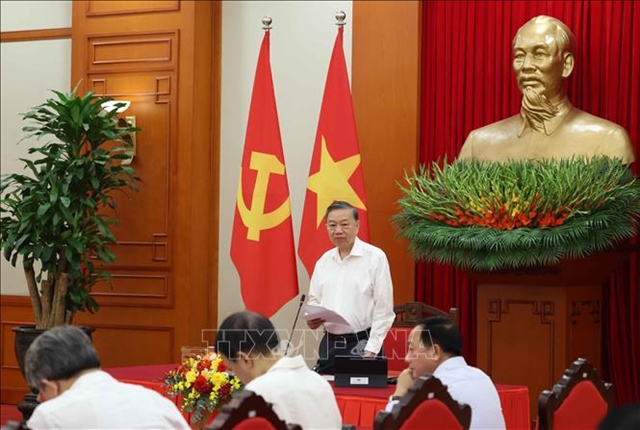
| Party General Secretary and State President Tô Lâm chairs a working session with the Central Policy and Strategy Commission in Hà Nội on Thursday. — VNA/VNS Photo Thống Nhất |
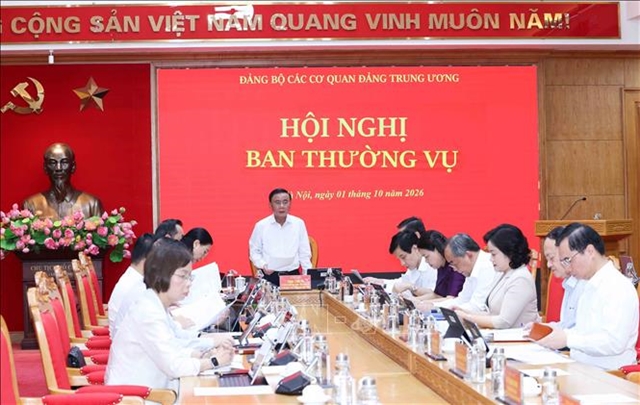
HÀ NỘI — Academies and research institutes need to build research, forecasting and strategic advisory capacity capable of meeting the country’s development needs for many years to come.
Party General Secretary and State President Tô Lâm made the request on Thursday at the Party Central Committee headquarters, where he chaired a working session with the Central Policy and Strategy Commission on mobilising the collective strength of researchers from academies and research institutes for strategic policymaking.
The top leader stressed the need to forge a common understanding and fully harness the research capacity of scientific institutions in providing strategic advice.
The country has substantial research potential, but it has yet to be organised into a unified force, he said.
He noted that academies, universities and businesses, as well as research institutes under ministries and sectors and domestic and overseas experts, each have their own strengths.
The commission has a key role in connecting these resources with the strategic advisory needs of the Party Central Committee, and is responsible for identifying issues, commissioning research, integrating evidence and developing policy recommendations.
“The task is to identify the right issues, mobilise the right experts at an early stage and ensure research findings feed into policymaking at the right time,” he added.
The goal is to build sufficiently strong research, forecasting and strategic advisory capacity for the Party Central Committee.
Lâm identified two academies in particular, the Việt Nam Academy of Science and Technology and the Việt Nam Academy of Social Sciences, as pillars of the country’s scientific knowledge base.
They are responsible for conducting in-depth research, providing data and forecasts, offering independent assessments and warning of emerging issues rather than waiting for specific requests.
He said the Việt Nam Academy of Science and Technology should leverage its strengths in natural sciences and technology, while the Việt Nam Academy of Social Sciences should focus on institutions, development models, culture and people.
“Major national challenges should involve both academies from the outset,” Lâm said.
Organising resources around strategic issues
The top leader also called for research resources to be organised around strategic issues.
“A major national issue cannot be divided along institutional or disciplinary boundaries,” he said.
Depending on the task, strong teams should be brought together from the two academies, research institutes under ministries and sectors, universities, businesses and leading experts.
Clear responsibility should be assigned for leadership, coordination and expected outcomes.
Calling for clear research commissions while respecting scientific independence, Lâm also said the Party Central Committee and the commission should define the questions to be answered, deadlines and requirements for research outputs, without predetermining the conclusions.
For major projects, scientists should be involved from the drafting of the research outline.
"Where issues remain open to different interpretations, parallel research teams should be commissioned and subject to independent peer review, with different views fully documented," he said.
Scientists should have access to the information they need while maintaining confidentiality and scientific integrity, and taking responsibility for their recommendations.
The top leader also called for greater flexibility in attracting talent.
“For major tasks, the most capable experts should be sought and assigned, without being confined by existing staffing structures,” he said.
Interdisciplinary research teams, rapid-response groups, part-time experts and time-limited secondments should be used, while personnel exchanges between advisory and research institutions should be encouraged.
Vietnamese experts overseas and international specialists should be brought into the process through specific research assignments.
“Young scientists should be given opportunities, responsibilities and initial support,” Lâm said.
Expanded cooperation must go hand in hand with protecting data, confidentiality and national interests, he noted.
He also ordered several tasks to be carried out in the near future, including developing regulations on coordination; strengthening the capacity of the commission and the two academies; reforming mechanisms for expert remuneration; removing institutional and infrastructure bottlenecks; and producing regular and ad hoc strategic reports. — VNS
Politics & Law
 Politics & Law
 Politics & Law
 Politics & Law
 Politics & Law
 Politics & Law
 Politics & Law
 Politics & Law
 Politics & Law
 Politics & Law
 Politics & Law
 Politics & Law
 Politics & Law
 Politics & Law
 Politics & Law