 Politics & Law
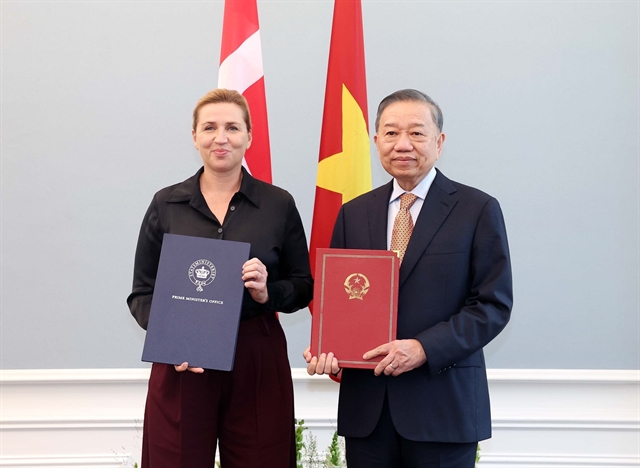
Top leader hails friendship association's role in nurturing Việt Nam–Denmark ties
1.
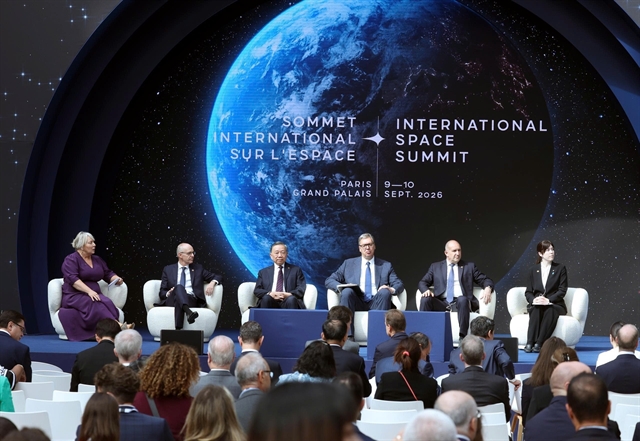 |
| Party General Secretary and President Tô Lâm attended the high-level thematic session of the International Space Summit in Paris on September 10. — VNA/VNS Photo |
PARIS — Party General Secretary and President Tô Lâm on Thursday proposed working with France, the United Nations, the Association of Southeast Asian Nations (ASEAN) and other partners to study the establishment of a 'Space for Development and Resilience' network.
Addressing the high-level thematic session on building a new space for a rapidly changing world at the International Space Summit in Paris, he said the network should focus on sharing, harnessing space data for development, strengthening capacity to ensure a safe, sustainable space environment and connecting research, training, businesses and investment to develop the space economy.
The network could initially focus on Southeast Asia, with Việt Nam ready to serve as a regional hub for connectivity, he said.
Lâm praised the initiative of French President Emmanuel Macron to convene the International Space Summit, saying it provided an opportunity for countries to exchange views and help shape a new vision in which capability development goes hand in hand with responsibility while and national interests are aligned with the common interests of the international community.
The top leader affirmed that outer space has become an essential part of modern life and the economy, with satellites, remote sensing, positioning and space data supporting communications, transportation, resource management, disaster prevention and climate-change response.
However, he noted that the rapid development of space activities has also brought challenges related to space debris, collisions, orbital congestion, frequency allocation, militarisation, appropriation, technological gaps and the increasingly important role of the private sector.
The international community needs a multilateral governance framework to ensure that outer space remains peaceful, safe, sustainable and accessible to all, while promoting innovation and the space economy and turning data into knowledge, services and better decisions for the benefit of Earth, he said.
He emphasised Việt Nam’s five principles.
First, outer space must be preserved for peaceful purposes and dialogue, trust building, conflict prevention and prevention of an arms race, with no threat or use of force.
Second, people and development on Earth must remain at the centre, with priority given to disaster early warning, climate monitoring, resource management and the Sustainable Development Goals.
Third, international law and the UN Charter must be upheld, with the United Nations and the UN Committee on the Peaceful Uses of Outer Space (COPUOS) at the centre of multilateral space governance, while strengthening the role of the International Telecommunication Union (ITU).
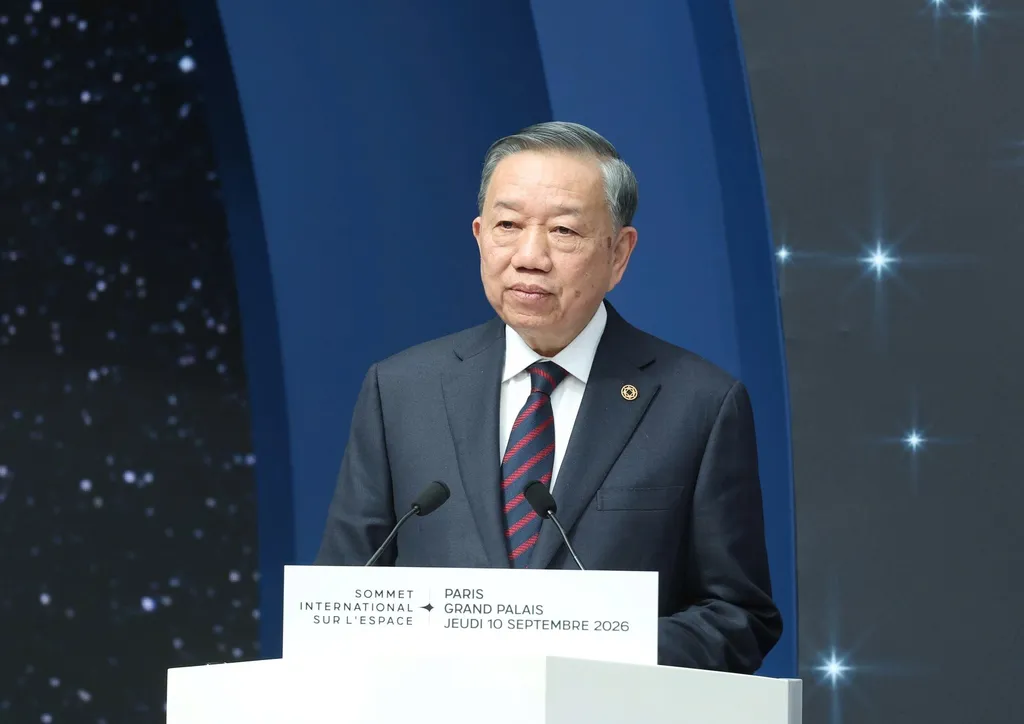 |
| General Secretary and President Tô Lâm addressed the official session of the International Space Summit on September 10. — VNA/VNS Photo |
Fourth, equality among countries must be ensured in participation and in sharing the benefits of research and technology.
Fifth, space must be used responsibly, transparently and sustainably, while reducing space debris and the risk of collisions.
The top leader said that for Việt Nam, aerospace technology is among the strategic technologies prioritised for development and forms part of the country's national development capacity.
Việt Nam, he said, places priorities on strengthening autonomy in space technology and data, developing a space-economy ecosystem and encouraging financing models for applications serving the public interest while improving institutions and governance capacity for space activities in line with international law.
He said international cooperation plays an important role in Việt Nam's efforts to use space for its people, peace and development. Việt Nam became the first Asian country to send a person into space in 1980 and has since manufactured and launched several small satellites while developing capabilities in research, training, remote sensing and observation for sustainable development.
He affirmed that France is one of Việt Nam's important partners in the field, with the VNREDSat-1 project being a notable example.
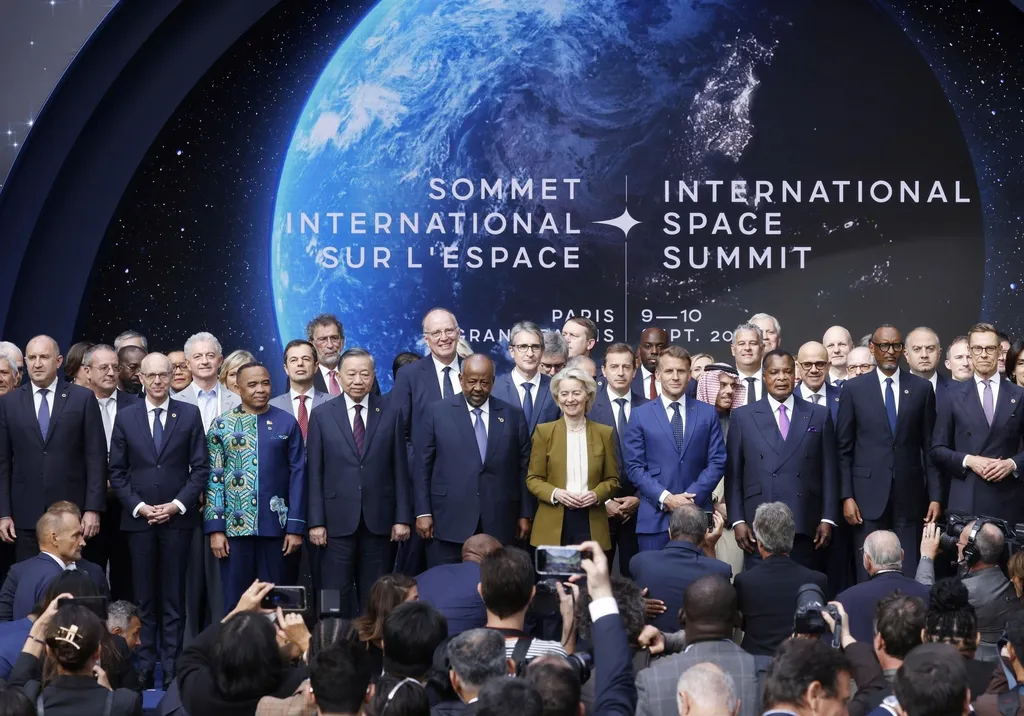 |
| Party General Secretary and President Tô Lâm with other world leaders at the International Space Summit in Paris on September 10. — VNA/VNS Photo |
Emphasising that outer space opens up vast new horizons, the leader said the ultimate measure of progress remained the value it brings to people and the Earth.
He affirmed Việt Nam's readiness to work with other countries to turn the outcomes of the summit into concrete actions for the present and future generations.
Speaking at the opening of the summit, French President Emmanuel Macron stressed the need for common governance mechanisms and clear international rules to ensure the safe, sustainable and peaceful use of outer space amid growing global competition.
He said sustainable space development must contribute to addressing climate change and protecting Earth's ecosystems.
Macron outlined his strategic vision for European space sovereignty, stressing the importance of developing independent launch capabilities for Europe and ensuring autonomy in strategic minerals and supply chains for space technologies.
He also called for the development of an integrated European market and the adoption of a Europe first principle in procurement to strengthen Europe's competitiveness.
European Commission President Ursula von der Leyen said the greatest potential benefits of outer space could only be fully realised through international cooperation.
She noted that the global space economy is expected to triple by 2035 and called on Europe to act in unity and increase investment to reduce its dependence on other countries.
She announced plans for a European Space Shield to jointly address threats including interference with navigation signals, cyberattacks and threats to satellites.
She also announced plans to expand the Infrastructure for Resilience, Interconnectivity and Security by Satellite project to more than 350 satellites, with deployment beginning in 2029.
Indian Prime Minister Narendra Modi said as orbits become more crowded and technologies more powerful, our choices must be clear: cooperation over confrontation sustainability over short-term gain and inclusion over exclusion.
“We support a safe, secure, peaceful and sustainable space domain anchored in international law, dialogue and multilateral cooperation. Scientific data must serve the common good, with openness and integrity,” he said, inviting France and the world to be co-travellers in India’s next space frontier.
European Space Agency Director General Josef Aschbacher stressed the need for Europe to achieve technological autonomy in space and proposed a three-stage roadmap for developing Europe’s space capabilities: the post-international-space-station era, expanding Europe’s presence on and around the Moon and using low-Earth-orbit capabilities and access to the Moon as a stepping stone toward Mars.
Such efforts will require the participation and investment of major industrial groups and private companies, as well as the political determination of EU member states, he said.
The same day, Party General Secretary and President Tô Lâm held meetings with French Prime Minister Sébastien Lecornu and National Secretary of the French Communist Party Fabien Roussel. — VNS
Politics & Law
 Politics & Law
 Politics & Law
 Politics & Law
 Politics & Law
 Politics & Law
 Politics & Law
 Politics & Law
 Politics & Law
 Politics & Law
 Politics & Law
 Politics & Law
 Politics & Law
 Politics & Law
 Politics & Law