 Politics & Law
Hưng Yên outlines three economic zones, two development corridors
1.
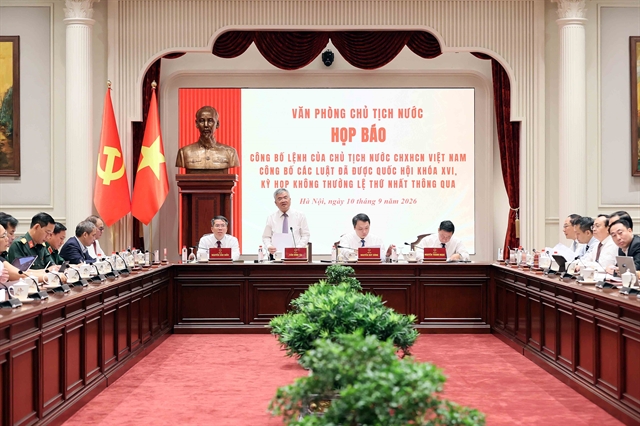 |
| Deputy Chief of the President's Office Cấn Đình Tài speaks at the press conference to announce the Presidential Orders to enact 15 laws on Thursday. — VNA/VNS Photo |
HÀ NỘI — Việt Nam will outlaw the sale of nitrous oxide for recreational inhalation, hand oil and gas regulators sweeping new authority, and grant HCM City expanded powers over its own development, among other rules under a package of 15 laws recently passed by the National Assembly.
The laws were enacted through Presidential Orders announced at a press conference in Hà Nội on Thursday, the constitutionally required step to make new legislation public. Deputy Chief of the President's Office Cấn Đình Tài presided over the briefing.
Among the changes is an amendment to the Investment Law banning the sale of nitrous oxide (commonly known as laughing gas) for recreational use starting January 1, 2027. The ban carves out exceptions for medical use, food technology, testing and scientific research.
The same amendment overhauls the list of conditional business sectors, industries where operators must meet specific licensing requirements, removing 62 and revising 14 others in a bid to simplify entry rules and shift regulation from pre-approval toward after-the-fact inspection.
Visa support services offered by authorised agencies have been added to the revised list, but the agencies will now require a business licence. Along with a new Petroleum Law and a customs law amendment, the Investment Law amendment will take effect on March 1, 2027.
The new Petroleum Law – comprising 12 chapters and 62 articles – decentralises regulatory authority to oil and gas watchdogs and hands greater operating power to the national energy group PetroVietnam, while simplifying licensing procedures.
Officials said the law also draws a clearer line between PetroVietnam's role as a commercial contractor and the specialised functions it performs on the State's behalf.
Approvals tied to national defence, security or force-majeure situations will still require a sign-off from higher authorities, preserving direct State control in sensitive cases. The law also introduces new rules on carbon capture and storage, offshore energy infrastructure and high-tech oilfield services.
A companion amendment to the Customs Law lays the legal groundwork for redesigning clearance procedures and rebuilding the sector's information technology systems to improve data sharing across ministries and local governments.
It simplifies customs paperwork, expands the one-stop-shop mechanism and extends how long goods can be stored in bonded warehouses and duty-free retail sites, while also tightening enforcement against smuggling and trade fraud.
A new Law on Preventing the Proliferation of Weapons of Mass Destruction, comprising four chapters and 36 articles, will take effect on July 1, 2027.
Officials said it is designed to close gaps in the legal framework for detecting and penalising the proliferation or financing of such weapons, and to bring Việt Nam into full compliance with United Nations Security Council resolutions and other international commitments. Rather than imposing blanket restrictions, the law adopts a risk-based approach to oversight, with technical details left to implementation regulations.
Nine defence and military laws on national defence, the officer corps, military service, border defence, civil air defence, reserve forces, civil defence and militia were amended together in a single package, effective September 1 next year.
The revisions are meant to align military legislation with the newly restructured two-tier local government system and to push more decision-making authority down to lower levels of command.
A new Law on Legal Dissemination and Education establishes the National Legal Portal as a shared digital platform for public access to legislation, and directs authorities to use AI and social media to make laws easier for citizens and businesses to understand.
It also designates eight priority groups for tailored legal education outreach and sets up coordinating councils at the central, provincial and communal levels.
A companion Law on Grassroots Mediation for the first time requires mediators and local authorities to jointly identify and defuse disputes before they escalate into violence, a shift officials described as putting public safety ahead of simply resolving disagreements after the fact.
The mediation law also widens the pool of eligible mediators, strengthens confidentiality protections and gives mediated settlements stronger legal weight by letting parties ask a court to formally recognise them.
Rounding out this trio, amendments to the State Compensation Liability Law extend the right to compensation to people who report corruption or misconduct, and to their family members, in cases where authorities fail to protect them adequately or act too slowly. All three of these laws will take effect on March 1, 2027.
A new Law on Urban Development, with five chapters and 66 articles, will come into force on October 1 and is aimed squarely at HCM City and other major urban centres.
It creates a legal basis for designating special economic zones and gives local authorities expanded powers over infrastructure planning, land use, marine economic development and duty-free commercial zones – a move intended to help cities attract higher-quality investment and build new growth engines.
Several other amendments focus on trimming bureaucracy in specific sectors. A package touching 10 agriculture- and environment-related laws eliminates 40 administrative procedures, simplifies 12 more, scraps 40 business licensing conditions and transfers 24 procedures from the Ministry of Agriculture and Environment to provincial leaders. It will become effective on January 1, 2027.
A parallel reform bundling the laws on radio frequencies, telecommunications, e-transactions and technology transfer will take effect on March 1, 2027. It abolishes two administrative procedures, cuts 47 business conditions, simplifies four more and revises three others, while strengthening legal protections for telecom infrastructure used for national defence.
Rounding out the package, changes to the law on Vietnamese workers going abroad prioritise sending skilled, trained labour overseas to boost incomes and technical know-how, while setting up mechanisms to connect returning workers with domestic jobs that match the skills they picked up abroad. This amendment will take effect on March 1, 2027.
A revised Publishing Law, also effective on March 1, 2027 (with a provision on export printing delayed until 2029), confirms that publishers bear direct responsibility for content, with the State exercising oversight through post-publication inspection rather than pre-release censorship.
Finally, an amendment to the Architecture Law, effective the same date, formally defines the rules for design competitions and selection processes used to choose architectural plans for public projects. — VNS
Politics & Law
 Politics & Law
 Politics & Law
 Politics & Law
 Politics & Law
 Politics & Law
 Politics & Law
 Politics & Law
 Politics & Law
 Politics & Law
 Politics & Law
 Politics & Law
 Politics & Law
 Politics & Law
 Politics & Law