 Politics & Law
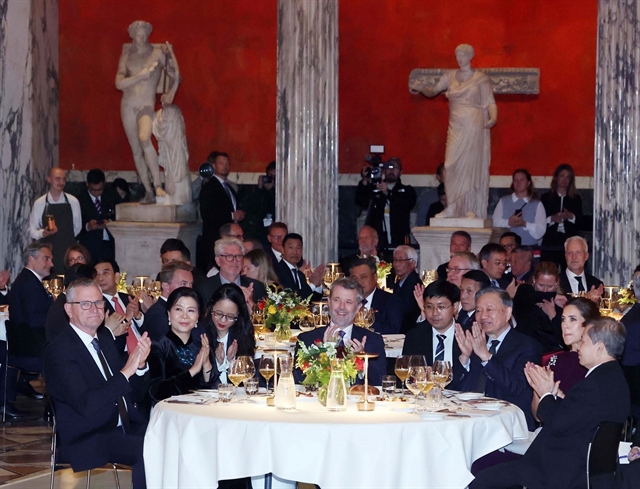
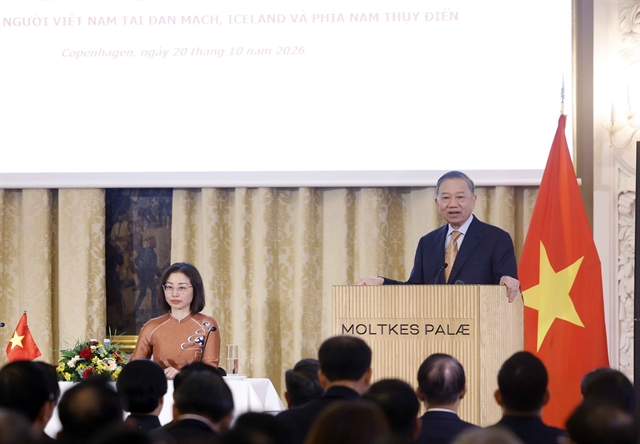
Top leader hails friendship association's role in nurturing Việt Nam–Denmark ties
1.

|
| Participants at the conference. — Photos courtesy of HCMA |
HÀ NỘI — Việt Nam and Indonesia have stepped up academic cooperation on religious harmony and social cohesion as both countries seek to share experience in managing increasingly diverse religious, ethnic and cultural communities.
The Institute for Ethnicity and Religion under the Ho Chi Minh National Academy of Politics (HCMA), in coordination with Indonesia’s Leimena Institute, held a scientific conference in Hà Nội on Thursday under the theme “Religious Harmony in the Context of Religious and Ethnic Diversity”.
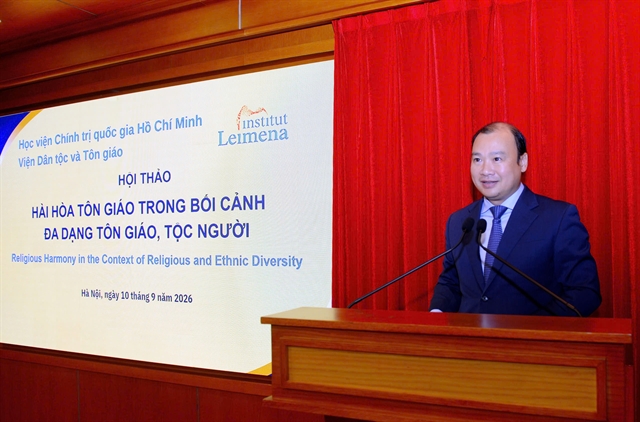
Associate Professor Lê Hải Bình, member of the Party Central Committee and standing deputy director of the HCMA, said religion has become increasingly involved in areas ranging from healthcare and education to humanitarian activities, environmental protection, community care and social dialogue.
He said Việt Nam, a multi-ethnic and multi-religious country with 54 ethnic groups and 41 religious organisations belonging to 16 religious traditions recognised by authorities, had consistently respected and ensured people’s freedom of belief and religion.
“It is important to promote the positive contributions of religions while identifying and appropriately addressing emerging issues in religious life on the basis of law, dialogue and persuasion,” Bình said.
|
| Standing Deputy Director of the Ho Chi Minh National Academy of Politics speaks at the conference. |
He said religious organisations and followers had contributed to social welfare, humanitarian activities and community development, while values such as compassion, responsibility, solidarity and sharing could help strengthen social consensus and human development.
Bình also highlighted the role of international cooperation in expanding knowledge, sharing experience and strengthening research and training capacity in ethnic and religious affairs.
He described Indonesia as a partner with valuable experience for Việt Nam, particularly given its high level of ethnic, religious and cultural diversity. Cooperation, he said, should go beyond exchanging experience to include joint learning and knowledge creation while respecting differences in the history, culture, institutions and development conditions of each country.
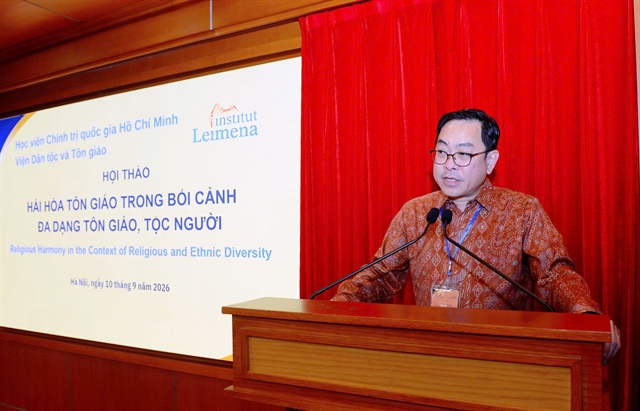
Matius Ho, executive director of the Leimena Institute, said the partnership between the two institutions reflected the longstanding friendship between Việt Nam and Indonesia.
He linked the cooperation to the legacies of President Hồ Chí Minh and President Sukarno, saying the two leaders had recognised the importance of unity in diverse societies.
“A strong and resilient unity will be achieved through bottom-up solidarity that nurtures social trust,” Ho said.
He said the Cross-Cultural Religious Literacy approach developed through the partnership sought to build people’s capacity to foster unity and solidarity in religiously and ethnically diverse societies.
|
| Matius Ho, executive director of the Leimena Institute, speaks at the conference. |
Against a backdrop of rising xenophobia and ethnoreligious sentiment globally, Ho said such capacity was particularly important for Southeast Asia, one of the world’s most diverse regions.
“The competency to cultivate social cohesion that respects religious, cultural and ethnic diversity is essential for the national development and progress in this region,” he said.
Ho also highlighted the potential regional dimension of the partnership, noting that cross-cultural religious literacy has been incorporated into the ASEAN Community Vision 2045 and its strategic plans.
The plans include cross-cultural religious literacy programmes aimed at building “an inclusive and cohesive Community that respects political, social, religious, cultural, ethnic diversities”.
With Việt Nam due to serve as ASEAN Chair in 2030, Ho said this could provide an opportunity for the country to draw greater regional attention to the importance of social cohesion and harmony in diverse societies.
He called for continued cooperation between the two institutes and engagement with other ASEAN member states, saying lessons from the Việt Nam-Indonesia partnership could be shared through regional academic and training platforms.
The Hà Nội conference followed a two-day cross-cultural religious literacy training programme jointly organised by the two institutions in Đà Nẵng on September 7-8.
The training brought together officials working in religious affairs, political theory lecturers, experts and religious dignitaries to discuss religious literacy in the context of cultural diversity and its role in building a harmonious and sustainable society.
The two activities form part of continuing cooperation between the Institute for Ethnicity and Religion and the Leimena Institute, which includes academic exchanges, training programmes and research on interfaith and cross-cultural dialogue. — VNS
Politics & Law
 Politics & Law
 Politics & Law
 Politics & Law
 Politics & Law
 Politics & Law
 Politics & Law
 Politics & Law
 Politics & Law
 Politics & Law
 Politics & Law
 Politics & Law
 Politics & Law
 Politics & Law
 Politics & Law