 Politics & Law

42 people hospitalised over suspected gas leak in Hà Nội
1.
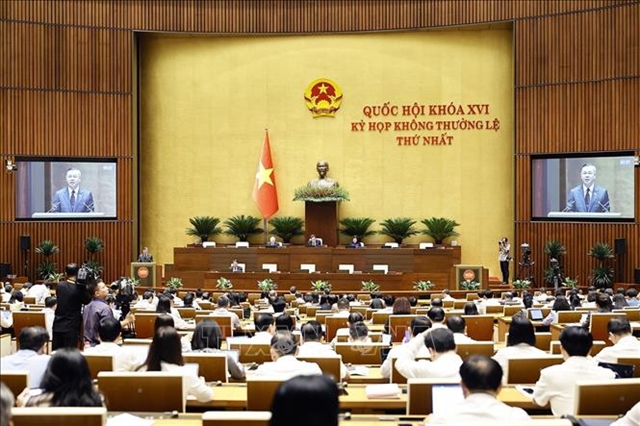 |
| An overview of the sitting where deputies discuss laws on housing and real estate. — VNA/VNS Photo Doãn Tấn |
HÀ NỘI — The National Assembly (NA) on Wednesday heard reports on policy orientations for amendments to the 2023 Law on Housing and the 2023 Law on Real Estate Business.
Minister of Construction Trần Hồng Minh presented the Government’s submission on the policy orientations for amendments to the laws.
Regarding amendments to the 2023 Law on Housing, the supplements are intended to continue institutionalising the Party’s and State’s policies on a socialist-oriented market economy; establish a favourable, transparent and safe legal environment with low compliance costs; simplify administrative procedures for construction investment; introduce housing development policies aimed at ensuring that everyone has a place to live.
The law is being drafted on the basis of retaining provisions that remain appropriate, while amending them in fully institutionalising the Party’s and State’s viewpoints, guidelines and policies; and developing housing in association with social welfare.
This includes focusing on the development of affordable rental housing to meet people’s accommodation needs.
The State will not subsidise housing, but neither will it leave the market to regulate itself entirely. The State will play an enabling role through institutions, policies, planning, and financial and credit instruments, so that the market can develop in a healthy and transparent manner and attract businesses to participate at reasonable profit levels.
A wide range of resources will be mobilised, rather than relying solely on the State budget. The focus will be on unlocking private capital and long-term capital from investment funds and credit institutions, while using State resources effectively to guide and stimulate the market and create incentives for private investment in the development of rental housing.
The draft amended Law on Housing comprises of 13 chapters and 132 articles. Compared with the current law, which contains 198 articles, the draft amended one reduces the number of articles by 66, equivalent to a reduction of 32 per cent.
Healthy real estate market
Regarding the policy orientations for amendments to the Law on Real Estate Business, the supplements are intended to build a favourable, transparent and safe legal environment with low compliance costs; create equal conditions for individuals and businesses; ensure the consistency and uniformity of the legal system; and ensure the healthy development of the real estate market.
The law will closely follow and update the Party’s new policies and orientations that have been issued or are under consideration.
The draft also seeks to diversify participating entities and forms of participation to ensure a balance between supply and demand.
The State will play a guiding role, using instruments, mechanisms and policies to exercise control, proactively prevent and curb speculation, and intervene when necessary so that the real estate market can develop in a healthy, transparent, stable and sustainable manner.
The amendments to the Law on Real Estate Business must be consistent with the Constitution.
They will continue to address practical difficulties and obstacles; accelerate decentralisation and the delegation of powers in association with inspection and oversight; reduce investment and business conditions and compliance costs; and ensure that the law regulates only matters falling within the National Assembly’s authority.
Matters of a technical, procedural or administrative nature will be assigned to the Government for detailed regulation, in accordance with the policy of reforming law-making practices.
Provisions of the 2023 Law on Real Estate Business will be promptly amended to meet practical requirements, accommodate the restructuring of the organisational apparatus and the two-tier local-government model, and improve mechanisms for managing the real estate market.
This will be done on the basis of digital transformation and the development and unified operation of an information system and database on housing and the real estate market.
The amendments will also strengthen the public disclosure and transparency of information, improve the management of real estate transactions, enhance the effectiveness of market forecasting and regulation, and prevent fraudulent activities, speculation and market manipulation.
The draft amended Law on Real Estate Business comprises of 10 chapters and 62 articles. Compared with the 2023 Law on Real Estate Business, which consists of 10 chapters and 83 articles, the draft amended one reduces the number of articles by 21, equivalent to a reduction of approximately 30 per cent.
The draft amended law is being developed mainly on the basis of provisions inherited from the 2023 Law on Real Estate Business.
These cover the business of housing, construction works and land-use rights with existing technical infrastructure within real estate projects; the lease, sublease and lease-purchase of housing and construction works; the lease and sublease of land-use rights with existing technical infrastructure within real estate projects; the transfer of real estate projects; and the provision of real estate services. — VNS
Politics & Law
 Politics & Law
 Politics & Law
 Politics & Law
 Politics & Law
 Politics & Law
 Politics & Law
 Politics & Law
 Politics & Law
 Politics & Law
 Politics & Law
 Politics & Law
 Politics & Law
 Politics & Law
 Politics & Law




