 Politics & Law

Dream of the visible 1300 years of history in the heart of Hà Nội starts to take shape
1.
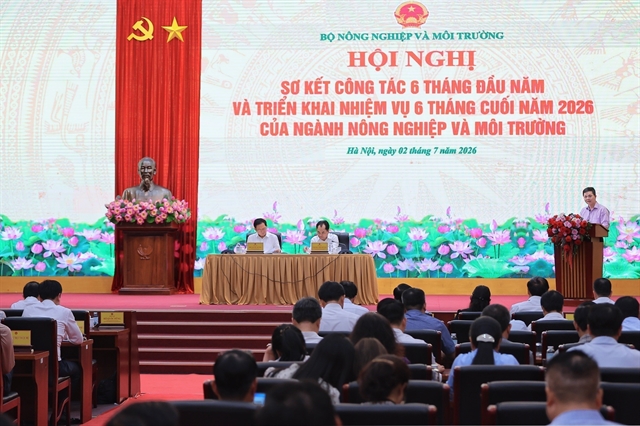 |
| The Ministry of Agriculture and Environment held on conference on July 2 in Hà Nội reviewing first-half performance and outlining tasks for the remainder of 2026. — VNA/VNS Photo |
HÀ NỘI — Deputy Prime Minister Hồ Quốc Dũng on Thursday called on the Ministry of Agriculture and Environment to accelerate institutional reform and digital transformation while maintaining growth momentum across the agriculture and environment sectors.
Addressing the ministry's conference reviewing first-half performance and outlining tasks for the remainder of 2026, the Deputy PM said completing the legal framework must remain the ministry's top priority.
He urged the ministry to expedite revisions to key legislation, including the Land Law, the Law on Environmental Protection, the Law on Water Resources and other related laws to meet the country's evolving development needs.
He instructed the ministry to review and complete sectoral planning, clearly identifying plans requiring revision or new formulation to meet the Government's implementation schedule.
Another key priority, he said, is the vigorous implementation of Resolution No. 57-NQ/TW on science, technology, innovation and digital transformation. The ministry was tasked with leading a 100-day nationwide campaign to review and complete outstanding tasks related to the resolution, with detailed weekly and monthly action plans and clearly assigned responsibilities.
Dung urged the ministry to strengthen agricultural production, resource management and environmental protection to help achieve the country's 2026 growth targets.
In agriculture, he called for stronger efforts to boost production, processing and consumption of farm produce while increasing product quality and added value.
He stressed the need to intensify measures against illegal, unreported and unregulated (IUU) fishing to secure the early removal of the European Commission's "yellow card", describing it as a challenging but strategically important task for maintaining and expanding Việt Nam's seafood exports.
Regarding national target programmes, the ministry, as the standing agency, was instructed to finalise coordination mechanisms, clarify responsibilities among ministries and localities, and strengthen supervision to improve implementation and public investment disbursement.
With natural disasters and climate change expected to remain unpredictable in 2026, the Deputy PM asked for practical response plans prioritising the protection of lives and property.
He also called for the wide application of science, technology and digital tools in forecasting, early warning and real-time disaster monitoring to improve response capacity.
Minister of Agriculture and Environment Trịnh Việt Hùng affirmed that the ministry would promptly translate the Deputy PM's directions into detailed action plans with clear timelines and accountability, while stepping up inspections and addressing implementation bottlenecks.
Delivering a report at the event, Deputy Minister Đặng Ngọc Diệp said that the ministry had maintained stable operations following organisational restructuring and proactively introduced measures to support growth in agriculture, natural resources and environmental management.
In the first six months of 2026, Việt Nam's agro-forestry-fishery exports were estimated at US$38.88 billion, up 6 per cent year-on-year, while the sector recorded GDP growth of 3.8–3.85 per cent, exceeding the annual target of 3.7 per cent.
The ministry also proposed a number of special mechanisms, including allowing coal producers to exceed licensed extraction capacity by up to 15 per cent to help ensure energy security and support economic growth.
Administrative reforms continued, with the ministry proposing the abolition of 149 outdated legal documents, equivalent to about one-quarter of those under review, helping improve the business environment and reduce compliance costs.
In implementing Resolution No. 57-NQ/TW, the ministry proposed 15 strategic technology projects worth an estimated VNĐ1.3 trillion (about $50 million) and identified 13 potential strategic technology products. Notably, Việt Nam's national agricultural product traceability system officially became operational on June 30, providing a foundation for quality management, information transparency and expanded export opportunities, according to Diệp. — VNA/VNS
Politics & Law
 Politics & Law
 Politics & Law
 Politics & Law
 Politics & Law
 Politics & Law
 Politics & Law
 Politics & Law
 Politics & Law
 Politics & Law
 Politics & Law
 Politics & Law
 Politics & Law
 Politics & Law
 Politics & Law