 Politics & Law
PM Hưng meets with Cambodian People's Party, Senate leader Hun Sen
1.
|
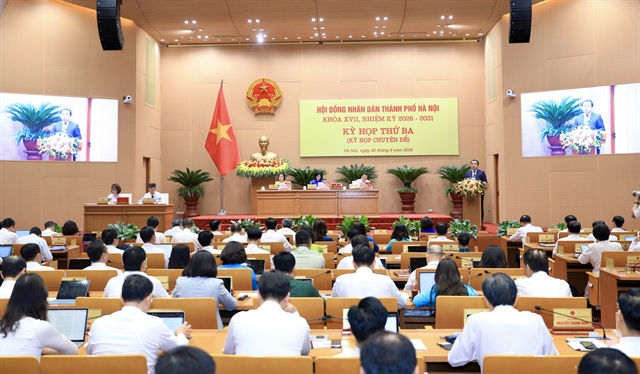
| Hà Nội's People's Council convenes its third session on Tuesday to discuss resolutions to implement the Capital Law. — Photo dbndhanoi.gov.vn |
HÀ NỘI — Hà Nội's People's Council opened a multiple-day session on Tuesday, with lawmakers racing to consider 23 resolutions to implement the Capital Law before it takes effect on July 1.
The session, the third of the council's 2026-2031 term, is expected to play a key role in translating the broad framework of the new law into specific policies governing urban development, social welfare, science and technology, environmental management and local administration.
City leaders described the coming month as a crucial period for preparing the capital to exercise a range of new powers and special policy mechanisms granted under the legislation.
People's Council Chairwoman Phùng Thị Hồng Hà said authorities were working under significant time pressure to ensure the law can be implemented effectively once it comes into force.
"The entire city is racing against time to bring the Capital Law into practice," Hà told delegates, adding that policies adopted by the council must remain practical and enforceable.
Several of the most closely watched proposals concern Hà Nội's long-term urban planning and environmental agenda.
Among them are plans to support the transition from fossil fuel-powered road vehicles to cleaner energy sources, encourage greater use of public transportation and introduce measures to limit polluting vehicles.
Lawmakers are also expected to discuss the city's proposed low-emissions zone within the Ring Road 1 area, alongside policies related to transit-oriented development and the management of low-altitude urban space.
Hà indicated that some of the more complex proposals would require additional consultation before final approval, particularly those expected to have significant impacts on residents, businesses and future urban growth.
Trần Đức Thắng, a Politburo member and secretary of Hà Nội's Party Committee, said the legislation provides the city with expanded authority and a range of special mechanisms intended to support faster and more sustainable development.
"The decisive task facing the city is to issue detailed implementation regulations that are practical, feasible and capable of being enforced effectively," Thắng said.
He urged delegates to focus on policies that promote decentralisation and administrative reform while ensuring adequate oversight and accountability. He also identified knowledge, digital data, science and technology and a skilled workforce as key drivers of future economic growth.
According to Dương Đức Tuấn, permanent vice chairman of the Hà Nội People's Committee, the session will review resolutions spanning six major policy areas: economic management, social affairs, urban development, legal affairs, science and technology and environmental protection, in addition to personnel matters.
In the economic sector, lawmakers will consider measures concerning land policies for ethnic communities and adjustments to business registration procedures.
Social and cultural proposals include new regulations on administrative penalties in the fields of culture and advertising, social welfare support for city residents, revisions to education-related administrative procedures and amendments to policies covering social insurance and health insurance support for eligible groups.
Urban development proposals include regulations governing the preparation and approval of planning documents under the Capital Law, procedures for emergency investment projects, adjustments to the Ngọc Hồi Bridge project and consideration of a public-private partnership proposal for upgrading part of the Hà Nội–Thái Nguyên–Chợ Mới expressway.
Lawmakers will also examine legal measures related to local residential administration, honorary civic titles and incentives for private drug rehabilitation facilities and businesses employing former drug users or former prisoners convicted of drug-related offences.
In the science and technology sector, the council is expected to consider a regulatory sandbox framework, incentives for innovation and digital transformation, policies supporting scientific research and technology transfer and new spending regulations for publicly funded research activities.
City officials have set a June 15 deadline for completing several major policy proposals that require further refinement before returning to the council for approval, underscoring the tight legislative timetable ahead of the Capital Law's implementation next month.
The objective is to ensure that implementing regulations are in place before the law takes effect, avoiding delays that could hinder enforcement of its provisions during the initial rollout period, according to Thắng. — VNS
Politics & Law
 Politics & Law
 Politics & Law
 Politics & Law
 Politics & Law
 Politics & Law
 Politics & Law
 Politics & Law
 Politics & Law
 Politics & Law
 Politics & Law
 Politics & Law
 Politics & Law
 Politics & Law
 Politics & Law