 Politics & Law
Five live military rounds found in passenger’s luggage at Tân Sơn Nhất Airport
1.
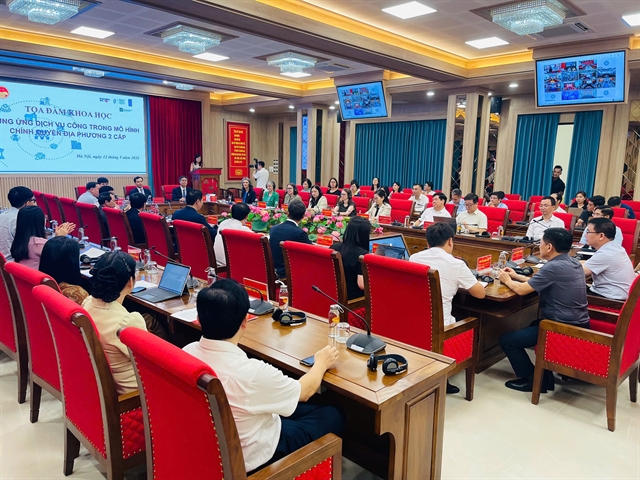 |
| An overview of the scientific conference. — VNS Photo Thu Trang |
HÀ NỘI — Việt Nam’s public administration system must move away from a mindset in which citizens simply follow prescribed procedures to instead designing service journeys around the problems people need solved, a leading governance expert has said.
Associate Professor Nguyễn Mạnh Hùng, deputy director of the Hồ Chí Minh National Academy of Politics, emphasised this at a scientific conference held on Tuesday in Hà Nội, as the country assesses sweeping reforms to its local government structure.
He said the change was not merely a technical administrative adjustment but, above all, a shift in governance philosophy.
The conference, rapid assessment of public service delivery in the context of the two-tier local government model, was co-organised by the academy in collaboration with the United Nations Development Programme, the Australian Embassy and the Irish Embassy in Việt Nam.
The event comes as Việt Nam prepares to conduct a preliminary review of one year of implementing the two-tier local government model. This is seen as a key opportunity to evaluate initial results, identify remaining bottlenecks and propose solutions so the new model remains close to the people, grounded at grassroots level and better serves the public.
“The transition from a three-tier to a two-tier local government model represents a profound change in governance methods: from delineating authority, responsibilities and resources to how the government interacts with citizens,” said Hùng.
The goal is to reduce intermediate layers, shorten the distance between administrative decisions and grassroots life, enable the Government to grasp situations more quickly, respond more promptly and be more clearly accountable to the people, according to Hùng.
“The benefits are not merely how streamlined the apparatus has become, but whether citizens and businesses are served more conveniently, swiftly, transparently and satisfactorily,” said Hùng.
After one year of implementation, the two-tier local government apparatus has begun to operate stably amid a heavy workload and high transformation demands. In many localities, the new system has quickly become operational, officials and civil servants have strived to adapt and the public has endorsed the streamlining policy while expecting a modern, efficient and accountable administration.
However, Hùng said the transformation process still faced many issues that would require frank recognition, evaluation and timely resolution.
When the organisational system is restructured, if decentralisation and devolution advance faster than resources, personnel and digital systems, public services are prone to bottlenecks, according to Hùng. Citizens may still face delays and multiple visits due to unclear points of contact, while grassroots officials must handle more complex tasks with limited working conditions, knowledge and skills.
“Therefore, with the overriding requirement to ensure public services remain uninterrupted, unbroken and undiminished in quality throughout any transition phase, organisational arrangements must be accompanied by process redesign, data standardisation, clear delineation of authority, adequate staffing with capable personnel and direct support for citizens, especially vulnerable groups and those with limited access to digital services,” said Hùng.
From this reality, breakthroughs are needed in implementation: regulations must be enforced swiftly, accurately, synchronously and verified through concrete results.
Discussion
Experts at the conference focused on four key areas.
First, objectively assess the results of one year of two-tier local government implementation and its impact on public service delivery, clarifying which sectors are functioning well, which procedures remain bottlenecked, which citizen groups still face difficulties and which areas lack personnel, infrastructure, data or coordination mechanisms.
Second, identify effective organisational models, weak interlinkage mechanisms, appropriate levels of digitalisation and how to design both online and in-person citizen support systems.
Public administrative service centres play a particularly vital role.
“It is not just a place to receive and return dossiers, but the frontline of government service, where citizens directly experience reform quality. Are dossiers guided clearly? Is data interlinked? Are staff dedicated and professional? Are timelines met? Are results reliable? All are tested here, where citizens feel the reforms in real life,” said deputy director Hùng.
Third, discuss practical lessons from localities in ensuring uninterrupted public services, handling interlinked procedures, land clearance compensation, health care, education and essential services, identifying what enables localities to resolve difficult issues swiftly, what hinders reforms and which mechanisms can scale up good practices.
Fourth, propose policy directions for the 2026-2031 term.
Experts agreed that decentralisation and devolution must be linked to resource allocation, workforce training, data standardisation, quality control and accountability.
The central level should design the system, issue common standards and ensure interlinkage, the provincial level should coordinate, support and supervise and the commune level should be empowered to handle grassroots issues.
Nguyễn Ngọc Nam, deputy chief of the Bắc Ninh Provincial People's Committee Office and director of the provincial Public Administrative Service Centre, said: “The leadership role of the head and the application of real-time quantitative indicators are decisive factors in the transition phase.”
He added that ensuring psychological stability and capacity among civil servants was a crucial condition.
“Putting citizens and businesses at the centre must be concretised into initiatives at each locality, especially for vulnerable groups. Whether indicators are high or low ultimately reflects whether citizens are truly served better,” said Nam.
He noted the fact that all 99 out of 99 communes simultaneously rolled out direct support models at residents’ places of abode, opened an additional land reception point in Nhân Thắng Commune to ease the load on Gia Bình Commune and applied the green channel for key projects all stemmed from the principle of viewing issues from the perspective of citizens and businesses.
Lê Anh Tuấn, deputy chief of the Hưng Yên Provincial People's Committee Office and director of the provincial Public Administrative Service Centre, proposed combining multiple channels for administrative dossier submission, both in person and via post, depending on citizens’ needs, linked with guidance on using online public services.
He also suggested establishing a system of provincial Public Administrative Service Centre branches located in communes and wards while fully applying digitalised processes.
Associate Professor Hùng said: “The key is not just sound policies, but correct, swift and sustainable implementation. A good system is not one without hitches, but one that detects them early, responds quickly, corrects errors promptly and does not burden citizens with the costs of incoherence. Good public services are not just procedurally correct, but deliver stable, reliable, accessible results that satisfy the public.” — VNS
Politics & Law
 Politics & Law
 Politics & Law
 Politics & Law
 Politics & Law
 Politics & Law
 Politics & Law
 Politics & Law
 Politics & Law
 Politics & Law
 Politics & Law
 Politics & Law
 Politics & Law
 Politics & Law
 Politics & Law