 Politics & Law

MoIT to build system to flag unusual fuel price movements
1.
|
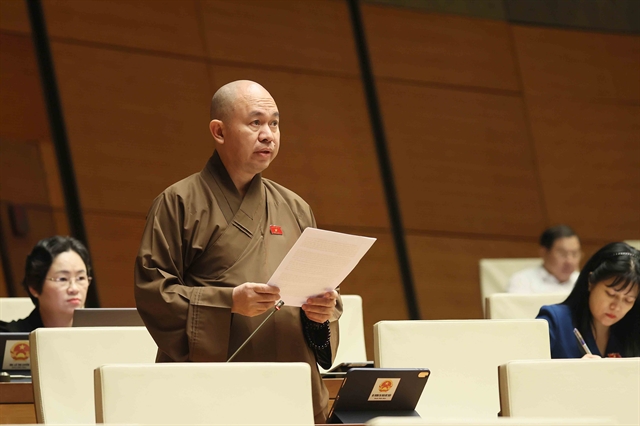
| National Assembly deputy Thích Đức Thiện speaks during discussions on the draft revised Law on Belief and Religion at the first session of the 16th National Assembly on Friday. — VNA/VNS Photo An Đăng |
HÀ NỘI — Lawmakers have urged stronger safeguards to ensure transparent management and proper use of religious donations, warning that loopholes in financial oversight could expose the system to risks such as money laundering and fraud, particularly involving overseas contributions.
The concerns were raised during discussions on the draft revised Law on Belief and Religion at the first session of the 16th National Assembly on Friday.
Deputy Hoàng Thị Thanh Thúy of Tây Ninh Province proposed amending Article 8 to require individuals and organisations conducting religious activities online to verify their identities with competent State authorities.
She stressed that the measure would not restrict freedom of belief, but rather safeguard legitimacy. It would help authorities manage activities more effectively while enabling followers to distinguish authentic religious sources from fraudulent ones, thereby protecting the reputation of legitimate religious organisations and safeguarding national cultural security.
Thúy also pointed out that the draft law does not clearly address the management and use of donations and contributions. Although Article 18 includes provisions on revenues from festivals and belief-related activities, she said gaps remain in ensuring financial transparency.
“This is an extremely large source of revenue and also a root cause of many issues within religious organisations, especially when it comes to foreign funding. Donations made through personal bank accounts are becoming increasingly complex and pose risks of money laundering or fraud,” she warned.
She proposed requiring religious organisations to use bank accounts registered with State authorities when mobilising donations online. Such a regulation, she said, would allow authorities to monitor financial flows in order to ensure funds are used for proper religious purposes, while also helping followers verify transactions and avoid scams.
The deputy further emphasised the need for a roadmap to support digital transformation across religious organisations, enabling them to adapt to the digital era while establishing a robust safeguard against the misuse of spiritual beliefs on online platforms.
She also suggested adding provisions prohibiting the manipulation of social media algorithms to spread misinformation about religious doctrines.
“Algorithms themselves are neutral, but they can be exploited to turn distorted information into widely accepted ‘truths’ through automated dissemination mechanisms,” she explained, adding that such regulations would help prevent misguided beliefs and protect legitimate religious institutions from fake and harmful content.
Deputy Thích Thanh Quyết of Quảng Ninh Province expressed strong support for revising the law, but called for clearer criteria to identify violations and more detailed coordination mechanisms among relevant stakeholders, particularly in detecting and handling cross-border digital content.
To ensure a balance between freedom of belief and maintaining public order, he urged clearer definitions to distinguish legitimate religious practice from acts that exploit religion to distort information, incite division or undermine social stability.
On the management and use of assets by religious establishments under Article 52, he recommended introducing clearer principles to govern donations, ensuring transparency, accountability, equality among religions, and proper use, while preventing losses and misconduct.
Sharing views aligned with the appraisal report of the National Assembly’s Committee for Culture and Social Affairs, deputy Vũ Minh Tâm of Quảng Trị Province called on the Government and local authorities to strengthen training and capacity-building for officials managing belief and religious affairs, particularly at the grassroots level.
He stressed the need for a competent and experienced workforce capable of handling emerging issues effectively, especially in local contexts. — VNS
Politics & Law
 Politics & Law
 Politics & Law
 Politics & Law
 Politics & Law
 Politics & Law
 Politics & Law
 Politics & Law
 Politics & Law
 Politics & Law
 Politics & Law
 Politics & Law
 Politics & Law
 Politics & Law
 Politics & Law