 Politics & Law
Businesses need to expand share of online export market
1.
 |
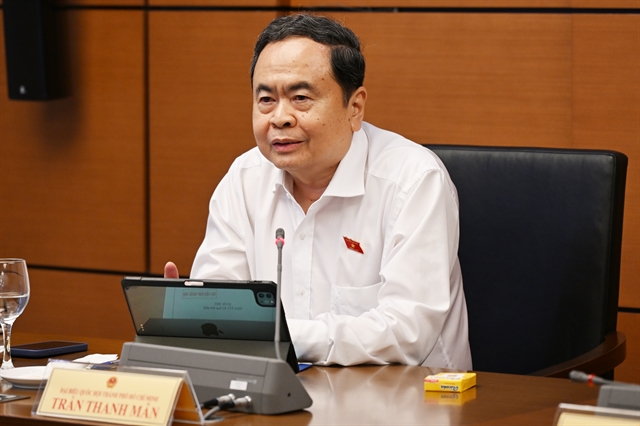
| Prime Minister Lê Minh Hưng at a group discussion on socio-economic issues on Friday morning in Hà Nội — VNA/VNS Photo An Đăng |
HÀ NỘI — Việt Nam will not pursue rapid or high growth at any cost if it risks undermining macroeconomic stability.
Prime Minister Lê Minh Hưng made the remarks during a group discussion on socio-economic issues on Friday morning, held at the first sitting of the 16th National Assembly in Hà Nội.
Hưng said that sustainable development must be grounded in a balance between growth, macroeconomic stability and the effective management of the economy’s major balances.
He added that achieving double-digit growth will require substantial investment resources.
During the 2026–2031 term, total social investment is expected to reach around 40 per cent of GDP, up from 33 per cent in the previous term. Public investment funded by the State budget is projected to exceed VNĐ8 quadrillion (US$305 billion), compared with around VNĐ2.87 quadrillion ($109 billion) in the previous term.
However, the level of public investment would account for only about 20 per cent of total social investment, meaning that the remaining 80 per cent must be mobilised from private domestic sources, businesses and both direct and indirect foreign investment.
To attract such capital, he emphasised the need for a transparent and clear legal framework that encourages participation from citizens, enterprises and foreign investors.
Hưng underscored that all growth objectives must rest on a solid foundation of macroeconomic stability.
“When building a house, the foundation must be reinforced before adding more floors. We do not accept overheated growth or high growth achieved at the cost of macroeconomic instability, as the price to pay would be far greater,” he said.
He added that the Government remains acutely aware of the principle and has, in recent days, directed key ministries and agencies, including the Ministry of Finance, the State Bank of Vietnam and the Ministry of Industry and Trade, to coordinate closely and respond flexibly to fluctuations in global monetary markets and fuel prices, thereby minimising adverse domestic impacts.
Describing 2026 as a pivotal year, Hưng said that during both group discussions and plenary sessions, Government members will continue to listen to and incorporate feedback from National Assembly deputies in order to refine policy and governance plans.
Institutional reform
Hưng also reiterated that institutional reform remains the most critical breakthrough.
“Institutional frameworks are like roads that create open pathways for the Vietnamese economic vehicle to move forward,” he said.
As the country shifts its growth model, the Party Central Committee has tasked the Politburo and the Central Policy and Strategy Commission with studying and submitting a resolution on this transformation.
However, even before such a resolution is adopted, it must continue to ensure that the economic vehicle operates smoothly.
“The vehicle remains the same, but if the institutional road is upgraded and more synchronised, development will undoubtedly accelerate. Therefore, institutions remain the key factor,” he said.
He stressed that throughout 2026, a series of institutional issues must be resolved comprehensively.
These include a full review of the legal system and the development of a legal strategy suited to a new era; addressing operational bottlenecks in the two-tier local government model by no later than the second quarter of this year; and strengthening the capacity of grassroots-level officials to ensure effective and seamless governance.
In parallel, the Government aims to complete the formulation, adjustment and approval of socio-economic development plans and land-use planning by the second quarter of this year.
Particular emphasis will be placed on resolving thousands of stalled projects facing obstacles related to land, capital and regulatory issues, including renewable energy projects.
The Government will submit proposals to competent authorities, including recommendations to the National Assembly to amend and supplement Resolution 170 on special mechanisms and policies to remove such bottlenecks.
He affirmed a determination to complete these tasks by the second quarter of this year, while also strengthening the role and accountability of local authorities.
Provincial Party secretaries and standing committees have been tasked with directly overseeing the resolution of backlogged projects once obstacles within the remit of the National Assembly, Government and Prime Minister have been addressed.
“Before we speak of new growth drivers, there is already a vast pool of resources tied up in stalled projects. If these are unlocked, they will provide a significant boost to growth,” he said. — VNS
Politics & Law
 Politics & Law
 Politics & Law
 Politics & Law
 Politics & Law
 Politics & Law
 Politics & Law
 Politics & Law
 Politics & Law
 Politics & Law
 Politics & Law
 Politics & Law
 Politics & Law
 Politics & Law
 Politics & Law