 Politics & Law

Việt Nam sets AI targets for 2030 - 2045
1.
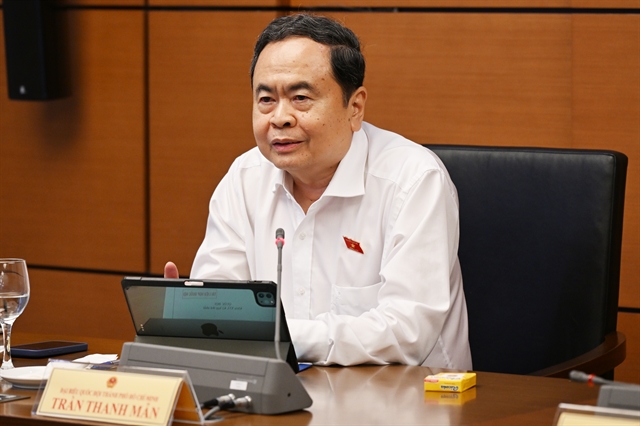 |
| National Assembly Chairman Trần Thanh Mẫn at a group discussion on Friday morning in Hà Nội. — Photo quochoi.vn |
HÀ NỘI — Việt Nam must pursue simultaneous breakthroughs in institutional reform, comprehensive digitalisation, and the unlocking of private sector potential, while tightening implementation down to each agency, official and measurable output, in order to achieve double-digit economic growth.
This was the message delivered by Trần Thanh Mẫn, Chairman of the National Assembly, on Friday morning during a group discussion session held as part of the first sitting of the 16th National Assembly in Hà Nội.
The session focused on a supplementary assessment of the implementation of the 2025 socio-economic development plan and State budget; the performance of these plans in the early months of 2026; and the formulation of the 2026-30 five-year socio-economic development strategy.
Mẫn said the most critical requirement for achieving the growth target is the adoption of synchronised, decisive and resolute measures, coupled with a determination to follow through to deliver tangible outcomes.
“Everyone may have ideas and vision, but without action there will never be results,” he stressed, calling for a consistent spirit of execution from senior leaders down to officials at all levels, across all sectors and fields.
He identified institutional reform as the foremost and enabling solution, emphasising the need for bold breakthroughs to remove bottlenecks hindering production, business activity and the mobilisation of social resources.
Drawing on recent governance experience, he said that strong economic growth has consistently been associated with institutional reform and the removal of legal obstacles.
The foundation helped the economy expand by more than 7 per cent in 2024, with key targets met or exceeded, while 2025 has maintained positive growth momentum alongside robust State budget revenues.
Building on this, 2026 has been identified as a year requiring even stronger efforts to achieve double-digit growth and further increase budget revenues.
Notably, he highlighted five pillars to be pursued in parallel, consisting of digitalisation, green transition, resource optimisation, smart governance and harmonisation of interests.
Among these, digitalisation was described as decisive.
“Without digitalisation, the State management apparatus, business operations and the entire economy will struggle to break through. The country cannot advance rapidly and sustainably,” he said.
He also underscored the need to shift the growth model towards science and technology, innovation, digital transformation and artificial intelligence (AI), noting that AI is already driving profound changes in legislative work, oversight, data governance, document processing and decision-making support.
The NA is actively advancing the development of a digital legislature, applying AI to review legal documents, synthesise materials, analyse data and support oversight.
Large volumes of documentation can now be processed within minutes, significantly saving time and labour while improving accuracy.
He also added that all agencies, from central to local levels, must cultivate a working culture based on digital data, digital platforms and AI tools.
Key engine of growth
In addition, Mẫn emphasised that one of the most important driving forces for achieving double-digit growth is the private sector.
He called for the continued development of major private conglomerates with strong financial capacity, advanced technology and modern governance, capable of undertaking national key projects.
“In practice, many large-scale projects delivered by private enterprises have progressed rapidly with high quality, while some public investment projects have been hampered by prolonged procedures, cost overruns and even negative practices,” he said.
Creating a more enabling environment for private sector expansion, he said, is not only an economic necessity but also a strategic solution to enhance national competitiveness.
On macroeconomic management, he urged a flexible yet firm approach, with proactive responses to external uncertainties such as conflicts, trade tensions and volatility in global financial markets.
Fiscal policy should be expanded in a targeted manner, concentrating resources on major infrastructure projects with strong spillover effects, while avoiding fragmented and inefficient investment.
He also called for the decisive resolution of stalled projects and prioritisation of flagship developments capable of driving regional growth and national connectivity, in line with remarks made by the Prime Minister Lê Minh Hưng before the legislature on Thursday.
At the same time, he highlighted the importance of promoting the night-time economy, boosting domestic consumption and effectively tapping into the country’s market of more than 100 million people as a significant growth driver amid ongoing global trade uncertainties.
Mẫn also said that implementation and personnel are the most decisive factors.
All resolutions and policies cannot translate into reality without clear assignment of responsibilities, timelines and measurable outputs.
“The implementation stage must specify each agency and locality, who is responsible, when tasks are carried out, when they are completed, and what outputs are delivered,” he said.
He stressed the need to make full use of time and opportunities, avoiding delays at every stage.
Looking ahead, he underlined that in the new phase of development, the cadre corps, particularly in major urban centres and growth hubs such as Hà Nội, HCM City, Đà Nẵng and Cần Thơ, must adopt modern governance mindsets, enhance professional expertise, foreign language proficiency, technological capability and the ability to operate in digital environments.
“These are the decisive conditions for turning the goal of double-digit growth into reality,” he said. — VNS
Politics & Law
 Politics & Law
 Politics & Law
 Politics & Law
 Politics & Law
 Politics & Law
 Politics & Law
 Politics & Law
 Politics & Law
 Politics & Law
 Politics & Law
 Politics & Law
 Politics & Law
 Politics & Law
 Politics & Law