 Politics & Law

AXA Global Healthcare Mind Health Report reveals global differences in how cost and stigma affect access to professional mental health care
1.
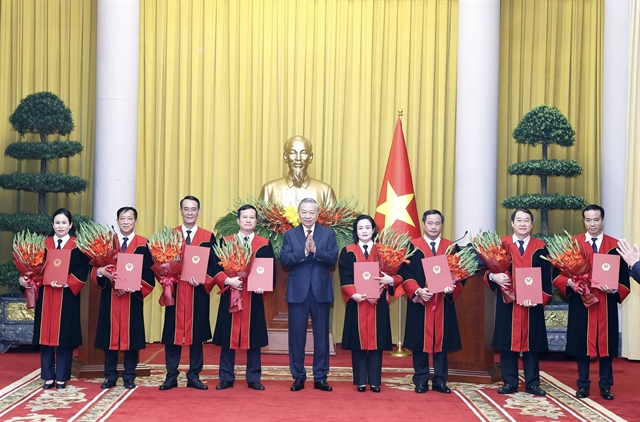 |
| Party General Secretary and State President Tô Lâm and the newly appointed judges of the Supreme People’s Court in Hà Nội on Thursday. — VNA/VNS Photo Thống Nhất |
HÀ NỘI — Party General Secretary and State President Tô Lâm presided over a ceremony in Hà Nội on Thursday to present decisions appointing eight judges to the Supreme People’s Court.
Deputy head of the Presidential Office Phạm Thanh Hà announced the State President’s appointments for Nguyễn Hải Trâm, member of the Party Central Committee, member of the Standing Board of the Party Committee of Central Party Agencies and Permanent Deputy Secretary of the Party Committee of the Supreme People’s Court, along with seven judges from local people’s courts.
Ha also announced the State leader’s decision appointing Trâm as Deputy Chief Justice of the Supreme People’s Court.
In his speech, General Secretary and State President Lâm described the appointments as both a major honour and a serious political responsibility to the Party, State and the public.
According to him, strengthening the Supreme People’s Court bench and leadership holds significance for both organisational restructuring and operational requirements, calling it an urgent step toward building and perfecting Việt Nam’s socialist rule-of-law state and improving judicial performance in the country’s next development phase.
He urged the entire People’s Court system, particularly the newly-appointed judges, to maintain political mettle and absolute loyalty to the Party, Fatherland and people while strictly upholding the rule of law in adjudication. Each judge must operate independently, base rulings solely on the law, resist external pressures, and ensure personal interests or relationships do not compromise fairness and objectivity.
Improving adjudication quality remains the core mission, he said, adding that every verdict must be lawful, reasonable, and persuasive, contributing to social education and orientation. He demanded a sharp reduction in overturned or revised cases caused by subjective errors and insisted that miscarriages of justice be avoided at all costs.
The Supreme People’s Court should also play a stronger role in ensuring uniform legal enforcement, developing case law and contributing to institutional improvements, he said, noting that rulings by the top court must set standards and guide nationwide legal practice.
The leader emphasised the need for a clean, disciplined, and integrity-focused judicial workforce, calling for greater efforts to tackle corruption and misconduct, enforce stricter discipline, increase inspections, and impose firm penalties for violations.
Judicial reform should move faster toward building a modern, professional, and efficient court system, with effective implementation of the three-tier court model, improved personnel quality, and wider use of information technology and digital transformation.
Placing people at the centre of judicial activities, he instructed courts to stay close to the people, understand their needs, and treat the protection of their legitimate rights and interests as the highest priority.
Each ruling, he said, must safeguard justice, uphold fairness, and reinforce public trust in the Party, State, socialist system, and the law’s strictness.
In response, newly appointed Deputy Chief Justice Trâm expressed gratitude to Party and State leaders for their support of the court sector. She pledged, together with the Supreme People’s Court’s leaders and Council of Judges, to fulfil the assigned duties, contribute to a professional, modern, fair, strict, and clean judiciary, and build a complete, unified, transparent, and practical legal system that supports national governance and development.
Trâm also promised to fully and seriously follow the General Secretary and State President’s directions and hoped for continued support from relevant ministries and agencies. — VNA/VNS
Politics & Law
 Politics & Law
 Politics & Law
 Politics & Law
 Politics & Law
 Politics & Law
 Politics & Law
 Politics & Law
 Politics & Law
 Politics & Law
 Politics & Law
 Politics & Law
 Politics & Law
 Politics & Law
 Politics & Law