 Politics & Law
Deputy PM urges removal of legal bottlenecks hindering development
1.
|
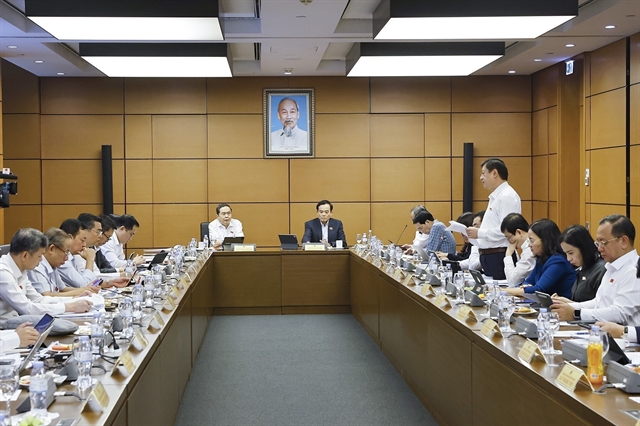
| National Assembly (NA) Chairman Trần Thanh Mẫn (first left) at the group discussions on draft laws amending and supplementing the Law on Legal Aid. — VNA/VNS Photo |
HÀ NỘI — National Assembly (NA) Chairman Trần Thanh Mẫn has called for expanding the pool of beneficiaries eligible for legal aid, stressing that no vulnerable individuals, particularly the elderly living alone and abandoned children, should be left behind.
He was speaking during group discussions at the ongoing first session of the 16th National Assembly on Thursday, focusing on draft laws amending and supplementing the Law on Legal Aid.
Commenting on key provisions, NA Chairman Mẫn urged the drafting agency to consider adding people with average living standards who fall into severe hardship.
“The national poverty rate has fallen to just 1.3 per cent, but the near-poor rate is three times higher, and the risk of falling back into poverty remains ever-present,” he noted.
For children, he proposed extending legal aid to all minors involved in criminal and civil cases related to their lawful rights and interests, instead of limiting eligibility to certain conditions as is currently the case.
Regarding workers, he recommended adding those who are unlawfully dismissed and those involved in collective labour disputes to the list of eligible beneficiaries.
The top legislator also emphasised the need to establish a legal framework that encourages corporate and social organisation charity funds to support legal aid activities.
On improving service quality, he proposed introducing an independent evaluation system, with the law mandating the collection of public feedback and satisfaction levels.
He further called for careful legal drafting to ensure consistency with relevant laws, including the Criminal Procedure Code, the Civil Procedure Code, and the Law on Lawyers.
|
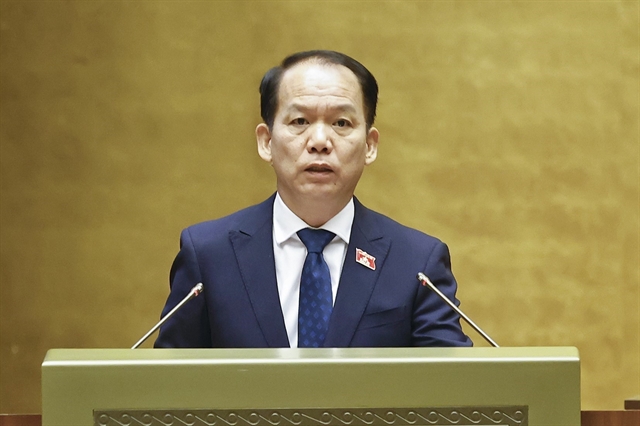
| Minister of Justice Hoàng Thanh Tùng speaks at the working session on Thursday. — VNA/VNS Photo |
Earlier, Minister of Justice Hoàng Thanh Tùng presented the Government’s proposal, which removes the requirement of 'financial hardship' for certain groups eligible for legal aid, including parents, spouses and children of martyrs, caregivers of martyrs in their childhood, victims of Agent Orange, and persons with disabilities.
A verification report presented by Phan Chí Hiếu, chairman of the NA’s Committee for Legal and Judicial Affairs, showed broad agreement with the proposed amendments, including removing financial eligibility conditions for some groups and adding new beneficiaries.
Some opinions suggested adding a provision on 'other legal aid beneficiaries as prescribed by law' to ensure comprehensive coverage and flexibility, allowing for the timely expansion of eligible groups as socio-economic conditions improve.
During discussions, Deputy Lê Nhật Thành from Hà Nội proposed extending legal aid to ethnic people living in disadvantaged communes, citing persistent barriers such as language, customs, low education levels, and difficult terrain.
“Adding this group is not only a way to protect citizens’ legitimate rights and interests, but also an essential governance tool to narrow gaps in access to justice and ensure the effectiveness of ethnic policies in the new context,” he said.
He also recommended establishing branches of State legal aid centres in remote mountainous areas to better serve ethnic communities, who often face significant hardships and have legal aid needs across many aspects of life.
Regarding the draft revised Law on Access to Information, Hiếu said the committee largely agreed with its contents, which include four chapters and 31 articles, but called for further refinement to meet the growing demand for information access.
The drafting body was urged to continue reviewing and supplementing provisions on information that must be disclosed on digital platforms, as well as categories of restricted and conditional access, to ensure consistency with existing laws and better safeguard citizens’ right to information.
Deputy Hoàng Văn Nghĩa from Quảng Ngãi Province proposed adding the phrase “ensuring the implementation of human rights” to the scope of the draft law, and stressed that beneficiaries should not be limited to “citizens” but expanded to “everyone”, including foreign investors and prisoners, in line with international conventions to which Việt Nam is a party.
Sharing this view, Deputy Phạm Thúy Chinh from Hải Phòng City said the draft law currently guarantees access to information only for citizens, without addressing the rights of foreigners.
In practice, she noted, many countries allow foreigners to access information to facilitate socio-economic activities. Therefore, the drafting agency should consider expanding the scope to include foreign nationals, in line with real-world demands and global trends.
Discussing conditional access to information, Deputy Nguyễn Thị Mai Thoa from Hải Phòng City expressed general support for provisions allowing heads of agencies to decide on disclosing information related to business secrets, privacy, personal data, and family secrets without consent in necessary cases for public interest or community health.
However, she urged further clarification of the scope, nature and extent of such sensitive information to prevent abuse that could harm legitimate rights and interests. She also recommended adding provisions on liability exemptions and compensation responsibilities in cases where disclosure causes damage.
On the same day, lawmakers heard proposals and verification reports on the draft revised Law on Civil Status, and the draft Law on amendments and supplementations to the Law on Notarisation, as part of the 16th NA’s agenda of its first session. — VNS
Politics & Law
 Politics & Law
 Politics & Law
 Politics & Law
 Politics & Law
 Politics & Law
 Politics & Law
 Politics & Law
 Politics & Law
 Politics & Law
 Politics & Law
 Politics & Law
 Politics & Law
 Politics & Law
 Politics & Law