 Politics & Law
Data centre market faces energy challenges
1.
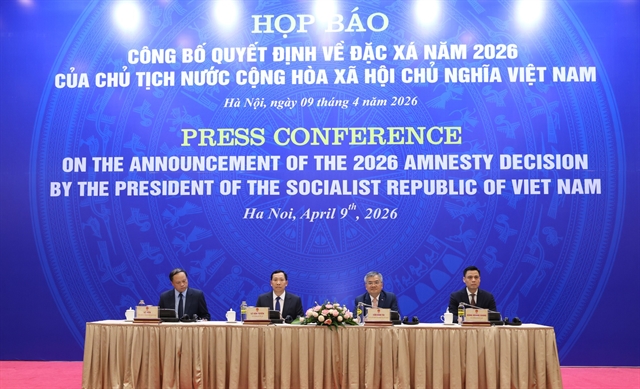 |
| The press conference on the announcement of the 2006 amnesty decision on Thursday in Hà Nội. VNA/VNS Photo |
HÀ NỘI — The President Office, in coordination with the Ministry of Public Security, the Ministry of Foreign Affairs, the Supreme People’s Court and other relevant agencies, on Thursday held a press conference to announce the President’s 2026 amnesty.
Deputy head of the Office Cấn Đình Tài said 2026 marks a pivotal stage of national development, coinciding with major strategic political events, including the success of the 14th National Party Congress, elections to the 16th National Assembly and People’s Councils for the 2026–2031 term, and the 51st anniversary of the Liberation of the South and National Reunification.
Following the Government’s proposal, on April 7 Party General Secretary and President Tô Lâm signed Decision No. 457/QĐ-CTN on the 2026 amnesty.
“This decision carries not only direct legal value but also profound political and social significance, demonstrating the continuation and development of the amnesty policy in line with the requirements of the new period,” Tài said. He emphasised that the approach balances strict enforcement of the law with conditional clemency, ensuring amnesty is applied carefully, to the right subjects, and in ways that maintain discipline, order and social safety.
The President has decided to grant early release on the occasion of the 51st anniversary of the Liberation of the South and National Reunification on April 30, celebrating the success of the 14th National Party Congress and the elections to the National Assembly and People’s Councils. Time served for amnesty consideration is calculated up to May 31.
Eligible beneficiaries include prisoners serving fixed-term sentences, those whose life sentences have been commuted to fixed terms, and those temporarily suspended from serving their sentences. Prisoners must show significant progress, good rehabilitation awareness, and be classified as having good or fairly good compliance with prison regulations.
Specifically, those with commuted life sentences must have at least 18 consecutive quarters of fairly good or higher classification; those serving 15 to 30 years must have at least 16 consecutive quarters; and those serving 10 to 15 years must have at least 14 consecutive quarters. Beneficiaries must also have served at least one-third of their sentence (for fixed-term prisoners) or at least 14 years (for commuted life sentences), fulfilled fines and court fees, and completed restitution, compensation and civil liability obligations, particularly in corruption cases.
The decision excludes 16 categories of individuals from amnesty, including those convicted of treason, activities aimed at overthrowing the people’s administration, espionage, territorial security violations, rebellion, terrorism against the people’s administration, or those with prior amnesties, multiple convictions, or ongoing investigations.
In 2025, more than 22,000 inmates were granted early release, with political security and social order maintained. Most beneficiaries quickly stabilised their lives and reintegrated into the community, earning public support and recognition internationally.
Asked about credit support for former inmates, Senior Lieutenant General Lê Văn Tuyến, deputy minister of Public Security, said nearly 15,000 individuals, including amnesty beneficiaries and former prisoners, have accessed loans totalling nearly VNĐ1.3 trillion (US$49 million) under the Prime Minister’s Decision No. 22/2023/QĐ-TTg to invest in production, business, and life stabilisation.
“In the coming period, the Ministry of Public Security will coordinate with relevant agencies to amend and supplement Decision No. 22/2023/QĐ-TTg to create more favourable conditions and increase credit limits for former inmates,” Tuyến said. VNS
Politics & Law
 Politics & Law
 Politics & Law
 Politics & Law
 Politics & Law
 Politics & Law
 Politics & Law
 Politics & Law
 Politics & Law
 Politics & Law
 Politics & Law
 Politics & Law
 Politics & Law
 Politics & Law
 Politics & Law