 Politics & Law

Viên dives again to popularise swimming passion
1.
|
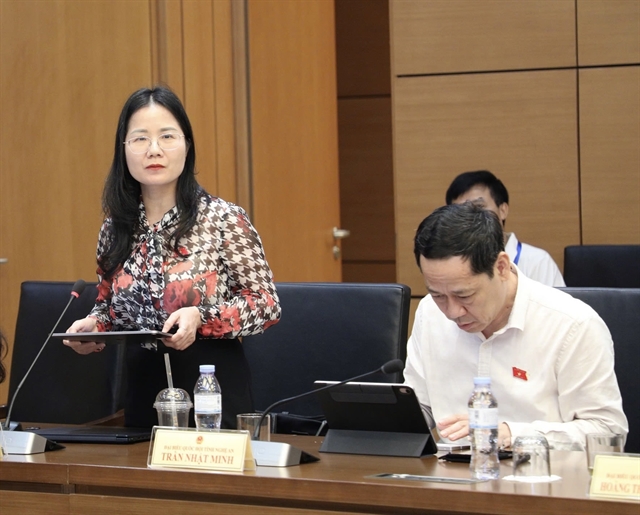
| National Assembly deputy Nguyễn Thị Minh Tú at a group discussion on Friday in Hà Nội. — Photo quochoi.vn |
HÀ NỘI — Việt Nam must invest in the care economy, treating it as a pillar of gender equality and an essential component of social infrastructure.
“It is not enough to simply call for a more equal sharing of household responsibilities. We must invest in care infrastructure, including childcare facilities, elderly care services, support for people with disabilities, social work, psychological counselling and community-based care.”
National Assembly (NA) deputy Nguyễn Thị Minh Tú, of Nghệ An Province, made the remarks on Friday morning during a group discussion in Group 7 on the implementation of national gender equality targets for 2025, held at the first sitting of the 16th National Assembly in Hà Nội.
The deputy also proposed integrating care services into urban planning, new-style rural development programmes, employment policies and social security frameworks.
She further called for the development of a unified, interoperable and reliable national gender data system.
For the 2026–30 period, she recommended setting concrete targets to standardise statistical indicators, assign focal agencies for data collection and ensure data connectivity across sectors such as home affairs, labour and social affairs, health, education, science and statistics.
“Priority should be given to disaggregated data by gender, age, ethnicity, region, disability status and migration status,” she said.
Referring to the Government’s report, which proposes the development of a gender statistics indicator framework, she urged the inclusion of a roadmap for digital technology application and data-sharing platforms to address inconsistencies in data collection across agencies and over time.
She also highlighted the need to strengthen communications and the application of science and technology, with tailored approaches for ethnic communities, including the use of bilingual materials suited to each group.
Gaps in implementation, data systems
Commenting on the overall implementation of gender equality targets in 2025, Tú noted that the Government’s report had comprehensively outlined achievements while also identifying key shortcomings.
These include unmet or insufficiently measured indicators, weak statistical and reporting systems, limited resources and inadequate inspection and enforcement.
The report also pointed to underlying causes such as the lingering impacts of the COVID-19 pandemic, climate change, entrenched gender stereotypes, institutional instability and weak inter-agency coordination.
While agreeing with the assessment, she said the analysis remained largely administrative and had yet to fully capture the real-life challenges faced by women and girls.
She called for a deeper and more substantive evaluation of both limitations and their root causes.
First, she stressed the need to assess substantive progress in achieving targets.
While many indicators under the 2021–25 strategy have reportedly been met or exceeded, some fail to reflect reality due to incomplete data and the lack of measures capturing the quality of policy outcomes.
Second, she urged greater clarity on overlapping inequalities, particularly those at the intersection of gender with ethnicity, geography, disability, migration and poverty.
“While the report references remote and ethnic areas, it should further acknowledge that women’s experiences vary significantly across these dimensions,” she added.
Women from ethnic groups, women with disabilities, migrant women and those working in the informal sector often face compounded or overlapping risks, particularly in accessing decent work, social protection, legal assistance and protection from violence.
Third, she called for a more thorough assessment of shortcomings in the gender data system.
While the report correctly notes that data remain fragmented and that some indicators lack standardised collection mechanisms, she argued that in an era of data-driven policymaking, this is no longer merely a technical issue but an institutional one.
“Without reliable, integrated and up-to-date gender data, it is difficult to implement gender-responsive budgeting, identify priority groups or conduct effective monitoring,” she said.
Calls for greater resources
Also speaking at the session, Cil Bri, a NA deputy from the Central Highlands province of Lâm Đồng’s delegation, said gender equality efforts continue to face significant challenges.
Gender disparities remain evident, particularly in employment, income and participation in leadership and management, while traditional norms and stereotypes persist, especially in remote and ethnic areas, limiting women’s opportunities.
At the grassroots level, policy implementation remains constrained, with insufficient resources and a shortage of dedicated personnel.
Many officials responsible for gender equality work hold concurrent roles, hindering the effective fulfilment of their duties and affecting the quality of policy advice and implementation.
Drawing on experience in the province, she said women in remote and ethnic areas continue to face barriers in accessing employment and social services.
Traditional practices and socio-economic conditions remain obstacles, while issues such as child marriage, consanguineous marriage and limited job opportunities following vocational training remain of concern.
Monitoring, statistical tracking and data aggregation on gender equality have yet to meet management requirements, with fragmented and inconsistent data collection complicating efforts to evaluate progress and design future policy responses.
Therefore, she called on ministries and agencies to allocate adequate resources, taking into account the specific conditions of each locality, particularly ethnic areas, to ensure effective implementation of gender equality targets.
She also urged enhanced technical support through training programmes, specialised capacity-building and the updating of knowledge and skills in gender mainstreaming, with a view to improving both policy advisory work and implementation outcomes. — VNS
Politics & Law
 Politics & Law
 Politics & Law
 Politics & Law
 Politics & Law
 Politics & Law
 Politics & Law
 Politics & Law
 Politics & Law
 Politics & Law
 Politics & Law
 Politics & Law
 Politics & Law
 Politics & Law
 Politics & Law