 Politics & Law

Ping An Digital Bank Completes HKMA’s Second GenA.I. Sandbox Cohort
1.
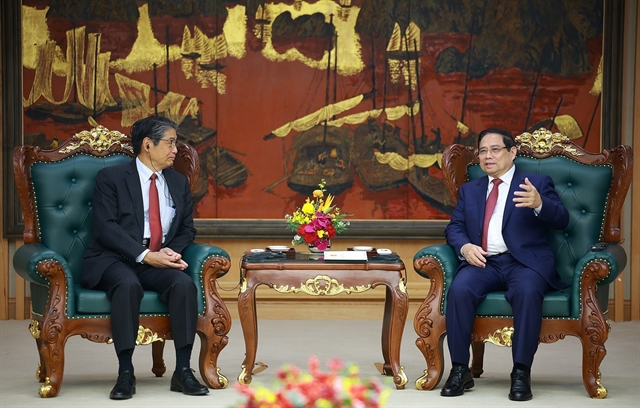 |
| Prime Minister Phạm Minh Chính on Tuesday received Japanese Ambassador to Việt Nam Ito Naoki. VNA/VNS Photo |
HÀ NỘI – Prime Minister Phạm Minh Chính on Tuesday received Japanese Ambassador to Việt Nam Ito Naoki, calling on Japan to support Việt Nam in ensuring energy security amid disruptions to global oil supply chains caused by tensions in the Middle East.
PM Chính thanked the Japanese Government, agencies, organisations and businesses for their support in the construction and development of the Vietnam Space Centre, which was recently inaugurated. He noted with satisfaction that bilateral relations have continued to develop substantively and comprehensively across all fields in the third year since the two countries elevated ties to a Comprehensive Strategic Partnership.
Noting that 2026 is a significant year for both countries as they enter a new phase of development with breakthrough programmes and initiatives, the PM suggested the ambassador further promote political trust between the countries' leaders through high-level exchanges and dialogue mechanisms between ministries and agencies.
He also asked for stronger cooperation in economic, trade, investment, national defence, security, education – training, labour, culture, tourism, locality-to-locality ties, and people-to-people exchanges, as well as closer coordination at multilateral forums. At the same time, he proposed expanding collaboration in emerging areas such as science – technology, innovation, digital transformation, green transition, semiconductors and energy.
Mentioning the increasingly complex security situation in the Middle East, particularly risks affecting shipping routes through the Strait of Hormuz and their potential impact on global oil supply chains, the Vietnamese leader said he had sent a letter to Japanese Prime Minister Takaichi Sanae to call for Japan’s support.
He suggested Japan consider providing Việt Nam with some crude oil from its reserves or allow the Nghi Sơn Refinery to diversify its sources of crude oil supply from other partners. Such measures, he said, will help ensure Việt Nam’s energy security and minimise negative impacts on both countries' businesses participating in the project.
The PM also proposed that the ambassador raise voice to help promote financial and input restructuring at the Nghi Sơn Refinery, as well as facilitate Việt Nam’s access, through appropriate forms, to part of the 80 million barrels of oil that Japan is considering releasing from its reserves to mitigate the impact of Middle East tensions on fuel prices.
In addition, PM Chinh praised Japan’s cooperation in the Block B gas project and the Ô Môn III thermal power plant, while urging Japanese enterprises involved to accelerate progress on the Ô Môn II thermal power plant project to ensure readiness when gas from Block B is exploited as planned.
He also pointed out difficulties in aviation fuel supply and called on Japan, in the spirit of the Comprehensive Strategic Partnership, to create conditions for Việt Nam to purchase aviation fuel from its reserves. He expressed his confidence that through mutual support, the two countries will overcome current challenges and further strengthen their long-standing friendship and cooperation.
For his part, Ito noted that Việt Nam – Japan relations have been developing strongly, with significant contributions by PM Chính both in his current role and previously as President of the Vietnam – Japan Friendship Association.
Agreeing with the PM’s assessment of the Middle East situation's impacts on the world economy, the diplomat said Japan is actively discussing cooperation with Vietnamese agencies, including ways to address Việt Nam’s current energy challenges.
He affirmed that he will report the PM’s proposals to the Japanese Government and relevant authorities, adding that Japan has already decided to release oil reserves and is encouraging other G7 countries to take similar measures to increase global fuel supply.
The ambassador also noted that Japan is actively considering measures to diversify crude oil sources, restructure the Nghi Sơn Refinery, accelerate the Block B – Ô Môn gas project, and support aviation fuel supply. It is also working to arrange financing and address challenges related to LNG-fired thermal power projects in Việt Nam under the Asia Zero Emission Community (AZEC) initiative, thereby contributing to the Southeast Asian nation’s energy security.
Highly valuing Việt Nam’s recent reforms and its development strategy, particularly the goal of achieving double-digit growth, Ito reaffirmed Japan’s commitment to accompanying the country in this process, especially in areas such as science – technology, innovation, digital transformation and green transition.
He added that Japan is promoting a wide range of cooperation activities with Việt Nam, including the Việt Nam – Japan local cooperation forum, economic and business forums, educational collaboration through theViệt Nam – Japan University project, as well as cooperation in labour, tourism and people-to-people exchanges. It is also considering the provision of next-generation official development assistance (ODA) to support infrastructure development in Việt Nam, including metro line systems.
These efforts, he said, will help further deepen the Việt Nam – Japan Comprehensive Strategic Partnership in a more substantive and effective manner. VNA/VNS
Politics & Law
 Politics & Law
 Politics & Law
 Politics & Law
 Politics & Law
 Politics & Law
 Politics & Law
 Politics & Law
 Politics & Law
 Politics & Law
 Politics & Law
 Politics & Law
 Politics & Law
 Politics & Law
 Politics & Law
.jpeg)