 Politics & Law

Việt Nam-EU, Belgium ties poised for new heights
1.
|
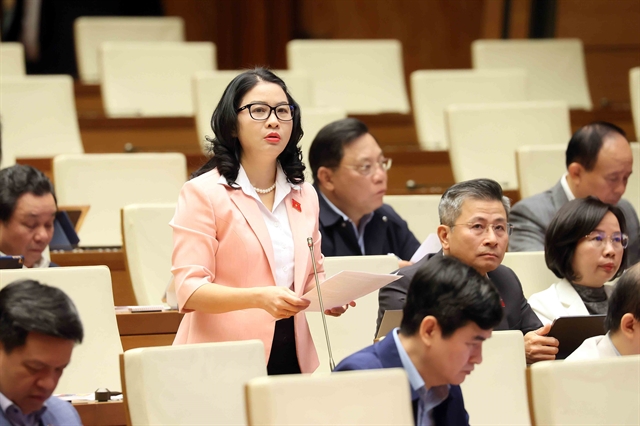
| Deputy Nguyễn Thị Lan, from Hà Nội, gives opinion at the session. — VNA/VNS Photo An Đăng |
HÀ NỘI — The National Assembly (NA) on Monday morning discussed the draft amended Law on Geology and Minerals as well as the draft amended provisions of 15 laws in the fields of agriculture and environment as continuing the 10th session’s agenda.
Commenting on the draft amended Law on Geology and Minerals, many deputies highly agreed with the inclusion of a separate chapter on rare earths.
This is a timely step to perfect the legal framework, fitting the global context of intense competition over strategic materials, renewable energy and high-tech supply chains.
Defining rare earths as a particularly important resource requiring unified national management aligns with the country's long-term development needs.
Deputy Trịnh Thị Tú Anh from Lâm Đồng Province stated that the draft must affirm the principle of managing rare earth resources based on science and strict risk control with environmental requirements at the highest level.
The draft must have mandatory technical safety thresholds include closed-cycle extraction-separation technology, radiation dispersion modelling, continuous monitoring systems and post-exploitation environmental restoration required from the licensing stage.
"Only enterprises with technological capacity, financial strength and international-standard environmental management systems should be allowed to participate," she said.
She also proposed emphasising the independent oversight role of the national radiation and nuclear safety agency across the entire rare earth extraction, separation and processing chain, from technology appraisal and risk assessment to on-site inspections, waste treatment and environmental restoration monitoring.
For rare earths, with long technical cycles requiring technology testing, in-depth environmental assessment and complex processing lines, project preparation often takes from three to five years.
"If priority deadlines are too short, investors may rush projects to retain rights, risking no deep processing development. Thus, I suggest the law allow more flexible principles for rare earths to encourage capable investors, avoiding crude and fragmented exploitation," said Anh.
On this issue, Deputy Nguyễn Tâm Hùng from HCM City suggested considering clear mechanisms for export controls and minimum domestic deep processing ratios to ensure rare earths truly serve national industrial development as a strategic resource, avoiding raw exports and foreign technology dependence in the value chain.
According to Hùng, the draft does not clarify enterprise selection mechanisms for rare earth exploration, exploitation and processing based on technology security, deep processing capacity and environmental management criteria, despite the sensitive nature prone to resource grabs or core technology leaks.
"Therefore, we should consider adding economic-technology security approval processes before technology transfers, deep-processed product exports or international joint ventures, ensuring national resource sovereignty, economic security and rare earth industrial autonomy," he said.
Asserting that rare earth exploration and exploitation is crucial, Deputy Phạm Văn Hòa from Đồng Tháp Province questioned how to exploit and manage it effectively, especially protecting it.
"Other minerals may still be abundant but rare earths are very limited with low reserves. Without tight management and strict protection, it could lead to indiscriminate exploitation, even by locals. Thus, drafting and environmental agencies should focus on good rare earth management with protective policies," said Hòa.
Enhance enforcement controls
Regarding the draft amended provisions of 15 laws in agriculture and environment, Deputy Nguyễn Thị Lan from Hà Nội noted Việt Nam's uneven grassroots veterinary network, inconsistent testing oversight and growing antibiotic-resistant bacteria spillover from livestock to humans.
Lessons from African swine fever and avian flu show strong veterinary systems control diseases better.
Lan proposed the draft emphasise strengthening veterinary capacity, perfecting surveillance, alerts, testing, veterinary drug and antibiotic controls while promoting One Health integration of veterinary-public health-environment.
"This is not just agriculture's task but directly protects public health and boosts national disease response," she said.
Additionally, the draft should set minimum grassroots veterinary capacity requirements and standardise training.
Regardless of organisation, all levels, especially provincial and communal, must have sufficient personnel and tools for early detection and timely handling per World Health Organisation and World Organisation for Animal Health recommendations.
Also, adding principles encouraging domestic sci-tech resources like research institutes, universities and accredited labs for disease surveillance and risk assessment.
At the session, Deputy Hà Sỹ Đồng from Quảng Trị Province recommended unifying legal frameworks with operational mechanisms, procedures with post-control capacity and data management, as delays often stem from fragmented agency data.
"Laws should be perfected with clear articles, responsibilities, criteria and application methods, reducing paperwork but increasing enforcement controls, protecting resources via economic mechanisms over mere administrative measures," said Đồng. — VNS
Politics & Law
 Politics & Law
 Politics & Law
 Politics & Law
 Politics & Law
 Politics & Law
 Politics & Law
 Politics & Law
 Politics & Law
 Politics & Law
 Politics & Law
 Politics & Law
 Politics & Law
 Politics & Law
 Politics & Law