 Politics & Law

Goat meat offers a feast of choice for every diner
1.

|
| State President Lương Cường delivers the opening speech at the Signing Ceremony and the High-Level Conference of the United Nations Convention against Cybercrime (Hanoi Convention) on Saturday. — VNA/VNS Photo |
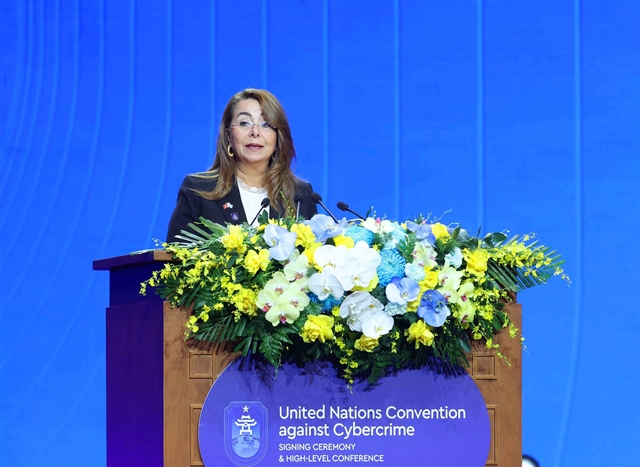
HÀ NỘI — The United Nations Convention against Cybercrime, known as the “Hanoi Convention”, was officially opened for signature in Hà Nội on Saturday, marking a historic milestone in global efforts to establish a framework combating the growing threats in cyberspace.
A commentary by Toronto-based Geopolitical Monitor, titled “UN Cybercrime Pact Hopes to Curb Rise of Transnational Criminal Networks”, underscored the event’s significance. Author James Borton noted that Hà Nội’s selection as the host city was a clear signal of Việt Nam’s rising international standing. Official commentary framed the event as a milestone in Việt Nam’s 48-year partnership with the UN, and a concrete step in its ambition to shape global digital-governance frameworks.
"For Việt Nam, playing host is a prestige-project: a signal of rising diplomatic heft and domestic ambition in digital transformation. But the choice brings high international expectations, placing on Hà Nội the responsibility to lead and promote a global cyberspace that is open and equitable, while maintaining a careful balance with national security requirements," he wrote.
The article also cited the UN as saying that the Hanoi Convention is the world’s first global treaty on cybercrime, establishing a shared legal foundation to accelerate and foster global cooperation in investigating, prosecuting, and preventing online offences. Losses to the global economy from illegal online activity are estimated at around US$8 trillion in 2023, rising to a forecast $10.5 trillion by 2025.
The signing ceremony, co-chaired by UN Secretary-General António Guterres and Vietnamese State President Lương Cường, drew high-ranking officials from about 110 countries, alongside representatives from international organisations, financial institutions, and cybersecurity experts. The treaty won praise for fully embedding human rights safeguards and adhering to international law.
The treaty aims to deliver a multilateral, legal framework for international cooperation: harmonised definitions of cyber-offences, shared investigative tools, electronic evidence transfer, 24/7 contact points. It consists of nine chapters and 71 articles and is being celebrated as the first major crime treaty of its kind in more than two decades.
Once at least 40 nations sign on, the treaty will finally give states a shared playbook to chase criminals who know no borders.
According to the UN Office on Drugs and Crime (UNODC), which led the negotiations, the Hanoi Convention targets a wide spectrum of cybercrimes, from online fraud, ransomware extortion, to illicit data trafficking, and online hate incitement. The treaty also encourages countries to enable legitimate cybersecurity research, fostering technological innovation and the development of secure and sustainable information systems.
The UN expects the Hanoi Convention to establish a transparent and effective mechanism for cross-border cooperation, bolstering trust in data sharing, investigations, and cyber incident response. Experts view the convention as a global framework for cooperation in the digital age, which reflects the global community’s shared resolve to build a safe, trustworthy, and humane cyberspace. — VNA/VNS
Politics & Law
 Politics & Law
 Politics & Law
 Politics & Law
 Politics & Law
 Politics & Law
 Politics & Law
 Politics & Law
 Politics & Law
 Politics & Law
.jpg) Politics & Law
Politics & Law
 Politics & Law
.jpg) Politics & Law
Politics & Law
 Politics & Law
 Politics & Law