 Opinion

Liechtenstein Prime Minister concludes official visit to Việt Nam
1.
|
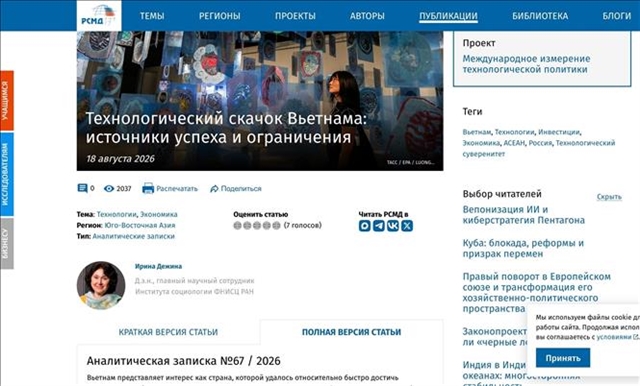
| Russian economist Irina Dezhina’s writing on the website of the Russian International Affairs Council. — VNA/VNS Photo |
MOSCOW — Việt Nam has made significant technological progress thanks to its open-door policy, foreign investment and infrastructure development, according to Russian economist Irina Dezhina in a writing on the website of the Russian International Affairs Council (RIAC) on Tuesday.
Dezhina, a senior researcher at the Institute of Sociology under the Federal Research Center of the Russian Academy of Sciences, noted that Việt Nam ranked 44th among 139 economies in the 2025 Global Innovation Index, ahead of Russia at 60th.
Việt Nam ranked 37th in overall innovation performance, significantly higher than its 50th position in terms of innovation inputs, she said. The country also has well-developed telecommunications infrastructure, with nationwide 5G coverage.
According to the 2025 Digital Nations Index, Việt Nam ranked 10th among 21 Asia-Pacific economies, behind strong players such as Singapore, Australia, Japan, the Republic of Korea, and New Zealand.
Dezhina said the rapid development of Việt Nam’s services sector and knowledge-based industries represents a technological leap driven largely by foreign investment and government policies aimed at developing infrastructure, boosting exports and attracting FDI.
Attracting FDI into projects with strong potential for technology transfer has now become a strategic priority, she noted.
The turning point in Việt Nam’s technological development dates back to the Đổi mới (Renewal) policy launched in 1986, according to Dezhina. She identified four major advantages underpinning the country’s progress: its proximity to major technology manufacturing hubs in Southeast Asia; its strategic location providing access to the Chinese and Indian markets; its reserves of rare earths, which are important for semiconductor production; and its rapid restoration of market-oriented economic mechanisms, facilitating technology-driven structural transformation.
However, Dezhina cautioned that technological progress does not necessarily mean technological self-reliance. While FDI has made a major contribution to GDP growth, technology transfer and management skills to domestic businesses remain limited. Việt Nam continues to focus largely on lower value-added activities and final assembly.
She also noted that science spending has remained low, averaging around 0.42 per cent of GDP over the past seven years. State funding is still allocated largely according to staffing levels rather than competitive mechanisms and research performance, while the country faces a shortage of highly qualified specialists, particularly in high-tech fields.
These shortcomings indicate that Việt Nam has been successful in attracting and absorbing foreign technologies but has yet to develop an ecosystem capable of generating technologies domestically, she said. This presents a key challenge as Việt Nam seeks to move from a manufacturing and assembly base toward a more innovation-driven economy.
Regarding Russia-Việt Nam cooperation, Dezhina said the comprehensive strategic partnership provides a foundation for expanding cooperation in science and technology and human resource training, particularly in engineering. Potential areas include cybersecurity solutions, fintech, public-sector software and nuclear medicine.
She also suggested promoting cooperation between fast-growing Russian mid-sized technology companies and Vietnamese businesses, while establishing bilateral working groups to exchange experience and develop joint projects in science, technology and education.
Dezhina concluded that Việt Nam’s technological leap has been driven by Đổi Mới, international integration, FDI attraction and infrastructure investment. To build greater technological self-reliance, however, the country needs to address bottlenecks in high-quality human resources, science funding, university research capacity, linkages between FDI enterprises and domestic firms, and technology transfer. — VNA/VNS
Opinion
 Opinion
 Opinion
 Opinion
 Opinion
 Opinion
 Opinion
 Opinion
 Opinion
 Opinion
 Opinion
 Opinion
 Opinion
 Opinion
 Opinion