 Opinion
84 individuals investigated for transnational online frauds
1.
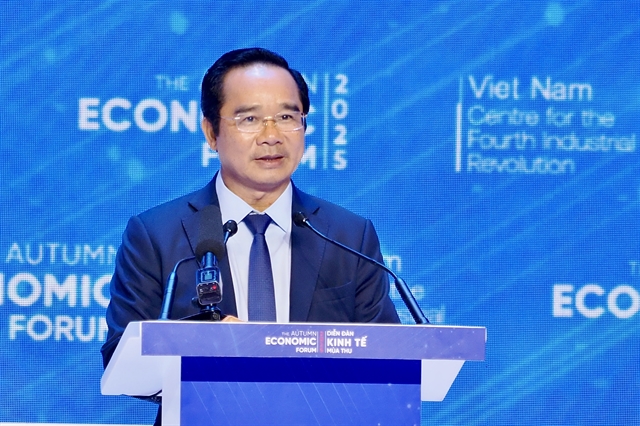 |
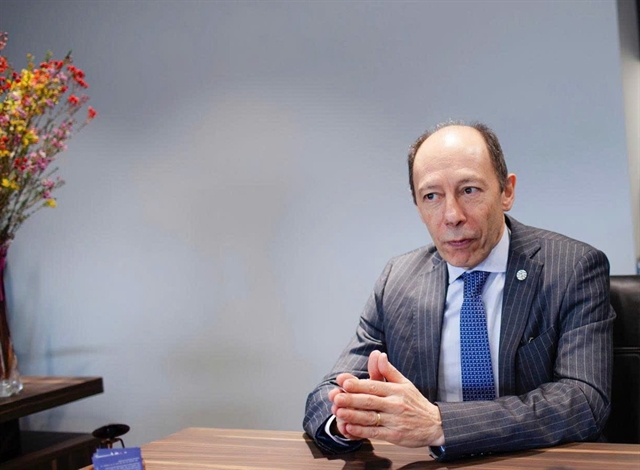
| Nguyễn Văn Được, member of the Party Central Committee, Deputy Secretary of the city's Party Committee, and chairman of the city's People's Committee. — VNA/VNS Photos |
HCM CITY — Accounting for 23.5 per cent of national GDP and nearly one-third of State budget revenue, HCM City closed 2025 with record-breaking results, overcoming major challenges posed by administrative restructuring and the expansion of its development space.
Vietnam News Agency (VNA) spoke to Nguyễn Văn Được, member of the Party Central Committee, deputy secretary of the city’s Party Committee, and chairman of the city’s People's Committee, about the city’s key achievements in 2025 and its development vision for the years ahead.
What were HCM City’s key socio-economic achievements in 2025, particularly after the launch of the two-tier local government model and the merger with Bình Dương and Bà Rịa-Vũng Tàu provinces on July 1?
The year 2025 marked a historic turning point for the city.
It was not only the final year of the 2021-25 socio-economic development plan, but also the year in which the city underwent a major transformation in both development space and governance institutions.
From July 1, 2025, after the two-tier local government model took effect and the merger with Bình Dương and Bà Rịa-Vũng Tàu was completed, the new HCM City officially became a 'super city' spanning more than 6,772sq.km and home to around 14 million people.
Administrative units were streamlined from 441 to 168 at the commune level, while all policies and benefits for civil servants were fully ensured, enabling the new administrative apparatus to operate smoothly and effectively from the outset.
Despite the scale of these changes, the city achieved highly encouraging results, reflected in 12 major highlights.
In terms of economy, GRDP grew by 8.03 per cent, with total GRDP estimated at nearly VNĐ3 quadrillion (US$114 billion), accounting for 23.5 per cent of national GDP.
GRDP per capita reached $8,755, about 1.7 times the national average.
State budget revenue exceeded VNĐ800 trillion ($30.4 billion), nearly one-third of national revenue, surpassing the central target by 19.1 per cent.
Tourism rebounded strongly, generating around VNĐ260 trillion ($9.9 billion) in revenue and welcoming 8.5 million international visitors.
Export turnover reached nearly $95.8 billion, while public investment disbursement is expected to reach 100 per cent of the annual plan by the end of January 2026.
Administrative reform and improvements in the investment climate helped attract approximately $8.2 billion in foreign direct investment, including nearly $2 billion in science, technology and innovation.
Nearly 60,000 new enterprises were established. Importantly, the city resolved or identified solutions for 712 long-delayed projects, uncloging more than VNĐ131 trillion ($5 billion) in investment capital.
Urban infrastructure and digital transformation also recorded clear progress.
Thirty transport projects were completed, major infrastructure works were accelerated, 5G coverage reached 68 per cent citywide, and large data centres were put into operation.
Long-standing urban issues such as flooding, waste treatment and environmental pollution were addressed through more fundamental solutions.
On the institutional front, the National Assembly passed three breakthrough resolutions on the urban railway network, the international financial centre and special development mechanisms for the city. These have created a strong legal foundation for long-term development.
In addition, the city successfully organised major cultural and social events, including the 50th anniversary of the Liberation of the South, ensured social welfare, upgraded healthcare and education systems, strengthened external relations, and maintained political security and social order.
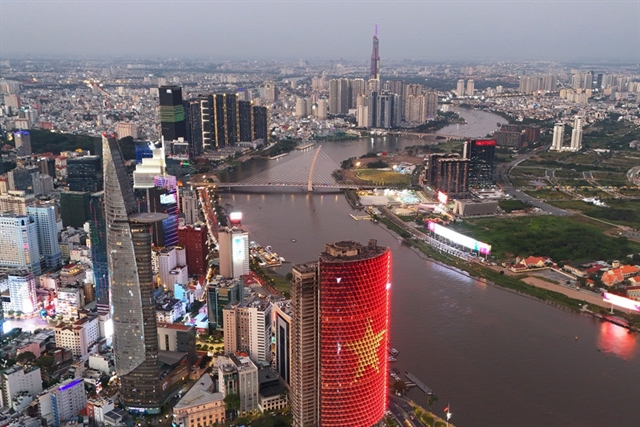 |
| A panoramic view of HCM City, Việt Nam’s largest economic hub, posts strong growth in 2025 and positions itself as an emerging international “super city”. — VNA/VNS Photo Hồng Đạt |
Based on these achievements, what are HCM City’s key socio-economic development targets for 2026?
The year 2026 is a pivotal one, creating momentum for the entire 2026–2030 period. The workload is enormous, and the requirements are extremely high.
The city has chosen the theme for 2026 as: “Perfecting and improving organisational quality – Unlocking institutions – Making breakthroughs in infrastructure – Enhancing the effectiveness of public services.”
Among 26 key targets, we aim for GRDP growth of over 10 per cent and a per-capita GRDP of $9,800.
The economic structure will shift strongly towards modern sectors, with the digital economy accounting for at least 30 per cent of GRDP, total factor productivity contributing around 60 per cent, and labour productivity growing by 7.5 per cent.
To achieve these ambitious goals, the city will focus on six main task groups.
These priorities include successfully organising elections for the 16th National Assembly and People’s Councils at all levels; reinforcing both traditional and new growth engines; streamlining the administrative apparatus for greater efficiency; completing the master plan for the expanded city and fast-tracking strategic infrastructure investment; promoting cultural development and social welfare; and deepening international integration while firmly safeguarding national defence and security.
As HCM City moves into 2026 with ambitious goals, what message do you have for the political system, residents and the business community?
For the political system, 2026 must be a year of decisive action, with continued discipline, stronger decentralisation linked to accountability, and more effective governance.
The city will fully utilise new mechanisms under recent National Assembly resolutions to prioritise strategic infrastructure projects and remove development bottlenecks.
For residents, the city remains committed to placing people at the centre of all policies, improving public services, infrastructure, living conditions and social security.
The prioritisation of land for parks and public cultural spaces reflects our people-centred development orientation.
For the business community, enterprises are seen as both resources and drivers of growth. The city will continue to improve the investment environment and accompany businesses in innovation, digital transformation and green growth.
The year 2026 must mark not only quantitative growth, but also a clear qualitative transformation.
With unity across the political system and broad public consensus, the city is determined to maintain its role as the nation’s economic locomotive and lay a solid foundation for sustainable development in the 2026-30 period. — VNS
Opinion
 Opinion
.jpg) Opinion
Opinion
 Opinion
 Opinion
 Opinion
 Opinion
 Opinion
 Opinion
 Opinion
 Opinion
 Opinion
 Opinion
 Opinion
 Opinion