 Life & Style
Int’l cooperation helps address nuclear power workforce shortages
1.
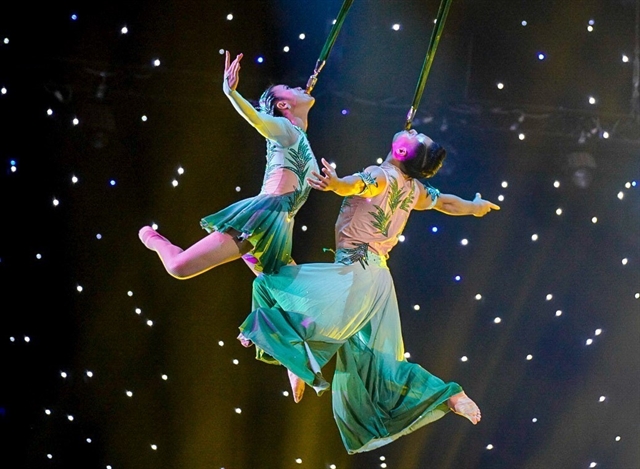 |
| A circus performance by Vietnamese artists. National circus needs changes for better development in the future. —VNA/VNS Photos |
HÀ NỘI — Vietnamese circus has developed strongly in recent years but to become an impressive product in the national cultural industry it still needs a Việt Nam-branded immersive circus complex.
Resolution No 80-NQ/TW sets a target for cultural industries to contribute 7 per cent of GDP by 2030 and 9 per cent by 2045, whereas the current share stands at approximately 4 per cent.
This gap necessitates transforming cultural potential and advantages into tangible products capable of generating revenue, employment, intellectual property, and national competitiveness.
Party General Secretary and State President Tô Lâm has called for mechanisms to develop, commission, and make targeted investments in cultural works and products that possess high artistic quality, broad public appeal, and educational value, while also demonstrating competitiveness and the potential for international reach.
In that context, circus – a highly visual art form that relies little on language, and can cater to the domestic market, tourists, and international exchanges alike – has advantages to receive support to develop stronger and complete its mission.
Creative cultural project
People’s Artist Tống Toàn Thắng, director of the Việt Nam Circus Federation, said a circus performance capable of representing Việt Nam at international festivals, meeting tourism demand and promoting the national image abroad should not be invested in in the same way as ordinary performances.
"A high-quality performance needs to be considered as a creative cultural project. It requires a suitable long-term and flexible mechanism of investment," said Thắng.
He said the unique nature of the circus lies in its elaborate preparation process and stringent safety requirements. Everything – from script research, musical composition, artistic design, and prop fabrication to technical training, stage rehearsals, and performance refinement – demands a significant amount of time. A new technique cannot be mastered overnight but only through a rigorous training process.
As a result, it took from one to two years for artists to introduce a new elite performance to the public.
The constraints of short-term investment cycles, inflexible funding sources and limited preparation time make it difficult for circus artists and performers to develop productions capable of competing internationally.
According to Thắng, funding should not rely solely on the State budget but should also be mobilised from society. A mechanism should be established to attract businesses from the outset, rather than seeking sponsorship only after productions have been completed.
“We should switch our mindset from working on a performing product to producing a long-term cultural product. We must determine where the work will be presented and who the target audience is, as well as the potential for frequent performances, international tours, and development into tourism products, educational resources, or digital content from the beginning," he said.
Extending the lifespan of shows
One problem in the performing industry is that many works are invested in but are staged only a few times before being shelved and the production crew dismissed.
Thắng said the cultural industry requires a new approach. A successful circus performance should be developed into a regular programme capable to serve tourists on site and to be taken on domestic and international tours.
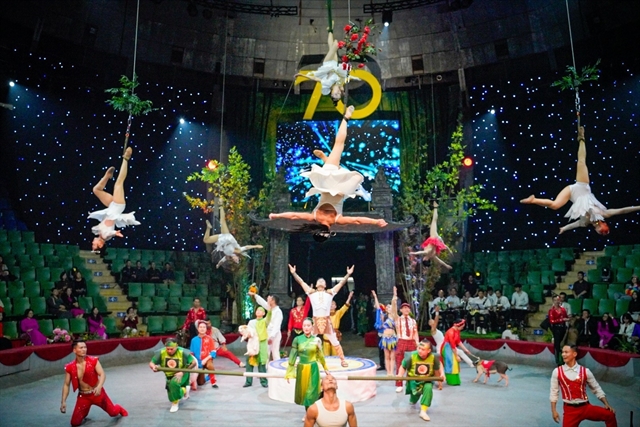 |
| Artists perform in the 70th anniversary of the Việt Nam Circus Federation. |
The performance should serve as a core creative asset that can be developed into digital products for experiential education, documentary films, image and music licensing, souvenirs, and a wide range of other creative products.
Revenue, therefore, should not come solely from ticket sales. The story, characters, music, visual design and other creative elements of the performance can be developed into intellectual property and leveraged across multiple platforms.
This approach not only extends the lifespan of a production but also generates revenue for reinvestment in creativity, improves artists' livelihoods, and gradually reduces reliance on state funding. More importantly, it transforms a theatrical production into a link within the cultural value chain, connecting the arts with tourism, education, media, technology, and commerce.
A regular programme will not only create jobs for performers but also others such as choreographers, musicians, designers, technicians, and media and administrative personnel. When it is linked with the tourism industry, it will help increase the length of stay and spending of tourists, and generate additional value for the transport, accommodation, culinary, and commercial sectors.
Thắng suggested developing an immersive real-scene performance complex with a distinct Vietnamese culture. It would be a regular large-scale performance show that employed modern technology and drew inspiration from history, legends, and national identity.
He said it would be an international-standard programme that told Vietnamese stories in a contemporary performance language, engaging with real-world settings, utilising natural landscapes or heritage sites as expansive stages to create an immersive experience for the audience.
There would be other sidelined activities such as workshops for experiential education, interactive spaces, digital content, international touring, and intellectual property exploitation.
He believed that circus would become a subject of entertainment, culture and tourism, promoting images of Việt Nam widely in the world. — VNS
Life & Style
 Life & Style
 Life & Style
 Life & Style
 Life & Style
 Life & Style
 Life & Style
 Life & Style
 Life & Style
 Life & Style
 Life & Style
 Life & Style
 Life & Style
 Life & Style
 Life & Style