 Life & Style
84 individuals investigated for transnational online frauds
1.
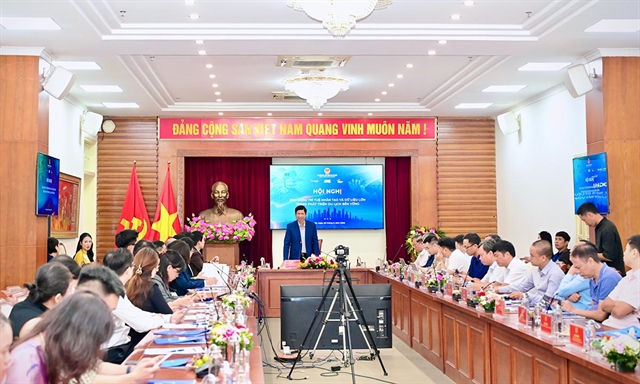
HÀ NỘI — Artificial intelligence (AI) and big data are advancing rapidly worldwide and have become an inevitable trend in tourism development, Deputy Minister of Culture, Sports and Tourism Hồ An Phong said at a recent conference on the application of AI and big data to sustainable tourism.
|
| Deputy Minister of Culture, Sports and Tourism Hồ An Phong speaks at the conference. — Photo courtesy of Vietnam National Authority of Tourism |
The conference was organised by the Vietnam National Authority of Tourism (VNAT) in collaboration with the Vietnam Multimedia Corporation (VTC). It was attended by leaders and representatives of tourism management agencies and leading businesses in the travel, hospitality and aviation sectors.
Opening the event, Phong noted that the adoption of AI and big data should be approached comprehensively, with the involvement of multiple stakeholders.
The State plays a central role in policymaking, governance and strategic direction, while businesses lead innovation and technology adoption, supported by the active participation of local communities, destinations and society as a whole.
He therefore called for a shared vision and coordinated action to accelerate the application of AI and big data across Việt Nam’s tourism ecosystem.
Phong said Việt Nam’s tourism industry was entering an important phase of development. According to a report by UN Tourism, Việt Nam and Japan were among the countries recording impressive tourism growth of more than 20 per cent in 2025, well above the global growth rate of 4 per cent and the 8 per cent recorded in the Asia-Pacific region.
With more than 21 million international arrivals in 2025, Việt Nam exceeded its pre-pandemic international visitor level. In 2026, the tourism sector aims to welcome 25 million international visitors and serve 150 million domestic tourists.
In this process, science and technology, AI and digital data are becoming direct drivers of tourism development. Tourism business and marketing models are also shifting rapidly from B2B, or business-to-business, to B2C, or business-to-consumer, as travellers increasingly take the initiative in searching for, selecting and directly booking tourism products, services and destinations on digital platforms.
The development of AI will further accelerate this trend, while also highlighting the need to improve regulations on intellectual property, copyright and the rights of authors and other parties concerned.
However, Phong stressed that despite the increasingly prominent role of technology, tourism remained an activity deeply rooted in culture and human interaction.
Technology can boost productivity, enhance convenience and replace people in certain tasks, but it cannot fully replace experiences centred on culture, people, nature, cuisine and the unique identity of destinations. These are precisely the elements that give Vietnamese tourism its distinctive appeal.
|
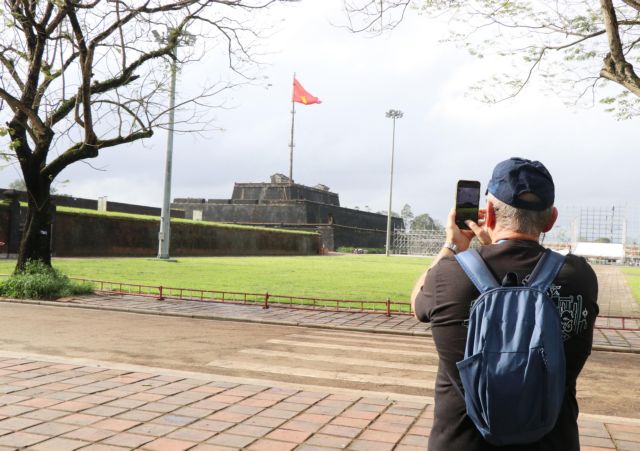
| A tourist take photos of the Flag Tower in the Imperial City of Huế. — VNA/VNS Photo |
Speaking at the conference, Phạm Văn Thủy, Deputy Director General of the VNAT, said the event was particularly timely as Việt Nam’s tourism sector accelerated its transition towards a data- and AI-driven governance model, in line with Politburo Resolution No 57 on breakthroughs in the development of science, technology, innovation and national digital transformation.
Thủy said the tourism data ecosystem would be developed under a “1+1+34+N” model.
Under the model, the Ministry of Culture, Sports and Tourism will be responsible for developing the institutional framework, standards and platforms, as well as coordinating data. The Ministry of Public Security will coordinate the connection of relevant databases, while the 34 provinces and centrally run cities will develop, update and use local data. Other ministries, sectors and businesses will connect to, enrich and use the data.
In addition, the VNAT has developed the Vietnam Travel app, which integrates a range of useful features and will continue to incorporate AI to enhance the visitor experience.
“In the digital era, shifting tourism promotion towards a data- and AI-driven model is essential to improving promotional effectiveness and enhancing the competitiveness of the national tourism brand,” he said.
He called on the tourism sector to build a promotional ecosystem based on the principles of “Shared data, AI support, connected platforms, business partnerships and tourists at the centre”, shifting from the promotion of individual destinations to the creation of journeys that deliver meaningful experiences and value.

|
| Việt Nam welcomed more than 21 million international arrivals in 2025. — VNA/VNS Photo |
Also speaking at the conference, Phi Tiến Đại, a customer strategy specialist at Google, stressed that Việt Nam's tourism sector should leverage AI to target the right markets, shifting its focus towards high-value potential travellers to increase visitor spending and length of stay, rather than competing on low-cost tourism.
Data on tourists’ search trends and behaviour in the first half of 2026 revealed that Việt Nam ranked third worldwide in Google searches for package tours, up 22 per cent year-on-year, while searches from international travellers rose 20 per cent.
Demand for high-end tourism products increased by 38 per cent, significantly outpacing overall growth in tourism-related searches.
Experts noted that users are increasingly submitting longer, more specific queries and treating search engines as “assistants” for travel advice. Therefore, integrating digital platforms, AI and short-form videos will enable businesses to engage with travellers more effectively throughout their journey.
They highlighted the importance of connecting and sharing unified data systems to support management, market forecasting and the personalisation of tourist experiences.
Tourism development, they said, should focus on quality, visitor spending, length of stay, satisfaction and contributions to local communities, rather than simply visitor numbers.
Deputy Minister Hồ An Phong acknowledged the contributions and underscored the importance of applying AI and big data. He called for a decisive shift from awareness to practical action in technology adoption, with concrete products developed and clear responsibilities assigned to each stakeholder.
Going forward, the tourism sector should strengthen cooperation among management agencies, technology companies and local communities.
In particular, as Việt Nam prepares to host APEC 2027 in Phú Quốc, the sector should step up the application of technology to promote Việt Nam's tourism image more strongly to the world, he added. — VNS
Life & Style
 Life & Style
 Life & Style
 Life & Style
 Life & Style
 Life & Style
 Life & Style
 Life & Style
 Life & Style
 Life & Style
 Life & Style
 Life & Style
 Life & Style
 Life & Style
 Life & Style