 Life & Style
Vietnamese Prime Minister meets Cambodian National Assembly President
1.
|
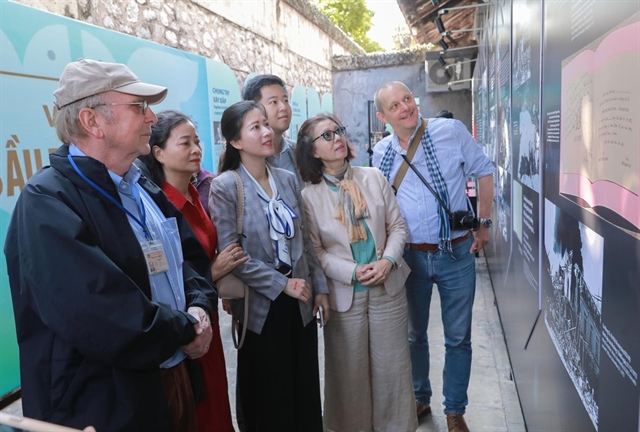
| Visitors explore the Hỏa Lò Prison Relic Site in Hà Nội. — VNA/VNS Photo Thanh Tùng |
HÀ NỘI — During the recent Reunification Day and May Day holiday, museums across Việt Nam emerged as crowd-pullers alongside beaches and entertainment destinations.
From Hà Nội to HCM City, thousands of visitors flocked to historical and cultural institutions to revisit key moments of national history through artefacts, thematic exhibitions and interactive activities.
The scenes reflected a renewed public interest in museums at a time when Việt Nam is implementing Resolution No. 80-NQ/TW, issued by the Politburo on January 7, 2026, which identifies culture as an endogenous strength and a driving force for sustainable national development.
According to the Hà Nội Department of Tourism, the Hỏa Lò Prison Relic welcomed around 36,000 visitors between April 25 and May 2. On May 1 alone, nearly 10,000 people visited the site.
From early morning, visitors lined up along Hỏa Lò Street waiting to enter. Inside, many paused quietly in front of prison cells once used to detain revolutionary soldiers, listening to stories about resistance fighters and paying tribute to those who sacrificed for the nation.
“I had learned about these events in school, but visiting the site made history feel much more real,” said Nguyễn Minh Anh, a high school student from Hà Nội.
|
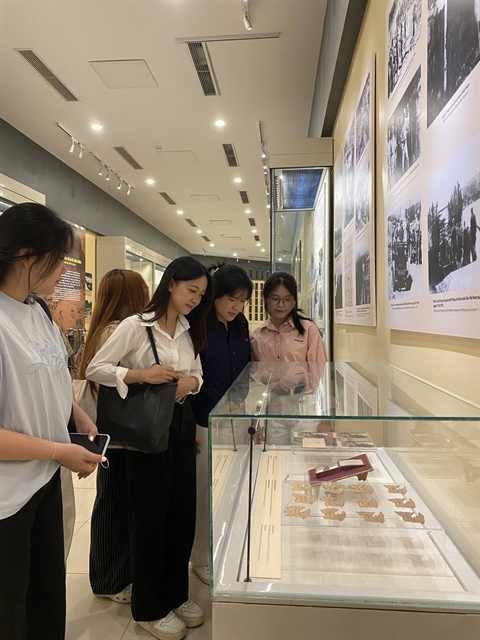
| Young visitors learn about the “Điện Biên Phủ Soldier” badge at the National Museum of History. Photos courtesy of the National Museum of History |
Similar scenes unfolded at the National Museum of History, where exhibitions related to the country’s resistance wars attracted large crowds.
Among the most discussed artefacts was the tiny 'Điện Biên Phủ Soldier' badge proposed by General Võ Nguyên Giáp before the historic campaign had even ended. Another emotional exhibit was a 1965 volunteer application signed in blood by 29 southern students asking to return to the battlefield.
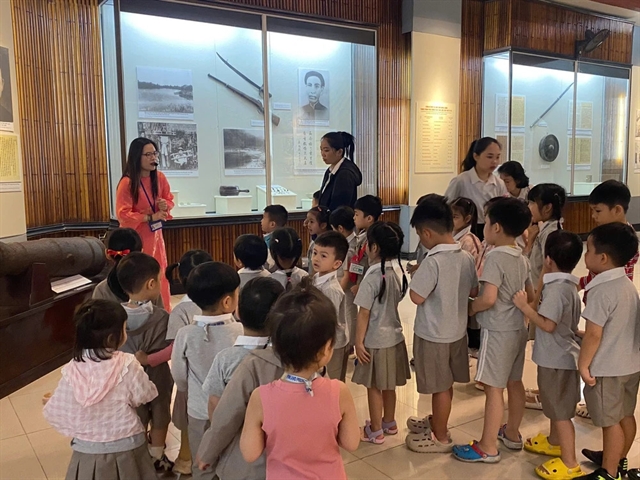
Beyond conventional displays, the museum also launched educational programmes for younger audiences. Its experiential programme Reunifying the Nation attracted nearly 3,000 students through online tours, thematic exchanges and English-language history lessons.
“I liked that history was presented through discussions and interactive activities instead of only long texts,” said secondary school student Trần Gia Hân.
|
| Students from the Finnish International School (FIS) Minh Khai campus visit the National Museum of History as part of an educational programme. |
In HCM City, the War Remnants Museum stood out as one of the busiest museums during the holiday, receiving more than 10,000 visitors each day.
“I’ve visited many museums around the world, but this one was especially powerful emotionally,” said Michael Turner, a tourist from Australia.
“It tells human stories, not just military history.”
Claire Dubois, a visitor from France, said Vietnamese museums were becoming increasingly accessible to international audiences through audio guides and digital technology.
“The exhibitions are much more engaging than I expected,” she said.
“You can understand both the suffering of war and the resilience of Vietnamese people.”
Elsewhere in Hà Nội, the Vietnam Military History Museum has attracted visitors with large-scale exhibits, 3D mapping technology and immersive audio-visual experiences recreating memories of the Điện Biên Phủ campaign.
Meanwhile, the Hà Nội Museum organised talks and exhibitions built around wartime letters and personal memories, offering visitors a more intimate perspective on history.
Together, these developments suggest that museums in Việt Nam are gradually moving beyond their traditional role as places that simply preserve artefacts. Increasingly, they are becoming open cultural spaces connected to contemporary life and capable of teaching history in more engaging ways.
The need for change
Museum development in Việt Nam has gone through different stages over the past century.
Before 1945, some of the country’s earliest museums were established under French colonial rule, including institutions that later became the National Museum of History and the HCM City Museum of History.
After 1945, museums took on a new role centred on preserving national memory and educating the public about patriotism and revolutionary history.
For decades, this model played an important role in society. However, as audiences gained access to more forms of entertainment and information, traditional museum approaches gradually revealed their limitations.
“In many cases, museum storytelling and exhibition design no longer matched the expectations of modern audiences,” said Associate Professor Nguyễn Văn Huy.
According to Huy, many museums relied too heavily on chronological displays resembling history textbooks, while exhibitions often lacked emotional highlights or interactive experiences.
The COVID-19 pandemic later became an important turning point. As in-person visits were disrupted, museums began experimenting with online exhibitions, virtual tours and digital storytelling on social media platforms.
What started as temporary solutions gradually showed long-term potential, helping museums reach younger audiences and expand public interaction.
Museums in a new cultural strategy
|
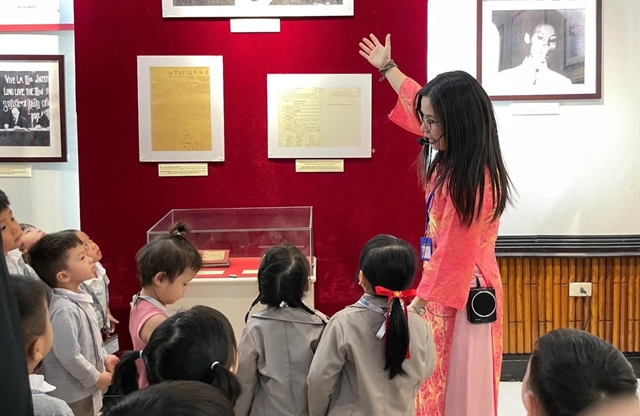
| Younger generations are expected to play an important role in shaping the future of museums in Việt Nam. |
The renewed development of museums aligns closely with Resolution No. 80-NQ/TW, which calls for the creation of 'digital cultural institutions', 'open museums' and modern cultural infrastructure meeting regional and international standards.
In this context, museums are increasingly seen not only as places preserving the past, but also as living cultural spaces where history, education and technology intersect.
“Museums today are no longer spaces where people simply walk quietly past glass cabinets,” said university student Lê Hoàng Nam after visiting the Vietnam Military History Museum.
"They are becoming places where younger generations can truly connect with history.”
The long queues seen outside museums during the recent holiday may signal more than a seasonal trend. They suggest that when history is told in vivid, accessible and emotionally resonant ways, museums can once again become meaningful public spaces in contemporary Vietnamese life. — VNS
Museums worth visiting in Hà Nội and HCM City
Hà Nội:
Address: 1 Hỏa Lò Street, Hoàn Kiếm District
Tel: (+84) 825 112 668
Opening hours: 8am–5pm daily
Highlights: A former colonial-era prison turned historical site, featuring exhibitions on revolutionary prisoners, wartime history and immersive night tours.
Address: 1 Tràng Tiền Street, Hoàn Kiếm District
Tel: (+84) 24 3825 7753
Opening hours: 8am–12pm and 1.30pm–5pm, Tuesday to Sunday
Highlights: Home to valuable artefacts spanning Việt Nam’s history from prehistoric times to the modern era, with regular thematic exhibitions and educational programmes for students.
Address: Km6+500 Thăng Long Boulevard, Nam Từ Liêm District
Tel: (+84) 24 6253 1367
Opening hours: 8am–4.30pm, Tuesday to Sunday
Highlights: One of the country’s largest military museums, featuring tanks, aircraft, large-scale artefacts and modern 3D mapping exhibitions recreating major battles in Vietnamese history.
Address: Nguyễn Văn Huyên Street, Cầu Giấy District
Tel: (+84) 24 3756 2193
Opening hours: 8.30am–5.30pm, Tuesday to Sunday
Highlights: A popular cultural museum showcasing the traditions, architecture and daily life of Việt Nam’s 54 ethnic groups through both indoor exhibitions and outdoor heritage spaces.
HCM City:
Address: 28 Võ Văn Tần Street, District 3
Tel: (+84) 28 3930 5587
Opening hours: 7.30am–5.30pm daily
Highlights: One of Việt Nam’s most visited museums, known for its powerful exhibitions documenting the impact of war through photographs, military equipment and eyewitness accounts.
Address: 97A Phó Đức Chính Street, District 1
Tel: (+84) 28 3821 6331
Opening hours: 8am–5pm daily
Highlights: Housed in a French colonial-era mansion, the museum features collections of Vietnamese modern and contemporary art alongside rotating exhibitions.
Address: 2 Nguyễn Bỉnh Khiêm Street, District 1
Tel: (+84) 28 3829 8146
Opening hours: 8am–11.30am and 1.30pm–5pm daily
Highlights: Offers visitors an overview of Vietnamese history from prehistoric times to the Nguyễn Dynasty through extensive artefact collections and cultural exhibitions.
Life & Style
 Life & Style
 Life & Style
 Life & Style
 Life & Style
 Life & Style
 Life & Style
 Life & Style
 Life & Style
 Life & Style
 Life & Style
 Life & Style
 Life & Style
 Life & Style
 Life & Style