 Life & Style

Vietnamese Prime Minister meets Cambodian National Assembly President
1.
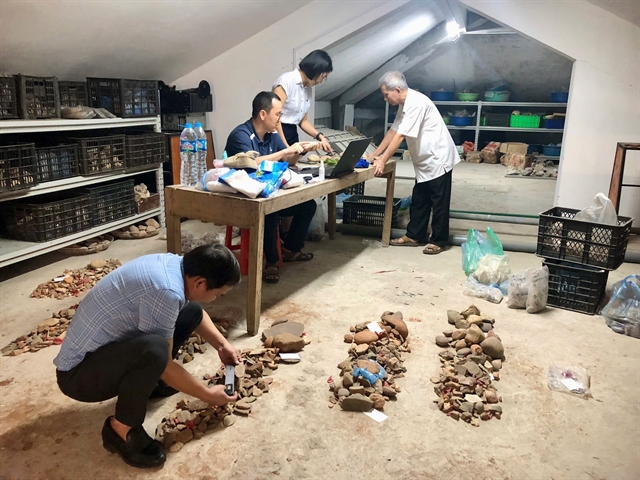 |
| Archeologists work on the artifacts collected from Ngòi Nhu excavation site in Lào Cai Province. — Photos from FaceBook page of Lào Cai provincial museum |
LÀO CAI — Initial archaeological analysis has proved Ngòi Nhù, a newly excavated site in the northern mountain province of Lào Cai, dates back around 4,000–3,500 years.
Excavations conducted from November 5 to December 25, 2025, indicate that Ngòi Nhù is a settlement site of considerable scale with a relatively clear stratigraphic structure, playing an important role in archaeological research.
Lào Cai’s Department of Culture, Sports and Tourism this week held a conference at the provincial museum to announce the analysis results from the Ngòi Nhù site located in Bảo Thắng Commune.
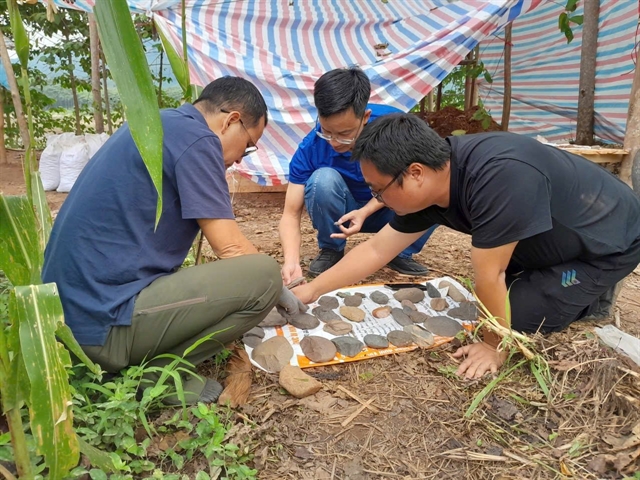 |
| Scientists discuss the artefacts found at the excavation site. |
The conference attracted the attention of scientists, experts and representatives from relevant authorities, including the Department of Cultural Heritage under the Ministry of Culture, Sports and Tourism, the provincial Party Committee, the provincial Department of Culture, Sports and Tourism, the University of Social Sciences and Humanities and the Lào Cai Historical Science Association.
Experts noted that a key highlight of the excavation is the application of an interdisciplinary approach alongside international cooperation.
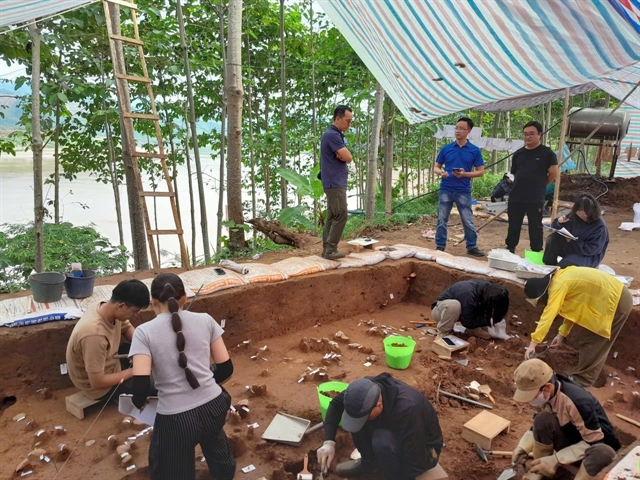 |
| Archaeological studies are carried out at the Ngòi Nhù excavation site. |
The University of Social Sciences and Humanities played the leading role, coordinating with the Institute of Archaeology and the Lào Cai Provincial Museum. It also involved participation and professional exchanges with Wuhan University in China.
Experts said the model has helped establish effective links between theoretical research, training, field excavation and heritage management, while also enabling initial access to modern analytical methods such as absolute dating, palaeoenvironmental studies and geomorphology.
Successive cultural layers discovered at the site suggest that settlement was not discontinuous but instead showed inheritance, continuity and relative stability, pointing to the existence of organised communities with strong adaptive capacity in the local ecological environment.
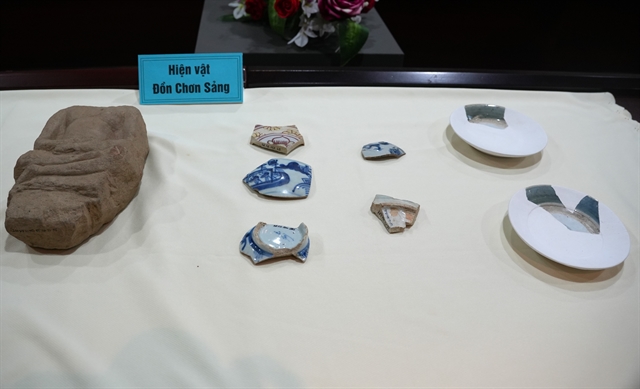
Artefacts collected at the site, including stone tools, pottery fragments and traces of hearths and living spaces, provide important evidence for early identification of prehistoric livelihoods.
Notably, the coexistence of technological elements characteristic of the post-Neolithic period alongside signs of transition to the early Metal Age reflects a continuous process of internal cultural transformation.
Based on initial analysis, the Ngòi Nhù site is estimated to date back approximately 4,000 to 3,500 years.
Scientists said this represents a pivotal period in the development of prehistoric society, marked by significant shifts in technology, economy and social organisation.
Located at the boundary between former Phố Lu Town in Sơn Hà Commune, former Bảo Thắng District and Cam Cọn Commune, former Bảo Yên District, the Ngòi Nhù excavation site lies at approximately 22.279713° North latitude and 104.223057° East longitude at an elevation of around 62 to 65 metres above sea level.
The site is situated close to the banks of the Hồng (Red) River and Nhù Stream and is therefore heavily influenced by the hydrological dynamics of these waterways.
The excavation at Ngòi Nhù not only aims to supplement existing documentation but also marks a shift in archaeological research in the upper Red River region towards a more systematic, controlled and interdisciplinary approach.
Establishing the age and cultural characteristics of the site is therefore significant not only for Lào Cai Province but also for contributing data to research on the pre- and early history of the Red River basin and northern Việt Nam.
The conference heard that precise dating results will continue to be verified through further in-depth analysis.
Experts also believe Ngòi Nhù is one of the important sites for studying the development pathways of the Hoà Bình culture and the Metal Age in the north-western region.
However, they warned that the site is experiencing impacts that threaten the integrity of its cultural layers, meaning a protection plan must be developed promptly to safeguard the relic.
They also recommended continued review and planning for other heritage sites alongside specific measures to preserve and promote the historical and cultural values of sites across the province, experts said. — VNS
Life & Style
 Life & Style
 Life & Style
 Life & Style
 Life & Style
 Life & Style
 Life & Style
 Life & Style
 Life & Style
 Life & Style
 Life & Style
 Life & Style
 Life & Style
 Life & Style
 Life & Style