 Life & Style
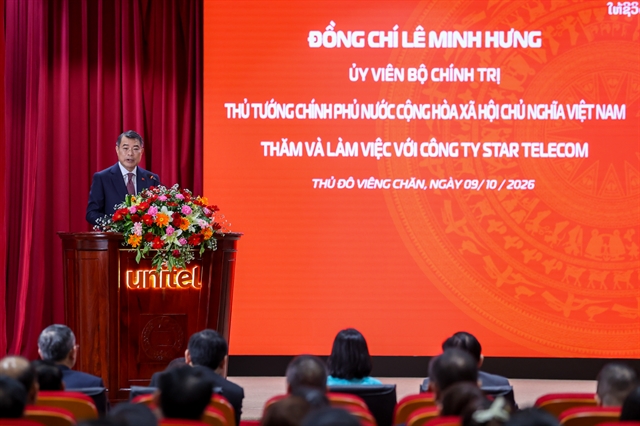
Viettel’s Unitel in Laos a symbol of Việt Nam-Laos friendship: Prime Minister
1.
 |
| Nguyễn Diệu Linh, founder of CHOI Workshop. Photo Linhuk.com |
After more than five years in operation, CHOI Workshop has gained increasing recognition, expanded in scale and generated a positive impact on the community. In recognition of these efforts, founder Nguyễn Diệu Linh has been named one of 12 finalists for the UK Alumni Awards 2026 in Việt Nam.
Linh spoke to media about CHOI Workshop, which has made a strong mark through art-based education programmes, cultural heritage projects and community-driven initiatives.
What led you, with a master's degree in climate change and development, to become a practitioner of creative education integrating culture and the arts?
Indeed, I had never imagined I would pursue anything related to the arts. I was originally a biology student at Việt Nam National University Hà Nội's University of Science. When I went to the UK for my master's degree at University of Sussex, I shifted to studying climate change.
After returning to Việt Nam, I initially worked on several projects with the World Bank in Việt Nam and the Ministry of Industry and Trade. However, I knew clearly that my true interest lay in education.
In 2020, I began researching a model for a creative space where parents and children can learn together through play, exploring mathematics as well as the history and cultures of Việt Nam’s ethnic groups.
That aspiration stemmed from my own experience as a mother. After having a child, I wished that every child could grow up in an environment where both parents are actively involved. I wanted to create something that could help families bond emotionally where they can play, learn and spend as much time together as possible.
What difficulties did you encounter when you founded CHOI Workshop?
Unfortunately, the initial model proved difficult to make accessible to the wider community, possibly due to the complexity of the subject matter, which made it challenging for many parents to fully engage alongside their children.
We continued refining the model to develop offerings better suited to societal needs. Drawing on experiences from the country where I studied, my team and I developed the idea of designing workshops that use art as a medium to convey cultural knowledge and raise environmental awareness.
These include activities like making lion dance heads for children during festive seasons, or recycling old clothes into teddy bears.
Through art, we aim to enable parents and children to keep learning through play, while also gaining awareness of environmental protection and developing emotional management skills.
Our workshops have helped parents better understand their children’s aptitudes and ways of thinking, supporting early guidance in shaping their future career paths.
It seems you have been quite forward-looking in tapping into the trend of interdisciplinary workshops that combine education with culture, the arts and environmental awareness. Can you tell us about that?
Five years ago, when we first launched CHOI Workshop, we were probably among the pioneers in pursuing this model. Today, such workshop formats have become quite common in major cities.
Our ability to tap into this trend stems from my background in education and my exposure to a wide range of professional environments. As the economy develops, people naturally place greater emphasis on cultural values as well.
How do you approach revenue generation from this model? What is the profitability of a creative workshop?
Although we were early movers in this field, in reality our workshop model has so far only managed to break even rather than generate profit.
In the early stages, we even had to cover additional costs ourselves, as significant investment was needed for research and the design of creative, engaging workshop formats.
CHOI Workshop is privately run. Personally, I want my work to go beyond making money. It has to be meaningful and contribute something of value to the community.
After five years, our model has achieved a certain level of community outreach, engaging participants across age groups, from children to adults.
We have been commissioned to design workshops for major domestic enterprises, with some programmes attracting thousands of participants, organised in successive groups throughout the day.
What will you do to keep CHOI Workshop stable and avoid being just a passing fad?
That’s exactly why I want CHOI Workshop to evolve in a more refined and thoughtful direction, so it can be sustained over the long term.
At present, we ourselves are not fully satisfied with the depth of knowledge we are able to deliver to our participants, especially children.
For instance, gaining a comprehensive understanding of environmental protection goes far beyond simply recycling used materials into creative or aesthetically pleasing items.
Not everything that is recycled necessarily contributes to environmental protection. We recognise the need to invest further in research and development to strengthen our core content and make our workshops more sophisticated.
We aim to introduce workshops that use art as a means to develop children’s emotional intelligence and resilience, which is the ability to face challenges without fear. This is a relatively new trend right now.
At CHOI Workshop, we have witnessed parents bringing their children to different workshops every week. One mother shared that she wanted to create as many memories as possible with her child. From being a very shy girl, her daughter has become someone who now enjoys and actively engages in conversations, opening up to her mother and to others.
CHOI Workshop has recently partnered with CA’ Library, a community library system offering free access to books on culture, the arts and architecture, to develop a new creative space model. What are your expectations for the future of this collaboration between two largely non-profit initiatives?
We aim to come together and build a stronger community centred on art, architecture and education. As I mention above, profit is not and has never been my primary motivation in this work.
I was inspired to contribute to the community by Hiệp Nguyễn, the founder of CA’ Library. Over the past 12 years, he has established eight free community libraries in Hà Nội and Đà Lạt specialising in architecture, art and cultural publications.
His dedication has motivated me to work with him to transform these libraries into more vibrant creative spaces.
We share the ambition of building an ecosystem that supports mutual growth, rather than prioritising fundraising. We want to remain proactive and pursue this path in our own way. — VNS
Life & Style
 Life & Style
 Life & Style
 Life & Style
 Life & Style
 Life & Style
 Life & Style
 Life & Style
 Life & Style
 Life & Style
 Life & Style
 Life & Style
 Life & Style
 Life & Style
 Life & Style