 Life & Style
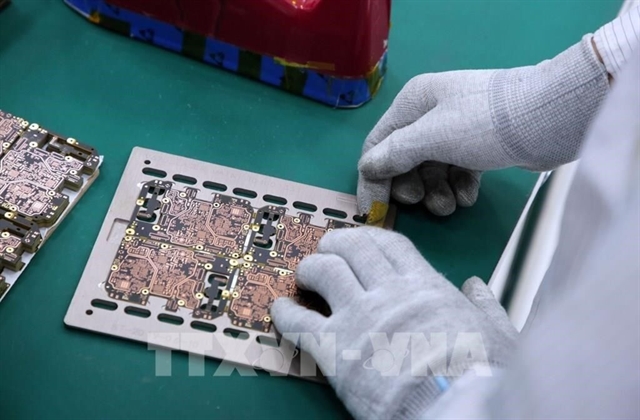
Việt Nam’s growing role in Asia-Pacific semiconductor supply chains boosts need for reliable logistics
1.
 |
| 'Nhà thờ tổ họ Trần làng Cựu' (The Ancestral House of the Trần Family in Cựu Village), watercolour, 40x60cm, by painter Phạm Thanh Sơn. |
HÀ NỘI — Nestled quietly in Chuyên Mỹ Commune, Hà Nội, the centuries-old Cựu Village will soon become the stage for an evocative art exhibition titled Cựu Village: Then and Now.
Taking place from November 14 to 24, 2025, the event features a group of devoted painters who share a profound affection for this heritage site - an architectural gem shaped by both Vietnamese and French influences.
The exhibition showcases 40 pieces in oil, lacquer, and watercolours by talented artists Đàm Chí, Phạm Thanh Sơn, Lê Kim Dung, Trần Kim Oanh, and Bùi Kim Nga.
Their creations, rich in colour and emotion, preserve the tranquil beauty of the ancient village while infusing it with a fresh, contemporary breath.
 |
| 'Nhà cầu nối làng Cựu' (The Connecting House of Cựu Village), oil on canvas, 80x100cm, by painter Đàm Chí. |
Among the artists, Đàm Chí holds a particularly special bond with the place – he is the village’s son-in-law. Moved by the poetic stillness of Cựu and deeply connected to his wife’s homeland, he has long painted its moss-covered gates and timeworn alleys.
His affection for the village also inspired his fellow artists to visit, explore and rediscover its cultural essence through their own brushes.
According to the organisers, the exhibition celebrates not just beauty but the spirit of Cựu Village, where tradition and modernity coexist in delicate harmony. The artists spent days living among the villagers, strolling through quiet lanes, observing the rhythm of daily life and absorbing the hues of time that linger on every wall and rooftop.
Unlike many other ancient villages that bustle with tourists, Cựu Village remains a place of calm and silence, inhabited mostly by the elderly and children. Narrow lanes wind between grand but fading French villas, their gates closed, their facades softened by layers of moss. The stillness feels almost sacred - an echo of a once-prosperous past.
 |
| 'Nhà cổ làng Cựu' (An Ancient House in Cựu Village), watercolour, 38x56cm, by painter Lê Kim Dung. |
Painter Đàm Chí recalls how this serenity conceals a remarkable history.
“Cựu was once famed as a tailoring village,” he said.
“During the French colonial period, local craftsmen - known as the finest tailors in Hà Nội - grew wealthy and built magnificent villas that became symbols of rural prosperity in northern Việt Nam.”
Over time, as families moved away in search of new livelihoods, many of those elegant homes were left abandoned, their grandeur slowly fading under the weight of time.
His visit to the village stirred a poignant question: What will remain when these ancient gates and mossy walls finally disappear?
That question became the seed for this exhibition.
Determined to preserve what could soon be lost, Đàm Chí invited four fellow artists to join him in capturing Cựu Village’s enduring spirit - each through their own artistic lens.
“What remains after time passes is culture,” he said.
“Culture carries within it the traces of history – it mirrors life, spirit, and the values of society.”
 |
| 'Đường làng Cựu' (Cựu Village Alley), watercolour, 38x56cm, by painter Trần Kim Oanh. |
For painter Phạm Thanh Sơn, heritage offers both inspiration and challenge.
“The legacies of nature and our ancestors are invaluable and must be preserved,” Sơn said.
“For us artists, these heritages are raw materials for creation. The challenge lies in breathing new life into them, infusing modern thought without losing their original essence.
"While embracing the contemporary, we must remain true to our own artistic identities.”
 |
| 'Bóng thời gian' (The Shadow of Time), watercolour, 38x56cm, by painter Bùi Kim Nga. |
Through Cựu Village: Then and Now, the group hopes to awaken public appreciation for the village’s cultural heritage, not as static relics of the past, but as living, evolving expressions of Vietnamese identity.
Each painting, they believe, is both a tribute and a call to safeguard the quiet beauty of Cựu for generations to come. — VNS
Life & Style
 Life & Style
 Life & Style
 Life & Style
 Life & Style
 Life & Style
 Life & Style
 Life & Style
 Life & Style
 Life & Style
 Life & Style
 Life & Style
 Life & Style
 Life & Style
 Life & Style