 Economy


Liechtenstein PM’s Việt Nam visit expected to provide fresh impetus for bilateral ties: Ambassador
1.
|
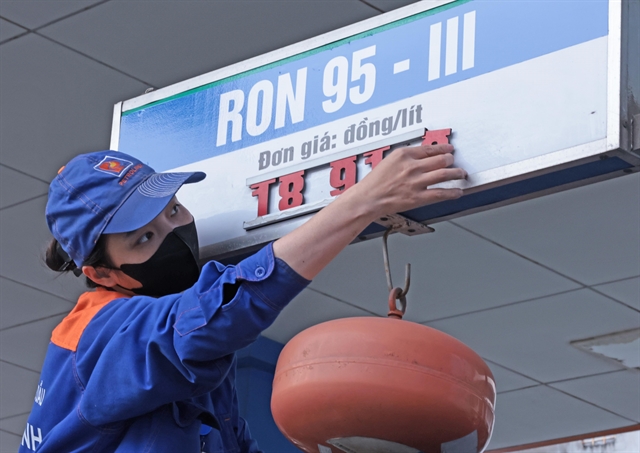
| A worker updating prices at a Petrolimex station in Hà Nội. — VNA/VNS Photo |
HÀ NỘI — The Ministry of Industry and Trade (MoIT) has proposed allowing major petroleum traders and distributors to set their own selling prices, while requiring advance disclosure of price changes and introducing tighter monitoring to prevent anti-competitive practices.
Under the latest draft decree on petroleum trading, which is being circulated for consultation, the State would stop announcing benchmark prices at regular intervals. Instead, major petroleum traders and distributors would determine their selling prices, declare them to authorities and connect relevant data systems to facilitate regulatory monitoring.
Major traders would have to publicly announce the effective time of a new price at least 30 minutes in advance, specifying the exact hour and minute. The requirement is intended to prevent businesses from raising prices ahead of the announced time or delaying reductions.
Traders would also be prohibited from exploiting price adjustments to suspend sales or restrict supplies in violation of regulations. Notices and data relating to price announcements, updates and relevant transactions would have to be retained without alteration or deletion.
The ministry and provincial-level People's Committees would use the declared data to monitor the market and detect possible collusion or monopolistic arrangements among traders.
Distributors operating within the same system would be allowed to set their own prices, provided they did not exceed the prices announced by their supplying major traders. They would not be required to raise prices whenever their suppliers increased theirs.
For areas far from ports and major traders' depots, retail prices could be higher, but the difference would be capped at 2 per cent.
Stronger safeguards for competition
The draft introduces indicators for investigating potential restrictions on competition. These include cases in which a group of at least two major traders or distributors operating in the same area, with a combined market share of at least 30 per cent, colludes or agrees on prices without corresponding changes in input costs.
According to the ministry, the proposed mechanism would strengthen price supervision and control anti-competitive behaviour under a system in which traders have greater pricing autonomy.
The draft also provides for State intervention in exceptional market conditions. Where necessary, authorities could temporarily impose maximum prices, price bands or specific prices to stabilise the market.
Regarding the standard business costs used in petroleum price calculations, the ministry would announce adjustments based on the consumer price index, together with their effective dates, no later than January 31 each year.
Businesses would be required to report their actual costs annually and undergo independent audits every three years.
The ministry has proposed requiring major petroleum traders to own at least 40 retail outlets, replacing an earlier proposal that required 10 directly owned outlets and at least 40 distributors within the same system.
The revision follows feedback from Petrolimex, the Vietnam Petroleum Association and major traders, which said distributors’ annual supply contracts make compliance harder to verify than traders’ five-year licences, potentially allowing paper compliance without meeting requirements in practice. — BIZHUB/VNS
Economy
 Economy
 Economy
 Economy
 Economy
 Economy
 Economy
 Economy
 Economy
 Economy
 Economy
 Economy
 Economy
 Economy
 Economy