 Economy

Việt Nam’s growth prospects appeal to long-term investors
1.
|
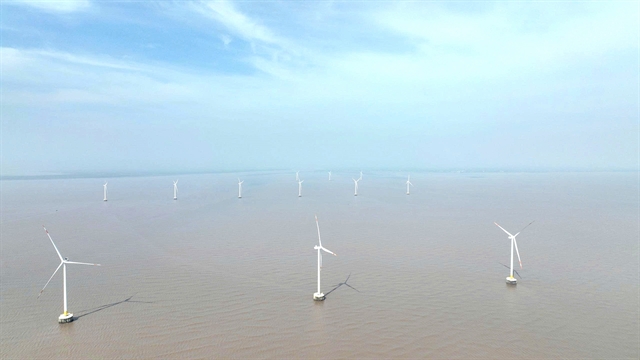
| Renewable energy is among the priority industries in Đồng Tháp’s strategy to develop a sustainable marine economy. — VNA/VNS Photo |
ĐỒNG THÁP — Marine aquaculture, renewable energy and coastal industry are driving Đồng Tháp Province’s strategy to turn its eastern coastline into a new marine economic growth corridor under Resolution No. 20-NQ/TW.
The resolution identifies the marine economy as a strategic growth engine, encouraging coastal localities to develop integrated economic zones, modern aquaculture, green industries and port services.
For Đồng Tháp, the eastern coastal region of Gò Công has become the province’s priority development area, connecting the Mekong Delta with HCM City through the Soài Rạp maritime route.
Mangrove forests along the Gò Công coast provide favourable conditions for clam and shrimp farming, making aquaculture the largest contributor to the province’s marine economy.
Đồng Tháp currently has around 2,300 hectares of clam farming and nearly 4,900 hectares of shrimp cultivation.
Annual production reaches about 19,850 tonnes of shrimp and 15,000-17,000 tonnes of clams, with most output destined for export markets.
At Gò Công Đông Commune, commercial clams are traded at VNĐ30,000-62,000 (US$1.1–2.4) per kilogramme, depending on size.
With average yields of 20 tonnes per hectare, farmers can earn profits exceeding VNĐ100 million ($3,800) per hectare under favourable conditions.
The clam industry also generates substantial employment. Around 100,000 seasonal jobs are created each year, while harvest workers earn VNĐ50,000-60,000 ($1.9-2.3) per hour during peak collection periods.
To enhance product value and sustainability, Đồng Tháp has partnered with international organisations to develop clam resource management under global standards.
Gò Công Đông has become the fourth clam farming area in both Việt Nam and the world to receive Aquaculture Stewardship Council (ASC) certification, strengthening the competitiveness of its seafood in premium overseas markets.
Alongside clam production, coastal communes including Tân Phú Đông, Tân Điền and Gò Công Đông are accelerating high-technology shrimp farming.
Tân Phú Đông now has 6,600 hectares of aquaculture, producing around 44,000 tonnes of seafood annually.
Farmers are increasingly adopting two-stage production systems, raising productivity to 40-70 tonnes per hectare, compared with 15-20 tonnes under conventional methods.
One of the province’s leading examples is a closed-net shrimp farming model covering 36 hectares, which produced more than 400 tonnes of white-leg shrimp last year and generated profits worth several billion đồng.
Provincial authorities are promoting ecological aquaculture, recirculating water systems, GAP and ASC certification, and climate-resilient production to increase export value while reducing environmental impacts.
Green energy powers coastal growth
Renewable energy has become another major pillar of Resolution 20’s implementation.
The Tân Phú Đông 1 and Tân Phú Đông 2 wind farms have a combined capacity of 150 megawatts and total investment of VNĐ7.5 trillion ($287 million).
Together, they contribute approximately VNĐ107 billion ($4.1 million) to the State budget each year.
Another project, the 100MW Tân Thành Wind Power Plant, is planned with investment of VNĐ4.7 trillion ($180 million). Its construction begun in September 2026, with annual electricity generation estimated at 264 million kilowatt-hours.
The province views renewable energy not only as a source of clean electricity but also as a catalyst for attracting supporting industries and green investment to its coastal communes.
|
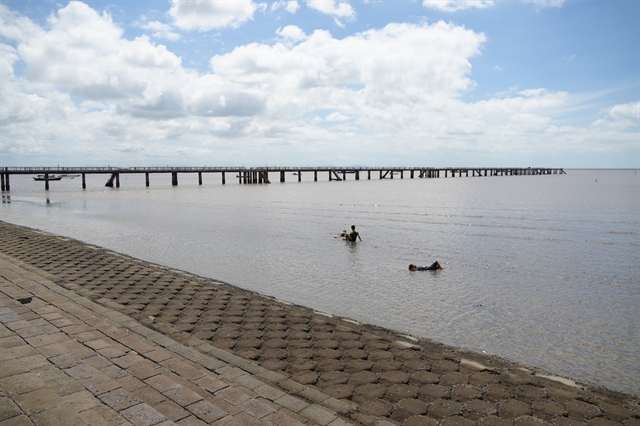
| Tân Thành Beach is one of Đồng Tháp Province’s best-known coastal tourism destinations. — VNA/VNS Photo |
Coastal industry and logistics
Industrial development is expanding rapidly along the eastern coastline.
Gia Thuận Commune has emerged as Đồng Tháp’s principal coastal industrial hub, anchored by the 285-hectare Soài Rạp Petroleum Service Industrial Park and the Gia Thuận 1 and Gia Thuận 2 industrial clusters.
Gia Thuận 1, developed with investment of more than VNĐ278 billion ($10.6 million), has completed its infrastructure and achieved occupancy exceeding 70 per cent, attracting manufacturers in processing, garments, footwear and construction materials.
Meanwhile, Gia Thuận 2 spans 50 hectares with investment of VNĐ391 billion ($15 million) and is targeting investors in food processing, electronics, electrical equipment, automotive components and high technology.
Local authorities are continuing to upgrade transport, electricity, water supply and telecommunications infrastructure to improve investment readiness and create stable employment for coastal communities.
As a key step in implementing Resolution 20, Đồng Tháp has approved the orientation for developing the Gò Công Coastal Economic Zone as a multi-sector development area integrating industry, services, urban development and marine agriculture.
The proposed economic zone will cover approximately 26,700 hectares, including 15,600 hectares of land and 11,100 hectares of coastal waters across Gia Thuận, Tân Điền and parts of Gò Công Đông, Tân Đông and Tân Phú Đông communes.
Priority sectors include renewable energy, shipbuilding, supporting industries, high-tech aquaculture, logistics, port services and marine tourism. The province also plans to establish a logistics centre linked to the Soài Rạp shipping channel, enabling larger vessels to access regional ports more efficiently.
By combining sustainable aquaculture, green energy and modern coastal industry, Đồng Tháp aims to turn Resolution 20 into a practical development strategy and establish its eastern coastline as one of the Mekong Delta’s emerging marine economic growth poles. — VNS
Economy
 Economy
 Economy
 Economy
 Economy
 Economy
 Economy
 Economy
 Economy
 Economy
 Economy
 Economy
 Economy
 Economy