.jpg) Economy
Economy

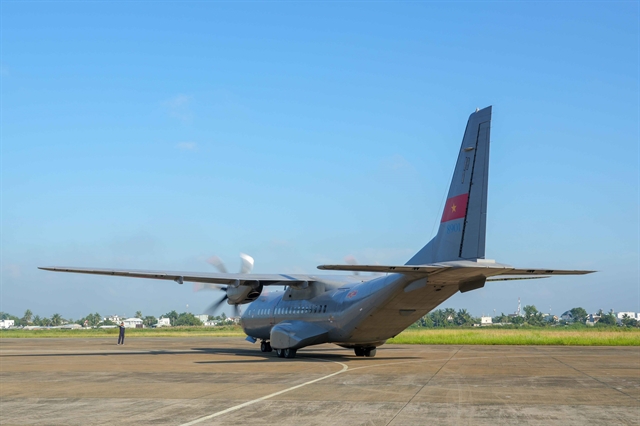
Military aircraft transports more samples of war martyrs’ remains to Hà Nội for DNA identification
1.
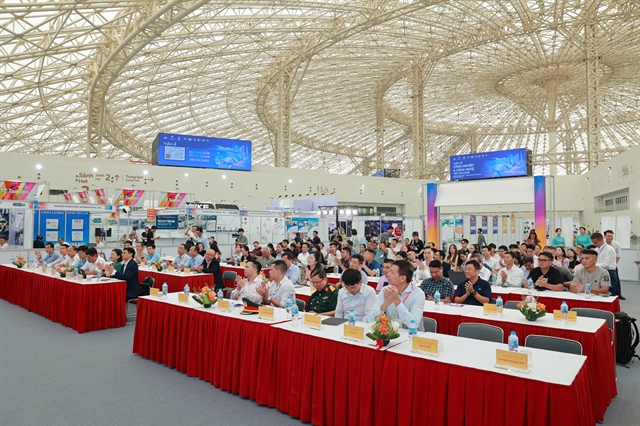 |
| Delegates attend the Việt Nam's Low-Altitude Economy and UAV Industry Forum 2026 in Hà Nội on September 9. — Photos courtesy of NIC |
HÀ NỘI — Việt Nam is seeking to develop a domestic unmanned aerial vehicle (UAV) industry and build an emerging low-altitude economy, with the sector expected to create opportunities across logistics, agriculture, infrastructure and smart-city services.
The issue was discussed at the Việt Nam’s Low-Altitude Economy and UAV Industry Forum 2026 in Hà Nội on September 9, which brought together policymakers, technology companies, researchers, investors and other stakeholders to discuss the development of the sector.
The forum, held under the auspices of NIC in cooperation with Global Expo, AUVS VN and LAEP, sought to turn industry networking into concrete cooperation, with testing infrastructure, domestic supply chains and technological capabilities identified as key to building a competitive UAV industry in Việt Nam.
The event took place as Việt Nam accelerates implementation of Politburo Resolution No. 57-NQ/TW on breakthroughs in science and technology, innovation and national digital transformation, and the Prime Minister's Decision No. 21/2026/QĐ-TTg on strategic technologies and strategic technology products, which includes UAVs.
The policy framework provides a basis for research and development, technology mastery, supply-chain development and wider UAV applications in socio-economic activities.
UAVs are increasingly moving beyond specialised uses as advances in artificial intelligence, robotics, sensors, new materials, positioning technologies, telecommunications and computing expand their capabilities.
The emerging low-altitude economy covers an ecosystem of technologies, infrastructure, data and services operating in low-altitude airspace. Applications include logistics, precision agriculture, surveying and mapping, infrastructure inspection, environmental monitoring, search and rescue and smart-city services.
NIC Deputy Director Võ Xuân Hoài said Việt Nam's opportunity lies not only in expanding UAV applications but also in developing industrial capabilities, mastering key technologies and participating more deeply in the value chain.
UAV development has strong links with strategic technologies such as AI, semiconductors, sensors, data and automation, he said.
Forum discussions highlighted testing infrastructure and an appropriate regulatory framework as key conditions for developing the market.
Huỳnh Thị Hồng Nhung, director of the Tây Ninh Department of Science and Technology, highlighted the role of localities in developing low-altitude economy ecosystems, from policy-making and testing infrastructure to practical applications.
Vũ Anh Tú, head of trade promotion at the Vietnam Low-Altitude Economy Alliance, discussed domestic capabilities, supply chains and the application market for UAVs, with a focus on increasing domestic value added and expanding opportunities for Vietnamese-made products.
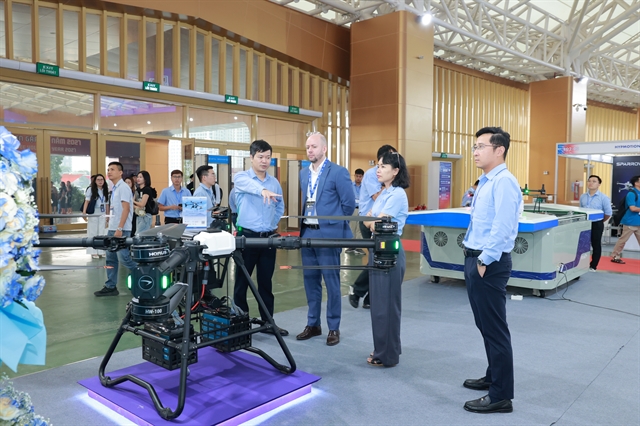 |
| Visitors examine an unmanned aerial vehicle (UAV) showcased at UAV Vietnam 2026 exhibition in Hà Nội on September 9. |
From a technology and security perspective, Lê Hải Triều, director of the Institute of Professional Electronic Engineering under the Ministry of Public Security's Security Industry Department, examined the growing role of UAVs and AI in modern warfare and the implications for Việt Nam's technological self-reliance.
Meanwhile, Tạ Ngọc Thanh, a representative of the Việt Nam Aerospace and Unmanned Vehicle Network, proposed a “linkage for technological mastery” model that brings businesses, research institutions, universities and technology partners together to develop unmanned systems and build domestic supply chains.
Experts agreed that the development of the UAV industry should also extend beyond manufacturing complete aircraft, covering areas such as precision engineering, materials, motors, batteries, semiconductors, sensors, communications, AI, software, data and flight-management platforms.
This could allow Vietnamese businesses to specialise in different segments of the value chain and gradually increase their domestic value added.
NIC expands UAV support ecosystem
NIC has identified UAVs as a potential new high-tech industry for Việt Nam, given their links with AI, robotics, semiconductors, new materials, data and digital transformation.
The centre is developing an ecosystem to connect businesses, startups, experts and research organisations in the sector, with the aim of facilitating access to technology, developing human resources, promoting R&D and helping Vietnamese technology products and solutions participate more deeply in global value chains.
Among the initiatives is the Vietnam UAV Innovation and Expert Network (UAVS Vietnam), which is intended to connect experts, companies, research institutes, universities and other organisations working in the UAV sector domestically and internationally.
NIC is also working with the Government of Japan and the United Nations Development Programme (UNDP) on the Việt Nam-Japan Innovation Space, which is expected to become operational in 2026. Under the initiative, the UAV Lab at NIC Hòa Lạc is set to receive facilities and equipment for research, testing, training, technology development and commercialisation. — BIZHUB/VNS
Economy
 Economy
 Economy
 Economy
 Economy
 Economy
 Economy
 Economy
 Economy
 Economy
 Economy
 Economy
 Economy
 Economy
 Economy