.jpg) Economy
Economy


"Thai Night Busan 2026" Makes a Grand Return, Connecting Thai Content with Global Partners to Create Business Opportunities and Strengthen Industry Collaboration
1.
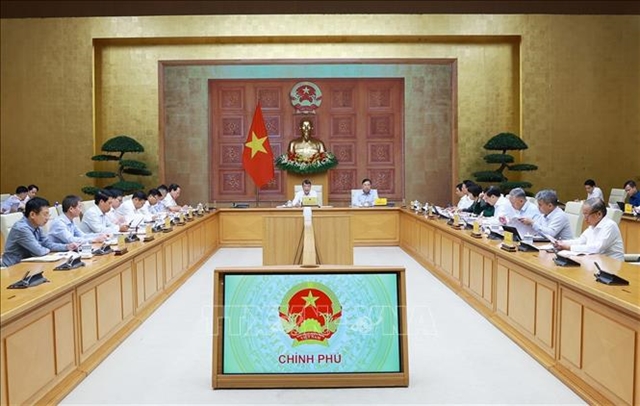 |
| A view of the meeting. VNA/VNS Photo |
HÀ NỘI — Prime Minister Lê Minh Hưng on Thursday directed ministries and agencies to address major and fundamental issues when drafting some amended laws to remove bottlenecks, streamline the legal framework, unlock resources, create new space and potential for development, and contribute to the achievement of double-digit growth and sustainable development.
The direction was made at a PM's meeting with the Ministry of Finance and other relevant ministries, sectors and agencies regarding four draft laws including the Law amending and supplementing a number of articles of the Law on Investment; the amended Law on Bidding; the Law on State Budget; and the Law on Small and Medium-sized Enterprise Development.
The meeting also addressed other issues related to land finance and land pricing within relevant draft laws.
The PM noted that these laws directly impact the investment and business environment, the allocation and utilisation of resources, business operations, and the enhancement of the economy's competitiveness.
“These laws are closely interrelated and mutually reinforcing, all aiming toward a common goal: effectively removing bottlenecks, perfecting the legal framework, unlocking resources, creating space and new room for development, and contributing to achieving double-digit growth and sustainable development,” he said.
According to the PM, the drafting of these four laws must be situated within the overall requirement to timely and fully institutionalise the Party's major guidelines. This is not merely a matter of technical amendments or addressing isolated issues; rather, it requires resolving major, fundamental problems and bottlenecks that hinder the mobilisation, allocation, and effective use of development resources.
Besides assigning the Deputy Prime Ministers in charge of these sectors to continue providing direction, the PM also instructed the Ministry of Finance to incorporate the opinions raised at the meeting and coordinate closely with relevant ministries and agencies to urgently finalise the draft laws, ensuring their quality, adherence to schedules, consistency, and feasibility. The ministry also needed to proactively coordinate with the National Assembly’s agencies during the processes of review, incorporation of feedback and revision of the draft laws.
“Drafts and proposals must fundamentally address practical bottlenecks and obstacles while fostering development and effectively unlocking and mobilising resources," PM Hưng said.
"Administrative procedures must be reformed and simplified to minimise red tape, intermediate, and ‘ask-and-grant mechanisms. Legal provisions and content must be clear and transparent to ensure consistent interpretation and implementation.”
He added that decentralisation of authority must be appropriate and clearly defined. Authority must be accompanied by the necessary resources, data, management tools, and accountability. Mechanisms for inspection, supervision, and post-implementation review must be established to manage risks and prevent corruption, waste, and ‘group interests’, without stifling the initiative and creativity of local authorities and businesses.
The PM also required full compliance with the Law on Promulgation of Legal Documents, including getting broad and substantive feedback from affected parties and consulting with associations, businesses, localities, experts, scientists, organisations, and civic groups.
Policy explanations must accompany these drafts to ensure accurate understanding among the public, businesses, and relevant stakeholders, thereby preventing divergent interpretations.
The Ministry of Finance must study and incorporate valid feedback while providing full, convincing explanations to ensure the draft law is truly effective upon enactment, the PM said.
He also emphasised the need to limit the issuance of excessive guiding documents and to rectify situations where a single matter is subject to multiple processes and regulations across different documents, causing overlaps and bottlenecks that increase compliance time and costs. — BIZHUB/VNS
Economy
 Economy
 Economy
 Economy
 Economy
 Economy
 Economy
 Economy
 Economy
 Economy
 Economy
 Economy
 Economy
 Economy
 Economy