 Economy

SBV to curb property price inflation, enforce lending rate rules
1.
|
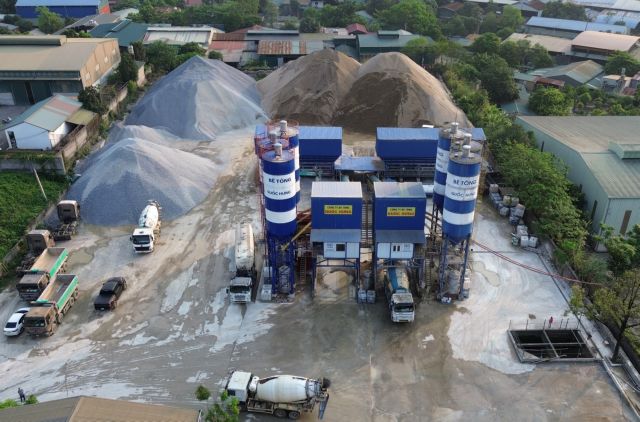
| Ready-mix concrete batching plants in Lào Cai Province. — VNA/VNS Photo Quốc Khánh |
HÀ NỘI — Plans are in place to establish a unified legal framework for the construction materials industry with an aim to promote greener production, more efficient use of resources and a stable supply of materials for infrastructure and development projects.
The Ministry of Construction is seeking feedback on a draft Law on the Management and Development of Construction Materials, which will introduce six policy groups covering the entire value chain, from strategy and raw materials to production, use and recycling.
The draft law comes as the construction materials industry faces shortages of fill materials in some localities, fragmented supply-and-demand data and insufficient technical tools for new and recycled materials.
The ministry said that a unified law is expected to address regulatory gaps caused by construction material rules being scattered across different legal documents governing planning, minerals, investment, environmental protection, construction and product quality while providing a consistent framework covering the full life cycle of construction materials.
Under the draft law, new materials including green, recycled, lightweight, smart and energy- and resource-efficient materials, will be brought under a clearer legal framework.
Criteria for identifying such materials would need to be measurable and verifiable and could be updated as technology advances. The criteria would also help link eligible products with existing policies on investment, taxation, credit, land, science and technology and environmental protection.
This is aimed at supporting research, pilot production, standardisation and commercialisation of new materials without creating unnecessary additional procedures.
Forecasting, early-warning and coordination mechanisms across regions and provinces would also be established for key materials such as sand, stone and construction fill, particularly for nationally important infrastructure and other major projects.
At the construction stage, the draft law would link product quality management with the quality of construction works and clarify responsibilities among parties throughout the supply chain.
New and recycled materials, or those without fully developed standards, could be assessed based on performance, design requirements, safety levels and technical evidence rather than through separate licensing procedures.
Another key proposal is the creation of a shared database covering production capacity, raw materials, quality, standards, prices, supply and demand, as well as new, green and recycled materials.
The system would be linked with databases on construction, minerals, the environment, businesses, investment and customs.
The ministry also proposed renaming the legislation to the 'Law on Construction Materials' to better reflect its scope.
The draft law is part of a broader push to modernise Việt Nam's materials industry, which has become an important supplier of inputs for economic development, infrastructure construction and technological self-reliance.
Under the Politburo’s Conclusion 83-KL/TW issued on August 8, Việt Nam aims to develop a national strategy for building the materials industry through 2030 by the fourth quarter of 2026 and establish a national database for the sector by 2027.
The industry’s development has been divided into three groups, including basic materials, strategic materials and future materials. — BIZHUB/VNS
Economy
 Economy
 Economy
 Economy
 Economy
 Economy
 Economy
 Economy
 Economy
 Economy
 Economy
 Economy
 Economy
 Economy
 Economy