 Economy



Drive to Great: BAIC FOTON Africa Partners Conference Set to Open
1.
|
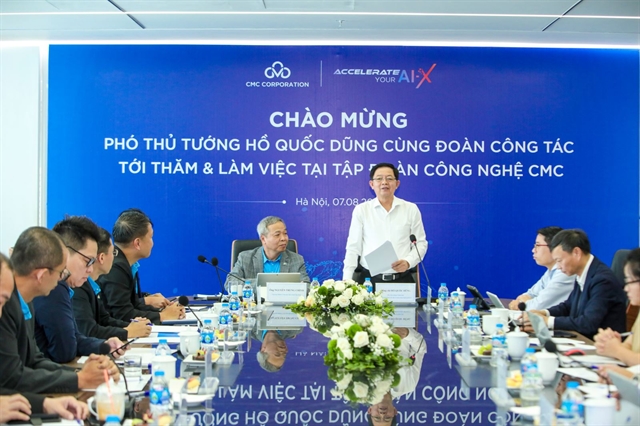
| Delegates at the working visit to CMC on August 7. — VNA/VNS Photo |
HÀ NỘI — Technology enterprises need to master core technologies, strengthen domestic ecosystems and expand into international markets as the country accelerates its science, technology and digital transformation agenda, Deputy Prime Minister Hồ Quốc Dũng said.
Speaking during a working visit to CMC Technology Group in Hà Nội on August 7, Dũng called on the Ministry of Science and Technology to coordinate with CMC in building a stronger cloud computing ecosystem and developing AI in a way that enables Vietnamese firms to control core technologies.
He said the goal is to improve domestic competitiveness while creating a foundation for technology companies to expand internationally.
CMC reported revenue of nearly VNĐ10.6 trillion (US$405 million) in 2025, up 17 per cent year-on-year, while profit before tax rose 26 per cent to VNĐ737 billion. The group currently employs more than 5,800 people.
The group plans to expand the application of AI and strengthen its ability to master strategic technology platforms and products through 2030.
Chairman of CMC Technology Group Nguyễn Trung Chính said the company has registered to participate in five areas under the national list of strategic technologies, and proposed two tasks under the national science and technology programme on strategic technology development, focusing on cloud computing and AI.
CMC is ready to undertake Government-assigned national technology projects, including sovereign cloud infrastructure and AI development, as Việt Nam works toward becoming a leading regional AI centre by 2045.
Deputy Minister of Science and Technology Hoàng Minh said the Government has recently introduced a series of policies to accelerate strategic technology development, including Decision 21/2026/QĐ-TTg on strategic technologies and products and Decision 808/QĐ-TTg assigning development tasks to ministries, sectors and localities.
On August 6, Dũng signed Decision 1493/QĐ-TTg approving a special national programme on science, technology and innovation for strategic technologies.
Minh said technology companies should accurately assess market size, master core technologies and accelerate international expansion.
He also called on enterprises to maintain strong innovation capacity through research and development, while major technology groups should help build ecosystems that allow smaller domestic firms to grow.
Science, technology, innovation and digital transformation are being positioned as key growth drivers and foundations for improving national competitiveness, Minh added.
In a major policy change, the Government is increasingly identifying large national technology challenges and assigning specific tasks, resources and responsibilities to ministries, agencies and enterprises.
Minh also stressed the need for stronger links among Government agencies, universities, research institutes and businesses to turn research outcomes into commercial products.
Cloud computing was identified as one of the most important areas of focus.
According to Dũng, domestic providers currently account for only about 20 per cent of Việt Nam's cloud computing market, while foreign companies hold most of the remainder.
He asked the Ministry of Science and Technology and CMC to study measures to build a stronger domestic cloud ecosystem and gradually raise the market share controlled by Vietnamese companies to around 50 per cent.
This would help strengthen technological sovereignty and provide a stronger base for domestic companies to compete internationally.
AI is another priority.
"AI is a strategic field that will determine national competitiveness in the near future," Dũng said, adding that Việt Nam needs to identify an appropriate development path and gradually build its own AI model.
He said the immediate focus should follow an 'AI First' approach, prioritising fields with urgent demand and strong value-creation potential such as healthcare, education and social welfare, rather than spreading investment too broadly while infrastructure and data remain limited.
CMC was asked to work with experts on a detailed report proposing an AI development roadmap suited to Việt Nam's conditions.
Dũng also noted that Vietnamese technology companies still account for only a small share of the overall market.
He therefore urged domestic firms to select the right strategic products, invest more deeply in R&D, strengthen technological capabilities and establish stronger positions in the domestic market before expanding abroad. —VNS
Economy
 Economy
 Economy
 Economy
 Economy
 Economy
 Economy
 Economy
 Economy
 Economy
 Economy
 Economy
 Economy
 Economy
 Economy




