 Economy


Drive to Great: BAIC FOTON Africa Partners Conference Set to Open
1.
|
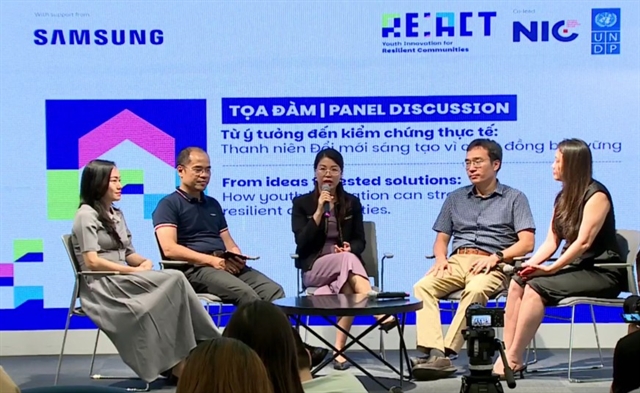
| Panelists at the discussion on how youth innovation can strengthen resilient communities during the launch of RE:ACT challenge on Friday in Hà Nội. — VNS Photo |
HÀ NỘI — A new innovation challenge aimed at helping young Vietnamese entrepreneurs develop technology-based solutions to social and environmental challenges was launched in Hà Nội on Friday, offering grants of up to US$15,000 for promising projects.
RE:ACT (Youth Innovation for Resilient Communities), jointly organised by the United Nations Development Programme (UNDP) in Việt Nam and the National Innovation Center (NIC) with support from Samsung, targets innovators aged between 18 and 35.
The programme is designed to support early-stage ventures that have already developed minimum viable products and are ready to test or expand their solutions in real-world settings, focusing on digital livelihoods, sustainable communities and the circular economy.
Eligible teams must comprise between one and five members, with at least one founder or key participant aged from 18 to 35. Applications will remain open until September 15. Organisers said the initiative aims to attract more than 600 applications from across the country this year.
Selected21q teams will receive grants of up to $15,000, six months of technical and mentoring support, access to so-called "living laboratories" where solutions can be tested in real-world conditions, and the opportunity to take part in an innovation study tour in the Republic of Korea.
The initiative comes as Việt Nam accelerates the implementation of Politburo Resolution No 57-NQ/TW on science, technology, innovation and digital transformation, while also promoting the private sector as a key engine of growth under Resolution No 68-NQ/TW.
Speaking at the launch event, Đỗ Tiến Thịnh, NIC’s deputy director, said the initiative would help develop a new generation of talent capable of meeting the country's evolving development needs.
He said the programme reflected a broader national strategy aimed at strengthening ties among the government, educational institutions and businesses while placing young people at the centre of the country's innovation ecosystem.
"Innovation is driven by young people," Thịnh said, noting that those aged between 18 and 35 often possess the energy, creativity and willingness to embrace new ideas needed to address emerging challenges.
He added that the programme would provide a practical pathway for young innovators to identify social problems, develop prototypes and test their ideas in real-world settings.
Francesca Nardini, UNDP's deputy resident representative in Việt Nam, said the country was home to around 20 million people aged between 10 and 24, accounting for roughly one-fifth of the population and representing a powerful force for change.
“Young people have an important role to play in helping shape Việt Nam’s future by turning their ideas, knowledge and energy into practical solutions. Young people are not only beneficiaries of development. They are partners in shaping it,” she said.
Nardini said Politburo Resolution No 57 and Resolution No 68 together an environment where new ideas can grow into practical solutions that benefit society.
She added that innovation should not be viewed solely through the lens of technology. "Innovation starts with people," she said.
Nardini said RE:ACT was intended to connect the efforts of the government, universities and businesses to support young innovators and the communities. The Government creates the enabling framework, universities contribute knowledge, talent and evidence, while businesses bring investment, implementation capacity and pathways to market and scale, she said.
Phạm Thu Trang, programme coordinator at UNDP Việt Nam, said the programme's name reflected a three-stage approach.
"Reflect" encourages participants to identify the root causes of social problems, "Rethink" challenges them to assess whether proposed solutions are genuinely necessary and effective, and "React" focuses on translating ideas into purposeful action, she said.
Trang added that the initiative was intended to promote social entrepreneurship by encouraging young innovators to address pressing social and environmental challenges while creating sustainable and scalable business models. — VNS
Economy
 Economy
 Economy
 Economy
 Economy
 Economy
 Economy
 Economy
 Economy
 Economy
 Economy
 Economy
 Economy
 Economy
 Economy




