 Economy



84 individuals investigated for transnational online frauds
1.
|
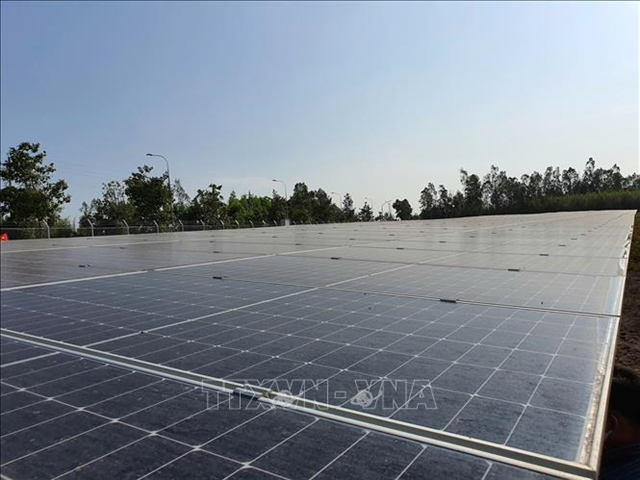
| A rooftop solar system in the Mekong Delta city of Cần Thơ. — VNA/VNS Photo |
HÀ NỘI — Việt Nam's rooftop solar market is showing renewed momentum following a series of policy changes, with businesses increasingly exploring new installations as the Government improves the regulatory framework for self-produced renewable energy.
Industry players say enquiries from corporate customers have risen sharply in recent weeks, driven by both the prospect of lower electricity costs and growing pressure from international buyers to adopt greener production and reduce carbon emissions.
Lê Trần Đạt, a representative of a rooftop solar company in Hà Nội, told Tiền Phong (Vanguard) newspaper that the demand for consultations has increased significantly since June.
Most enquiries have come from manufacturers in the electronics, mechanical engineering, textile and garment, logistics and food processing sectors.
Đạt said many businesses have long been interested in rooftop solar, but delayed investment because they were uncertain about long-term returns and the mechanism for selling surplus electricity. But he said the number of recent calls and requests for on-site surveys has increased considerably.
A similar trend has emerged in the South.
Nguyễn Tiến Lê, head of sales at an energy consulting company in HCM City, told the newspaper that many businesses that had postponed rooftop solar investment plans since 2024 are now reassessing their projects.
He said unlike when the feed-in tariff mechanism was in place, customers are no longer investing simply because of market enthusiasm. Their focus is now on the payback period, long-term electricity costs and meeting green standards required by export markets.
The renewed interest comes after the Government issued Decree 243/2026/NĐ-CP amending regulations on rooftop solar development and the direct power purchase agreement mechanism.
One of the most notable changes is an increase in the amount of surplus electricity that self-produced, self-consumed rooftop solar systems can sell to the national grid. The allowable proportion has doubled from 20 per cent to as much as 50 per cent.
Industry participants believe the adjustment will significantly improve project economics by shortening investment payback periods and making rooftop solar more financially attractive.
The market recovery also comes as electricity demand continues to rise, particularly in industrial zones and during the summer peak season.
According to the Northern Power Corporation (EVNNPC), businesses in industrial parks and industrial clusters are increasingly interested in combining rooftop solar with battery energy storage systems to reduce electricity costs while meeting sustainability requirements across global supply chains.
EVNNPC estimates that 17 northern provinces and cities alone have the potential to develop more than 19,000MW of rooftop solar capacity, mainly on factory buildings, industrial facilities and commercial properties.
The corporation said that if the revised National Power Development Plan VIII achieves its target of having rooftop solar installed on 50 per cent of households and 50 per cent of public buildings by 2030, the systems would provide a substantial source of clean electricity for northern Việt Nam during periods of peak demand.
Bùi Quốc Hùng, deputy director of the Electricity Authority under the Ministry of Industry and Trade, said Việt Nam still has considerable untapped potential for rooftop solar development.
He said the ministry has proposed several support measures in a draft decision from the Prime Minister, including partial investment subsidies from local government budgets and improved access to preferential loans.
However, some of the proposals have yet to gain consensus during the consultation process. The Ministry of Finance has argued that there is currently no budgetary basis for providing direct financial support for rooftop solar investments.
Hùng said that although direct subsidies and concessional financing have not yet been approved, the issuance of Decree 243/2026/NĐ-CP marks an important step in strengthening the legal framework for renewable energy development.
The revised regulations are expected to create more favourable conditions for the expansion of self-produced, self-consumed rooftop solar systems, supporting the next phase of growth for the sector. — VNS
Economy
 Economy
 Economy
 Economy
 Economy
 Economy
 Economy
 Economy
 Economy
 Economy
 Economy
 Economy
 Economy
 Economy
 Economy