 Economy


China’s Professional Hair Care Brand ISYUN Announces Victoria song as Global Brand Ambassador, Accelerating Global Expansion with Strategic Focus on Southeast Asia
1.
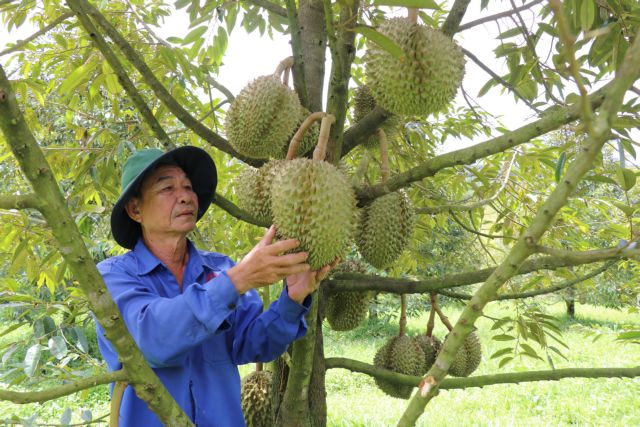 |
| A durian garden in Lâm Đồng Province. Việt Nam still has significant production capacity and market potential to expand ago-forestry-fishery exports. — VNA/VNS Photo Nguyễn Huy Thành |
HÀ NỘI — A high-level government task force should be established to coordinate efforts to transform its agricultural sector and raise agro-forestry-fishery exports to US$100 billion by 2027, experts said at a policy dialogue held by the Government Information and Communications Bureau on July 9.
The target is ambitious but achievable if the country shifts from a production-based model to a value-driven agricultural economy, participants said, warning that fragmented supply chains, weak coordination and rising technical barriers in export markets could slow progress.
If exports are expected to total about $75 billion this year, from $70 billion in 2025, shipments would need to grow by more than 30 per cent in 2027 to meet the Government's target, which experts said remained challenging but achievable.
"The target is ambitious, but Việt Nam still has significant production capacity and market potential," Nguyễn Thanh Bình, president of the Vietnam Fruit and Vegetables Association (Vinafruit), said.
However, he warned that product quality, quarantine procedures and inspection requirements had emerged as major bottlenecks that could undermine export growth if left unresolved.
A new growth model
Nguyễn Hoài Nam, secretary general of the Vietnam Association of Seafood Exporters and Producers (VASEP), said Việt Nam needed a new approach to achieve the target within the limited timeframe.
"We need a new solution and a new growth model. If we continue with annual growth of only 15-20 per cent, reaching $100 billion next year will be very difficult," he said.
Nam said the seafood industry, which expects exports of more than $12 billion this year, would need growth of roughly 30 per cent to contribute to the national target.
That would require expanding raw material supplies, addressing labour shortages and improving access to credit, while allowing businesses to participate in designing new policy measures, he said.
According to Đặng Kim Sơn, former director of the Institute of Policy and Strategy for Agriculture and Rural Development, Việt Nam had already become one of the world's leading agricultural exporters but could no longer rely on volume-driven growth.
Many Vietnamese products already rank among the world's largest by output, but their value remains relatively low, he said.
He stressed that Việt Nam should focus on raising product value through branding, quality improvements, traceability and more efficient value chains, adding that better coordination across the supply chain could significantly increase exports.
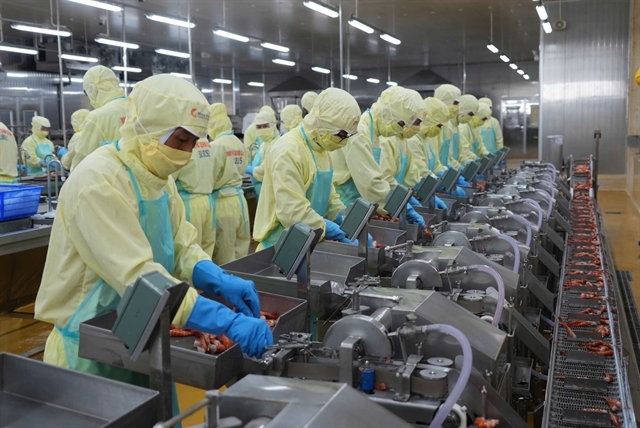 |
| Shrimp processed for export at a plant of Minh Phú in Cà Mau Province. It is necessary to establish a dedicated inter-agency working group to promote agricultural export. — VNA/VNS Photo Tuấn Phi |
Nguyễn Sĩ Dũng, former deputy chairman of the Office of the National Assembly, said the first breakthrough must come from changing the way Việt Nam views its agricultural sector.
"The shift has to be from agricultural production to an agricultural economy," he said, stressing that simply producing more for export will not be enough to reach the $100 billion target.
Dũng said Việt Nam should focus on creating more value rather than increasing output. Exports should compete on quality, branding, trust and product stories rather than volume alone.
"We should not only sell products, but also sell quality, brands, credibility and the story behind our products," he said.
Dũng said doing so would require a fully integrated value chain involving farmers, processors, logistics providers, exporters and government agencies.
Building a more efficient value chain would allow Việt Nam to generate higher export earnings without necessarily expanding production, Dũng said, adding that stronger coordination across ministries and agencies was therefore essential.
In addition, it is necessary to establish a dedicated inter-agency working group which should be empowered to coordinate policies across ministries, oversee implementation and remove regulatory bottlenecks that individual agencies have been unable to address.
The mechanism would help identify bottlenecks, coordinate policies and ensure that the entire chain, from farmers and processors to customs authorities, operated smoothly.
A data-driven economy
Experts also highlighted the importance of digital transformation and traceability in meeting increasingly demanding export standards.
Tô Nguyễn Thành, an expert on agricultural and seafood traceability technologies, said exporters were no longer required only to prove what their products were, but also where and how they were produced.
“Selling a product now means selling the product together with its data profile,” Thành said.
He said Việt Nam needed to promote digitisation from production areas, farming records, processing facilities, testing results and export procedures to create a connected database throughout the supply chain.
For products such as durian, digital identification could be applied at multiple levels, including individual fruit, packaging and export containers, allowing foreign authorities to quickly access production and inspection information, he said.
“Data is the foundation. AI can only work when it operates on a reliable data system,” Thành stressed.
He said digital platforms could also support forecasting, risk management and macro-level policy decisions.
Âu Anh Tuấn, deputy director of the Department of Customs under the Ministry of Finance, said digital transformation was essential not only for faster customs clearance but also for more effective management.
Tuấn said the $100 billion target was challenging, but reforms in administrative procedures, digitalisation and trade facilitation could help Việt Nam move closer to the goal.
He added Việt Nam should further simplify procedures, connect databases among ministries and strengthen cooperation with importing countries to recognise inspection results.
Customs data showed that agro-forestry-fishery exports have grown by an average of 10-12 per cent annually since 2021.
In the first six months of 2026, exports reached $35.88 billion, up about 6 per cent year-on-year. — VNS
Economy
 Economy
 Economy
 Economy
 Economy
 Economy
 Economy
 Economy
 Economy
 Economy
 Economy
 Economy
 Economy
 Economy
 Economy