 Economy



Weaving the unique heritage of the Thu Lao
1.
|
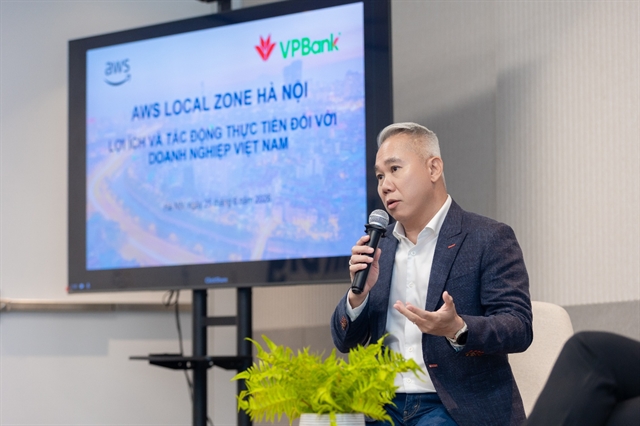
| Eric Yeo, Country General Manager at AWS Vietnam. — Photos courtesy of AWS Vietnam |
HÀ NỘI — Vietnamese companies want to deploy AI, but latency, cost and data residency have been standing in the way. A new piece of infrastructure changes the equation for businesses of all sizes.
Việt Nam is one of Southeast Asia's fastest-moving AI markets, with 170,000 businesses adopting AI solutions in 2024, with 60 per cent reporting improved profitability.
But for many companies, a fundamental constraint remained: the cloud infrastructure they needed was located overseas, milliseconds too far for real-time applications, and too far for data that regulators say must stay in-country.
That constraint lifted on June 19, when Amazon Web Services (AWS) launched its first Local Zone in Hà Nội, placing compute, storage and AI inference directly in Việt Nam, with single-digit millisecond latency and data residency.
"Việt Nam's companies should have the ability to innovate, build and compete globally regardless of speed or infrastructure constraints," said Eric Yeo, Country General Manager of AWS Vietnam.
"Before the Local Zone, there were a lot of constraints; local data residency issues, latency issues. I think that's, quote unquote, unfair. Today, the Local Zone allows them to do it more freely."
The demand is clear.
According to GlobalData analyst Alfie Amir, approximately 69 per cent of Vietnamese organisations now prioritise domestic data storage to comply with data sovereignty requirements – yet cloud budgets continue to rise, with 65 per cent of enterprises committed to increasing spend and the market projected to reach US$4.3 billion by 2029.
Faster, accessible, local
The Local Zone addresses all three barriers simultaneously. Latency drops to single-digit milliseconds, critical for any application requiring instant response.
Data stays in Việt Nam, unlocking AI for industries previously locked out of the cloud. And because it runs on AWS's pay-as-you-go model, companies avoid massive upfront GPU investments.
"If you buy your own hardware and GPUs, the investment is enormous. Even large companies find it difficult to keep purchasing GPUs continuously," Yeo said.
"AI needs to run on the cloud. The cloud enables SMEs to experiment quickly and affordably. If something works, they can scale it. If it doesn't, they can simply stop and move on."
Yeo shared how sectors can benefit.
Telecommunications companies can keep subscriber data in-country, while running AI analytics inferences locally. Banks can speed up fraud detection to shut it down faster. Smart manufacturers gain more rapid insights into their factory, before a problem occurs. Gaming companies eliminate the lag that drives users away.
But the opportunity extends well beyond regulated industries. Any Vietnamese business, regardless of size, can now access world-class AI infrastructure and foundation models.
VPBank, one of Việt Nam's largest private banks, offers an early example of what cloud agility enables.
The bank redesigned its credit card sales process from 25 steps to six, reduced required data fields from 150 to 37 and went from concept to pilot in weeks.

|
| Nguyễn Hồng Trung, VPBank's Group CIO. |
"When we use digital infrastructure and cloud services such as AWS, our expectations can be summarised in two words: faster and safer," said Nguyễn Hồng Trung, VPBank's Group CIO.
"AWS acts as the architect of that infrastructure and continuously delivers the best possible performance. This allows us to move faster and focus more on innovation and business outcomes."
Critically, the Local Zone is not a standalone facility. It connects directly to the full AWS Region – over 240 services including Amazon Bedrock, AWS's managed AI platform offering access to foundation models from Anthropic, Meta and others. Companies can keep sensitive workloads local while using the Region for training, analytics and experimentation.
"We are not asking every customer to use the Local Zone," Yeo clarified.
"Customers now have a choice. They can use the Local Zone for sensitive workloads or applications with very stringent latency requirements. Otherwise, they can continue to use the Region to help them scale better."
Talent is next
AWS's decision was driven by converging demand.
"In Hà Nội, most of the major telecommunications companies are here. Most of the major banks and State-owned enterprises are also headquartered here. So we started where customers needed these capabilities the most," Yeo said.
The timing aligns with Việt Nam's national ambition: a Government programme targets 30 per cent of GDP from the digital economy. IDC Research Director Daphne Chung noted the shift: "If previously infrastructure was only about scalability, today data placement has become the critical factor."
But both AWS and VPBank emphasised that infrastructure alone is insufficient. The bigger bottleneck is people.
"The technology itself already exists and will continue to evolve. But perhaps the most important factor is people, human talent," Yeo said.
"Alongside infrastructure investments, we are placing an even greater emphasis on developing skills and talent. In many ways, that's even more important than the technology itself."
AWS has trained more than 157,000 Vietnamese professionals in cloud and AI skills since 2017, collaborating with 25 universities through its First Cloud Journey programme. For SMEs specifically, Yeo noted that skills, not cost, are often the real barrier to AI adoption.
Yeo noted the Local Zone is certainly not going to be the last investment.
"We will continue listening to our customers, building the business case and evaluating demand," he confirmed. — VNS
Economy
 Economy
 Economy
 Economy
 Economy
 Economy
.JPG) Economy
Economy
.jpg) Economy
Economy
 Economy
 Economy
 Economy
 Economy
 Economy
 Economy
 Economy