 Economy



PM pledges continued support for Vietnamese community in Cambodia
1.

|
| An offshore oil field owned by Petrovietnam. National energy security is no longer simply about ensuring adequate supply, but building an energy system that is secure, flexible, competitive, green and self-reliant. — VNA/VNS Photo Huy Hùng |
HÀ NỘI — The energy industry has called for further regulatory reforms to safeguard energy security, as output from mature oil and gas fields declines and electricity demand surges alongside the country's drive for double-digit economic growth.
Speaking at the Annual Oil and Energy Forum held by the Vietnam Petroleum Association and the National Industry - Energy Group (Petrovietnam) in Hà Nội, association president Nguyễn Quốc Thập said national energy security is no longer simply about ensuring adequate supply, but building an energy system that is secure, flexible, competitive, green and self-reliant.
He said the industry no longer enjoys the favourable conditions of previous decades. Many major oil and gas fields are starting to decline, while new discoveries are increasingly located in deeper waters, requiring higher investment, more advanced technology and stricter environmental standards.
According to Trịnh Quốc Tuy, a senior expert at the Party Central Committee’s Policy and Strategy Commission, electricity demand is expected to rise by up to 16 per cent annually in the next five years, as Việt Nam pursues double-digit economic growth. This would require an additional 10,000MW of power each year.
Demand is also being driven by electrification and the rapid expansion of artificial intelligence, semiconductor manufacturing and data centres, he said.
Although the revised eighth National Power Development Plan targets more than 183,000MW of installed capacity by 2030, only about 56.7 per cent of planned projects have been implemented since 2021, highlighting a significant gap between planning and execution.
Trần Thanh Tùng, deputy director general of the Ministry of Industry and Trade's Oil, Gas and Coal Department, said the current legal framework lacks adequate incentives to attract investment into emerging energy sectors including offshore wind, green hydrogen, green ammonia and carbon capture, utilisation and storage (CCUS).
He added that inconsistencies in investment, planning, bidding and maritime laws continue to delay projects, while reforms to corporate income tax, carbon taxation and clean energy incentives remain at an early stage.
Energy pricing also remains a bottleneck, aside from other problems including rising energy demand, declining output, pressure from energy transition, fluctuations in the global market and local procurement capability, Tùng said.
Policy breakthrough
|
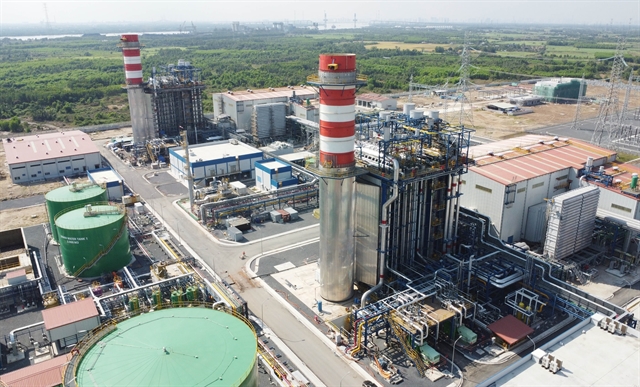
| Nhơn Trạch 3 LNG power project in Đồng Nai Province. Further reforms are needed to create a stable, coherent and predictable regulatory framework for the energy sector. — VNA/VNS Photo Công Phong |
Experts at the forum called for further reforms to create a stable, coherent and predictable regulatory framework for the energy sector, saying energy security should be treated as a prerequisite for achieving Việt Nam's double-digit economic growth target through 2030.
They also proposed a special fast-track approval mechanism for strategic power, grid, LNG and oil and gas projects, with clearer accountability for ministries, local governments and project developers.
Reforms to gas and electricity pricing, power purchase agreements and risk-sharing mechanisms are needed to unlock major projects, including the Lô B–Ô Môn gas-to-power project, the Cá Voi Xanh gas development, LNG-to-power projects and other strategic energy infrastructure, experts said.
Vietnam Financial Consultants Association economist Ngô Trí Long said despite strong investment demand, Việt Nam still lacks financing mechanisms that make large-scale energy projects commercially bankable.
He called for a dedicated financial and market framework for the oil, gas and energy sector through 2035, including reforms to energy pricing, long-term contracts, financing, guarantees, risk-sharing mechanisms, carbon markets, transition bonds and greater autonomy for key State-owned energy firms.
Long also suggested market-based energy pricing with appropriate State regulation, saying that energy companies should not bear the cost of social welfare policies, as doing so would weaken their long-term investment capacity.
Energy companies should be allowed to hedge commodity prices, exchange rates and interest rate risks under a robust regulatory framework to improve the bankability and implementation of large-scale energy projects, he added.
Petrovietnam Deputy Director General Vũ Đào Minh said the oil and energy sector needs breakthrough policies to unlock investment and accelerate large-scale energy projects.
He called for amendments to the Law on Petroleum and related regulations to encourage exploration and production, particularly in deep-water fields, while allowing greater flexibility to maximise recovery from existing reservoirs and reuse oil and gas infrastructure for new energy projects.
Minh also urged the Government to establish a legal framework for emerging industries, including green hydrogen, green ammonia, sustainable aviation fuel, offshore wind, energy storage, CCUS and carbon trading.
Special approval mechanisms could be instrumental for nationally strategic energy projects, including a single approval process, one-stop administrative procedures and parallel processing of investment, construction, environmental and land-use approvals to shorten project timelines, he said.
Petrovietnam also called for greater authority to lead strategic projects such as LNG terminals, gas infrastructure, gas-fired power plants, refineries, offshore wind and CCUS facilities, while encouraging private and foreign investment in supporting projects through public-private partnerships and joint ventures.
According to Minh, State-owned energy firms should also be given greater financial flexibility, including wider powers to reinvest profits, raise capital, issue debt and pursue mergers and acquisitions.
These powers could also include stronger decentralisation of investment decisions subject to transparent governance and risk controls.
He added that Petrovietnam would need to undergo sweeping internal reforms to achieve its ambition of joining the world's top 500 companies, including changes to its governance, business model, execution, technology capabilities, international competitiveness and value chain management.
Tạ Đình Thi, deputy chairman of the National Assembly's Committee for Science, Technology and Environment, said the oil and gas industry should optimise its value chain by better integrating upstream production and processing with emerging energy sectors, such as offshore wind and LNG.
He also called for greater digitalisation, integrated offshore data systems, expanded international cooperation and controlled regulatory sandboxes to accelerate innovation. — VNS
Economy
 Economy
 Economy
 Economy
 Economy
 Economy
 Economy
 Economy
 Economy
 Economy
 Economy
 Economy
 Economy
 Economy
 Economy