 Economy


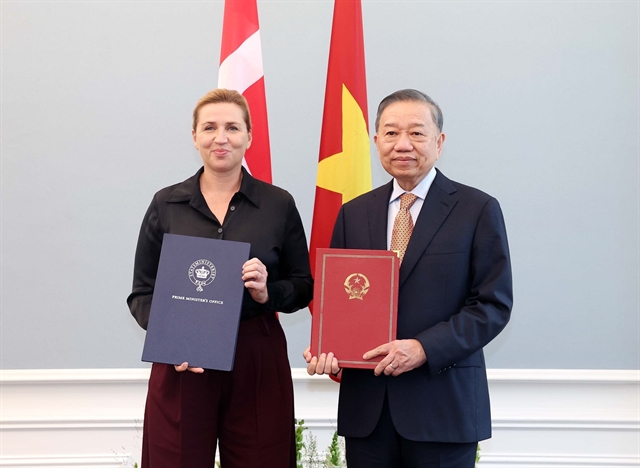
Việt Nam, Denmark issue joint statement on establishment of Comprehensive Strategic Partnership
1.
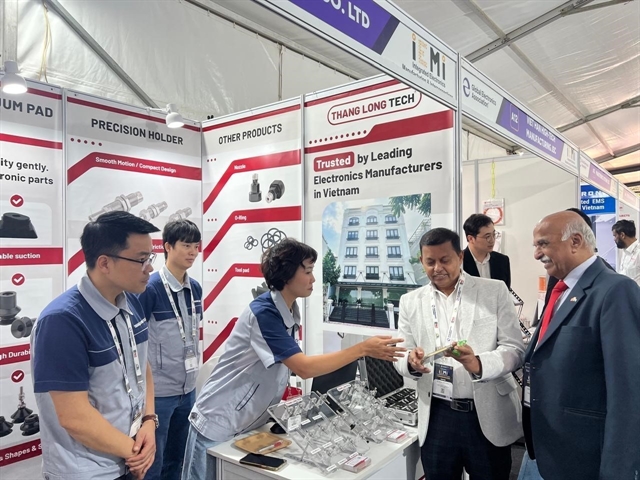 |
| A Vietnamese booth at the 2026 Integrated Electronics Manufacturing and Interconnections (IEMI) exhibition in India. — VNA/VNS Photo |
HÀ NỘI — A sweeping restructuring of global supply chains is creating new opportunities for Vietnamese enterprises, but experts warn that significant gaps in technology, governance capacity and green standards remain major obstacles for local firms hoping to secure a stronger role in global value chains.
The issues were discussed at a seminar titled 'Trends and solutions to support enterprises joining global production and supply chains' held on May 26.
Lê Hoàng Tài, deputy director general of the Trade Promotion Agency under the Ministry of Industry and Trade, said multinational corporations are accelerating supply diversification strategies, relocating production closer to consumer markets and shifting value chains toward countries with more aligned policy environments.
Việt Nam has emerged as an attractive destination thanks to its stable macroeconomic conditions and network of 17 signed and implemented free trade agreements, Tài added.
"We are standing before a major opportunity to transition from a simple processing link into a high value-added production and supply hub within the global network," Tài said.
Similarly, Vương Thị Oanh, a representative of the ministry's Import-Export Department, said that global trade is no longer driven solely by low-cost advantages but increasingly prioritises supply chain security, resilience and sustainable development.
The continued expansion of major technology manufacturers such as Apple, Samsung, Intel, Foxconn and Pegatron in Việt Nam is generating rising demand for locally sourced components and services.
Experts said this trend presents an opportunity for Vietnamese firms to move beyond low-value contract manufacturing and integrate more deeply into multinational production systems.
Participation in global supply chains is also forcing domestic firms to adopt modern governance models and international production standards, helping raise competitiveness and operational efficiency.
Growing opportunities, greater challenges
Yet experts cautioned that growing opportunities also come with intensifying screening requirements.
According to Tài, Vietnamese enterprises seeking entry into global supply chains must satisfy increasingly stringent standards related to environmental, social and governance (ESG) criteria, traceability, digital transformation and corporate governance.
Most small and medium-sized Vietnamese enterprises, however, still lag behind multinational requirements in terms of capital, technology, data management and logistics infrastructure.
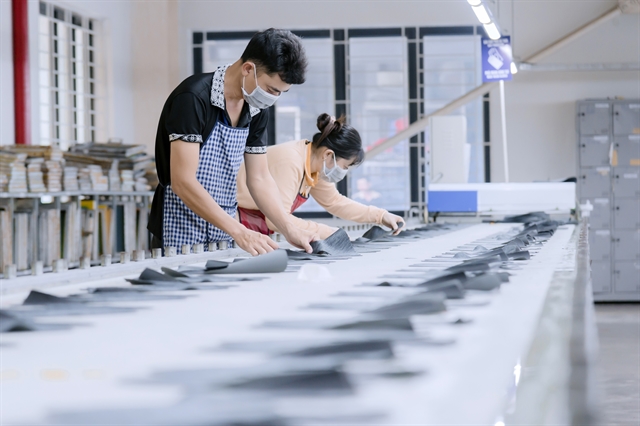 |
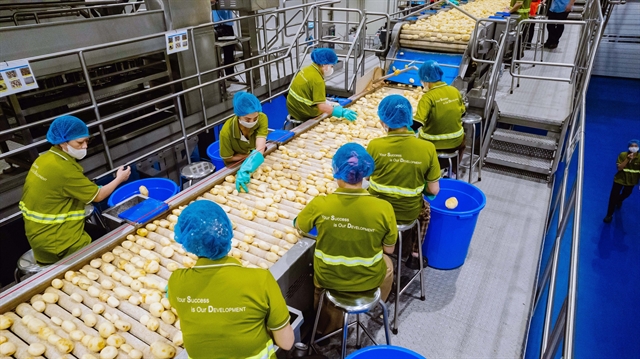
| Workers making products for export at a plant in An Giang Province. — VNA/VNS Photo |
Oanh noted that localisation rates in sectors such as electronics, automotive manufacturing and precision engineering remain relatively low, with many domestic suppliers still confined to low value-added activities, including packaging, simple components and basic assembly work.
Pressure from green standards is also mounting rapidly. Regulations, including the Carbon Border Adjustment Mechanism and ESG compliance requirements, are becoming mandatory conditions in key export markets across Europe and North America.
"Any enterprise that is slow in obtaining a 'green passport' risks being removed from global supplier lists," Oanh warned.
Digital transformation is also becoming increasingly critical for supply chain participation. Modern supply chains operate on big data systems and real-time connectivity.
Experts said enterprises relying on manual management models or lacking integration with foreign-invested partners' digital systems could face exclusion from international supply networks.
Nguyễn Cao Đức, deputy director of the Institute for European and American Studies, said recent geopolitical shocks have fundamentally changed the structure of global supply chains, prompting major economies to pursue safer and more resilient production allocation strategies.
While supply chain shifts are creating opportunities for Việt Nam, Đức observed that most relocations currently focus on assembly operations, while core segments such as semiconductors, key components and foundational technologies still depend heavily on China.
Another key challenge for Vietnamese firms is not being able to improve their position within the broader global value chain (GVC).
Đức emphasised the need for enterprises to distinguish between global supply chains, which focus on the flow of goods and services, and GVC, which concerns how value and profits are distributed across production stages.
To narrow capability gaps, Oanh urged businesses to standardise production processes according to international benchmarks and view green and digital transformation as long-term strategic investments rather than short-term costs.
She also called for stronger cooperation among enterprises instead of fragmented operations.
"Only when business alliances with sufficient scale, technological capacity and financial strength are formed can Vietnamese enterprises meet large orders from multinational corporations," Oanh said.
Meanwhile, Trần Chí Dũng, head of the Innovation and Technology Board at the Vietnam Logistics Business Association, said the association is promoting the development of a Digital Supply Network (DSN) ecosystem to support end-to-end digital transformation across supply chains.
The ecosystem integrates digital planning, smart sourcing, intelligent manufacturing, smart warehousing and digital logistics solutions.
He cited several pilot models, including smart seaport platforms and digitally managed durian export supply chains, in which DSN applications reportedly reduced customs clearance times by 30-40 per cent and increased on-time delivery rates to 98 per cent. — BIZHUB/VNS
Economy
 Economy
.jpg) Economy
Economy
 Economy
 Economy
 Economy
 Economy
 Economy
 Economy
 Economy
 Economy
 Economy
 Economy
 Economy
 Economy