 Economy



Deputy PM asks for highest education quality, safety for students
1.
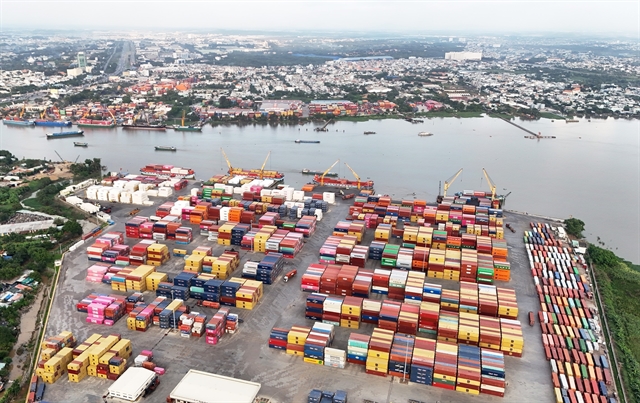 |
| SOWATCO Long Bình Port in Long Bình Ward, part of the HCM City seaport system. — VNA/VNS Photo |
Compiled by Mai Hương
HÀ NỘI — Infrastructure development, digital transformation and policy reform are emerging as the three central pillars shaping Việt Nam’s logistics sector, as the country works to strengthen supply chain resilience amid global trade volatility, experts have said.
Global supply chains are facing mounting disruptions from geopolitical tensions, rising transport costs and shifting trade routes, putting pressure on Việt Nam to upgrade its logistics capabilities.
Meanwhile, the country’s rapid rise as a manufacturing hub is driving demand for more efficient, reliable and cost-effective logistics services.
According to Bjoern Traemann, managing director of global logistic firm Kuehne+Nagel Vietnam, Việt Nam has made strong progress in production and trade infrastructure, with rising investment in ports, highways and airports.
A wave of investment in transport infrastructure is laying the foundation for long-term growth, with new expressways cutting transit times and port expansions enabling larger vessels and higher cargo volumes.
Major projects such as the Long Thành International Airport are expected to significantly boost air cargo capacity, particularly for high-value goods. Meanwhile, the rapid expansion of industrial parks along key economic corridors is improving connectivity between production centres and logistics networks, Traemann told vneconomy.vn.
However, gaps in multimodal connectivity remain a key constraint. Freight transport still relies heavily on roads, increasing costs and limiting efficiency, while rail and inland waterways remain underutilised.
Such imbalances leave the sector more vulnerable to external shocks. Disruptions linked to geopolitical tensions, particularly in the Middle East, have driven up fuel prices and extended shipping routes, increasing both transport time and costs.
“Fuel can account for 30-50 per cent of transport costs,” said Viettel Logistics Director Đoàn Quang Chiến. “When fuel prices surge, it pushes up the entire cost base, not just freight rates.”
Freight transport maintained double-digit growth in 2025, with total cargo volume rising 14.1 per cent, according to the General Statistics Office of Việt Nam.
Road transport remained dominant, expanding 14.7 per cent, while inland waterways and maritime transport also recorded solid growth of 12.8 per cent and 12 per cent, respectively. Rail and air transport, by contrast, accounted for only a small share, with more modest increases of 7.1 per cent and 4.4 per cent.
Multimodal logistics solutions are also gaining traction, combining sea, air, rail and road transport to balance cost and delivery speed. This approach is helping businesses reduce dependence on single routes or transport modes, particularly in the context of global uncertainty.
Chiến said Viettel Logistics is accelerating its shift towards multimodal transport, combining road, rail, inland waterways and air to reduce reliance on trucking and optimise costs. The company has expanded rail use on key north–south routes, helping cut fuel consumption and improve efficiency.
According to the Global Connectedness Report, Việt Nam remains one of the world’s most promising trade growth markets, supported by strong FDI inflows, a strategic location and improving infrastructure. These factors are helping exporters mitigate the impact of global shocks.
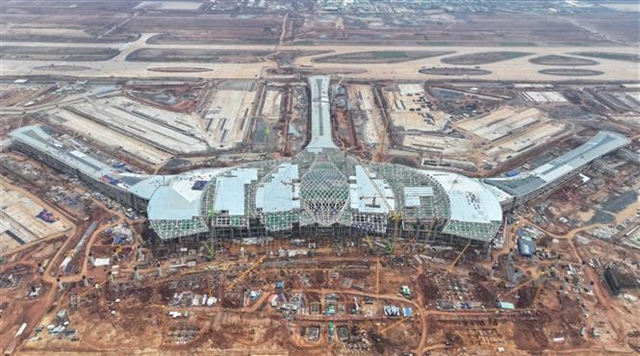 |
| The passenger terminal at Long Thành International Airport. — VNA/VNS Photo Công Phong |
International logistics providers are expanding their presence in Việt Nam, bringing advanced technologies and integrated service models that support end-to-end supply chain management.
“Việt Nam is a fast-growing logistics market that is gradually narrowing the gap with more developed ASEAN economies,” Masamichi Ujiie, president of FedEx Asia Pacific, was quoted as saying on hanoimoi.vn.
He said digitalisation is emerging as a key driver of logistics competitiveness across ASEAN, where integrated ecosystems combining infrastructure, digital systems and policy are increasingly seen as essential to improving efficiency and execution.
Across the region, logistics development is being driven by the alignment of infrastructure, digitalisation and policy, rather than any single factor, he said.
Ujiie went on to note that investors are increasingly prioritising markets with advanced digital capabilities, including real-time visibility, faster customs clearance and more stable cargo flows through integrated systems.
Government policy is also playing a central role in shaping the sector’s long-term development. Việt Nam has set targets to reduce logistics costs to 12-15 per cent of GDP and to place the country among the world’s top 40 logistics markets by 2035.
These goals are supported by a broader strategy focused on infrastructure investment, digitalisation and stronger public–private coordination, alongside efforts to streamline customs procedures and promote multimodal transport.
As part of this broader push, construction of the US$2 billion Liên Chiểu deep-sea port in Đà Nẵng has recently begun, adding new capacity in central Việt Nam and strengthening connectivity with industrial zones and international shipping routes.
With continued investment in infrastructure, faster digital adoption and more effective policy implementation, Việt Nam is positioning itself to become a more resilient and competitive logistics hub in regional and global supply chains. — BIZHUB/VNS
Economy
 Economy
 Economy
 Economy
 Economy
 Economy
 Economy
 Economy
 Economy
 Economy
 Economy
 Economy
 Economy
 Economy
 Economy