 Economy


Việt Nam, China seek stronger substantive parliamentary cooperation
1.
|
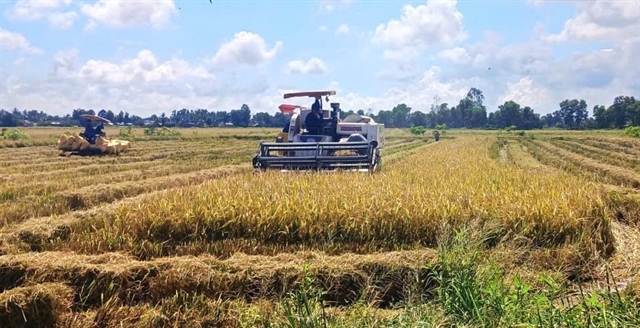
| Harvesting low-emission rice at Hồng Phát Agricultural Service Cooperative in Vĩnh Thanh Commune, Cà Mau Province. — VNA/VNS Photo |
CÀ MAU — Rice cultivation in Cà Mau Province is increasingly under pressure from climate change, with prolonged droughts, saltwater intrusion, rising input costs and unstable market prices undermining farmers’ livelihoods.
Against this backdrop, the national project to develop one million hectares of high-quality, low-emission rice linked with green growth in the Mekong Delta by 2030 is emerging as a strategic solution to restructure production, enhance rice value and improve environmental resilience.
At Hồng Phát Agricultural Service Cooperative in Vĩnh Thanh Commune, farmers have now entered their third crop season applying low-emission farming techniques.
Across more than 50ha of rice fields, cooperative members have adopted advanced practices such as using certified seeds, reducing seed density, fertiliser and pesticide use, improving irrigation efficiency, and applying biological products to treat rice straw.
These measures have enabled rice plants to grow more robustly with fewer pests and diseases, while significantly cutting production costs without compromising yield.
Trần Quốc Duẫn, a cooperative member cultivating over three hectares, said the new approach has reduced seeding rates by around five kilograms per 1,000sq.m and fertiliser use by approximately 10kg per 1,000sq.m.
“Just these two inputs alone help my family save about VNĐ300,000 (roughly US$12) per 1,000sq.m,” he noted.
Beyond cost savings, Duẫn emphasised that the model improves crop resilience, reducing vulnerability to pests compared to traditional farming practices.
Similarly, Nguyễn Văn Châu, another farmer managing three hectares under the low-emission model, highlighted clear efficiency gains.
Reduced seed use, lower fertiliser input and fewer pesticide applications have all contributed to lower investment costs.
“Rice grows healthier, pest pressure is lower, and most importantly, enterprises commit to purchasing our output at favourable prices. This gives farmers confidence to maintain production,” Châu said.
According to Nguyễn Hồng Phúc, chairman of the cooperative, all 65 members are participating in the model.
During the 2025–2026 Winter-Spring crop, the cooperative continues to implement low-emission, high-quality rice farming across 50ha.
The model integrates multiple technological advancements, including row seeding combined with deep fertiliser placement, increased use of organic fertilisers, integrated pest management (IPM), and the application of drones for fertiliser spreading and pesticide spraying.
Input costs have been reduced by approximately 30 per cent, saving between VNĐ3 million and VNĐ3.5 million ($120–140) per hectare.
Meanwhile, yields remain stable at around 6.5–7 tonnes per hectare.
Importantly, farmers also benefit from stable output markets, with enterprises purchasing rice at prices about VNĐ200 per kilogramme higher than the market rate.
|
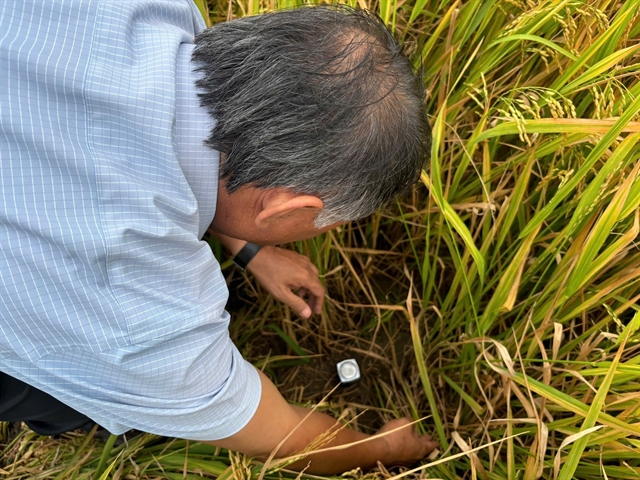
| Applying alternate wetting and drying (AWD) irrigation in low-emission rice cultivation. — VNA/VNS Photo |
As a result, profits have increased by roughly 20 per cent compared to conventional farming.
Beyond economic benefits, the model also contributes to environmental improvements.
The use of drones reduces chemical exposure, while straw collection and reuse help limit open-field burning, cutting greenhouse gas emissions.
Ngô Nguyên Phong, party secretary of Vĩnh Thanh Commune, stressed that low-emission rice farming not only enhanced rice value but also directly improved farmers’ living environments and health.
The adoption of traceability and safety standards enabled higher selling prices and strengthened market competitiveness.
The model is expected to expand from 50ha to 100ha during 2026–2027, according to Phong.
In addition, enterprises are actively working with farmers to develop large-scale production linkages, with plans to reach over 1,000ha under contract farming.
“This will position Vĩnh Thanh as a pioneer in Cà Mau’s transition towards low-emission agriculture,” Phong said.
At the provincial level, Phạm Văn Mười, deputy director of the Department of Agriculture and Environment, reported that after more than one year of implementation, the programme had delivered encouraging results.
During the 2025–2026 Winter-Spring crop alone, 24 pilot models covering approximately 1,400ha had been deployed. Preliminary findings showed farmers’ profits rising by VNĐ4–6 million ($160–240) per hectare.
Notably, greenhouse gas emissions had been reduced by an estimated 3.3–3.5 tonnes of CO₂ per hectare – a critical indicator supporting Việt Nam’s climate commitments.
Cà Mau aims to scale up to 55,000ha of high-quality, low-emission rice across 20 key communes and wards by 2030, according to Mười.
To achieve this goal, the province will continue promoting farmer awareness, strengthening cooperative models and encouraging production-consumption linkages through formal contracts.
Training programmes will also be expanded to enhance farmers’ capacity in applying technical packages, monitoring systems (MRV), and production record-keeping.
At the same time, investments will be prioritised to upgrade irrigation systems, dykes and intra-field transport infrastructure.
These improvements will enable better water management, particularly for alternate wetting and drying irrigation, while controlling salinity intrusion and facilitating mechanisation.
Local authorities also plan to strengthen grassroots agricultural extension services, using cooperatives, enterprises and exemplary farmers as core drivers to promote sustainable rice value chains. — VNS
Economy
 Economy
 Economy
 Economy
 Economy
 Economy
 Economy
 Economy
 Economy
 Economy
 Economy
 Economy
 Economy
 Economy
 Economy