 Economy



Drive to Great: BAIC FOTON Africa Partners Conference Set to Open
1.
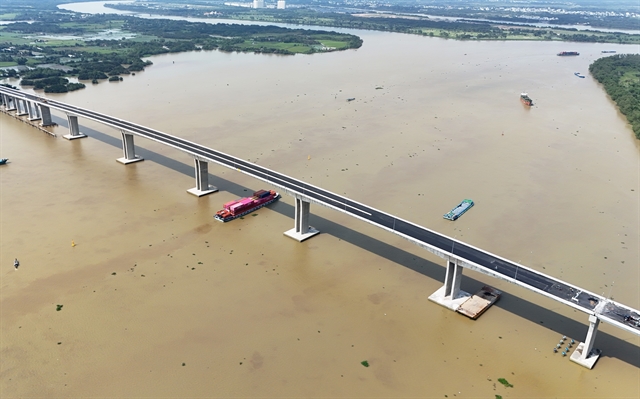 |
| The Nhơn Trạch Bridge, linking HCM City and Đồng Nai Province, was officially inaugurated, strengthening regional connectivity and easing traffic pressure on key transport corridors. — VNA/VNS Photo |
HCM CITY — As Việt Nam enters 2026, the industrial real estate sector is undergoing a structural transition in which infrastructure is no longer simply a supporting factor but a key force reshaping competitiveness across the market.
In the Southern Key Economic Region, a series of large-scale infrastructure projects were launched, completed or approached operation in 2025, and early 2026 is opening a new growth phase for industrial property, where connectivity, scale and location are becoming decisive advantages.
In previous development cycles, infrastructure expansion in southern Việt Nam largely followed long-term master plans, with economic benefits expected to materialise over extended periods.
The 2025–26 period, however, marks a shift from planning to delivery, as multiple strategic projects are being implemented simultaneously and brought closer to operation, providing a more immediate foundation for industrial and logistics growth.
The most transformative project is Long Thành International Airport in Đồng Nai Province.
Phase 1 is being implemented with the target of commencing operations in 2026, featuring a designed capacity of 25 million passengers and 1.2 million tonnes of cargo annually.
Once operational, Long Thành is expected to gradually assume the role of the region’s primary international aviation gateway from Tân Sơn Nhất International Airport in HCM City, while significantly expanding logistics capacity for industrial centres in Đồng Nai, Tây Ninh and HCM City.
Alongside aviation infrastructure, the region’s transport network is undergoing visible transformation.
The city’s Ring Road No.3, linking the city with Đồng Nai and Tây Ninh, recorded substantial progress in 2025 and is expected to open key sections from 2026.
At the same time, Ring Road No.4 and the Biên Hòa–Vũng Tàu Expressway are gradually forming a direct corridor connecting industrial parks with deep-water port clusters, reducing travel times and logistics costs.
According to John Campbell, head of Industrial Services at Savills Việt Nam, this year will represent a pivotal year for the Southern Key Economic Region, as large-scale infrastructure officially “unlocks” new capacity in terms of scale, connectivity and competitiveness for industrial real estate.
The combined development of Cái Mép–Thị Vải Port and Long Thành International Airport and the expansion of expressway and ring road network are creating a comprehensive infrastructure ecosystem for manufacturing and logistics.
This ecosystem is reinforcing the region’s position as Việt Nam’s primary industrial growth engine while strengthening its role in regional supply chains with higher value-added activities.
“Infrastructure is reshaping where industrial growth takes place, not just how fast it grows,” Campbell noted, adding that once these projects come into operation from 2026, the competitive position of southern Việt Nam’s industrial real estate market will move to a higher baseline.
Against this backdrop, Savills views 2026 not merely as an infrastructure milestone but as the starting point of a longer development cycle, in which industrial real estate shifts from extensive land expansion towards optimising quality, connectivity and operational efficiency.
Infrastructure improvements are also redefining the geography of industrial investment.
As new transport corridors take shape, industrial development is extending beyond traditional core locations, helping to redistribute demand and ease pressure on existing land supply.
HCM City, Đồng Nai and Tây Ninh remain central markets, but development boundaries are increasingly following new infrastructure links towards Long Thành Airport and the Cái Mép–Thị Vải port complex.
In the second half of 2025, southern Việt Nam recorded around 25,700 hectares of operational industrial land, with an average occupancy rate of approximately 90 per cent.
Key markets such as Đồng Nai and HCM City, including the former Bình Dương area, reported occupancy levels exceeding 90 per cent.
Meanwhile, Tây Ninh and the former Bà Rịa–Vũng Tàu area continue to offer room for expansion, supported by new land banks and strategic locations along emerging infrastructure routes.
Industrial land rents have remained elevated, reflecting stable demand from manufacturers.
Savills estimates that average industrial land rents in the southern region reached around US$193 per square metre per lease term in 2025, up from $183 per square metre in 2024, with the city recording the highest rental levels.
Beyond land leasing, the ready-built factory and warehouse segment has also benefited from infrastructure upgrades.
Total ready-built factory supply in southern Việt Nam reached approximately 11.6 million square metres, with occupancy rates rising to 92 per cent.
Improved transport and logistics connectivity has shortened travel times between factories, seaports and airports, enhancing the appeal of ready-built facilities, particularly for tenants seeking rapid deployment.
From another perspective, CBRE Việt Nam reported that the southern industrial land market rebounded strongly in the second half of 2025 after early-year concerns over trade barriers.
More than 100 hectares of industrial land were absorbed in the final six months of the year, accounting for roughly two-thirds of total annual absorption.
The ready-built warehouse market also recorded its strongest performance in five years, with absorption exceeding 466,000 square metres, driven mainly by demand from e-commerce, logistics and the expansion of foreign retail and lifestyle brands.
Looking ahead, CBRE expects the 2026–28 period to see more than one million square metres of new ready-built factory and warehouse supply, concentrated mainly in the city and Đồng Nai.
Combined with strategic infrastructure development and an improving legal framework for high-tech industries, these factors are positioning southern Việt Nam for a new phase of industrial growth centred on efficiency, connectivity and higher-value activities. — VNS
Economy
 Economy
 Economy
 Economy
 Economy
 Economy
 Economy
 Economy
 Economy
 Economy
 Economy
 Economy
 Economy
 Economy
 Economy




