 Economy

Hà Nội seeks public feedback on plans for 22 metro stations
1.
|
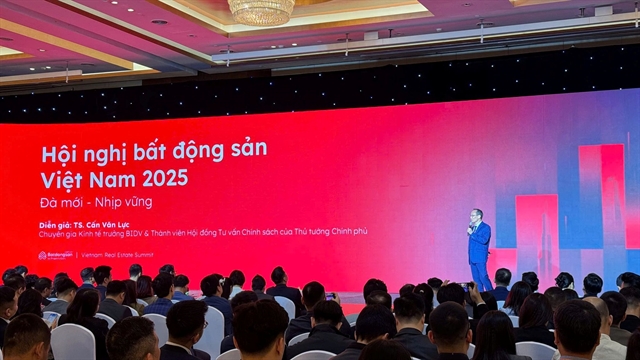
| The Việt Nam Real Estate Conference 2025 was held in Hà Nội on December 9 by Batdongsan.com.vn. — Photo courtesy of Batdongsan.com.vn |
HÀ NỘI — Việt Nam real estate market is currently driven by real demand, transparent legal frameworks, and a more positive foundation thanks to new legal corridors, with expectations of a clear recovery in 2026.
Nguyễn Quốc Anh, Deputy CEO of Batdongsan.com.vn made the remarks at the Việt Nam Real Estate Conference (VRES 2025) held in Hà Nội last week.
Anh said that entering the last quarter of the year, interest rates have started to tick up as many commercial banks recorded declining deposits, pushing 12-month deposit rates to 5.3–5.5 per cent per year.
He stated that the slight increase in deposit interest rates is merely technical, aimed at rebalancing capital costs after the deep decline in 2024.
Lending rates are mostly around 6-7 per cent per year - higher than the 5-5.5 per cent offered in young-buyer incentive packages, but still supportive for transactions.
“The current market pressure mainly comes from capital demand for public investment and production, while low deposit rates are pushing money flows toward real estate and securities,” he said.
He also argued that banks’ slight increase in deposit rates at year-end is a positive development because it helps the system better balance long-term capital, creating a stable foundation for the next market cycle.
At the conference, Dr. Cấn Văn Lực, chief economist at BIDV and a member of the Prime Minister's Economic Advisory Council, affirmed that interest rates are becoming the 'decisive factor' shaping the new recovery cycle of Việt Nam’s real estate market.
The 2023-2025 period has demonstrated that interest rates serve as an essential 'soft lever' for Việt Nam’s real estate market - supporting real housing demand, helping developers overcome difficulties, and enabling a more stable and sustainable recovery cycle, no longer dependent on speculation.
Lực expects interest rates to remain a major force shaping the market in 2026 and beyond.
However, he said that interest rates, while necessary, are not sufficient on their own. The overall health of the market also depends on project legal frameworks, new supply, procedural reforms, and market confidence.
Low interest rates only maximise their impact when accompanied by a transparent ecosystem and supply that meets real demand.
From a market perspective, Anh said the market this year is much 'calmer' with a clear shift toward end-user-driven products.
Although buying and selling interest has yet to return to the 2022 peak, capital is now concentrated in legally transparent products, reflecting investors’ cautious sentiment after the 2022 shock as well as the market’s more sustainable development trajectory.
According to the Deputy CEO of Batdongsan.com.vn, new legal corridors from the revised Land Law and Real Estate Business Law have increased transparency and improved project-development procedures.
Land prices in 2025 in many localities have remained below the 2022 peak, helping the market maintain stability and reduce risks.
He said that there are currently no signs of widespread land fever. The hotspots mostly relate to administrative boundary mergers, while transactions remain concentrated in apartments and private houses in major urban areas.
“In the short term, the market may continue to be in a probing phase, but in the medium and long term, the recovery cycle that began in 2024 still has plenty of room to grow," Anh said.
"I believe that 2026 will be the time when the market becomes clearly differentiated and enters a more stable trajectory. A stressful scenario like in 2022 will be very difficult to repeat.”
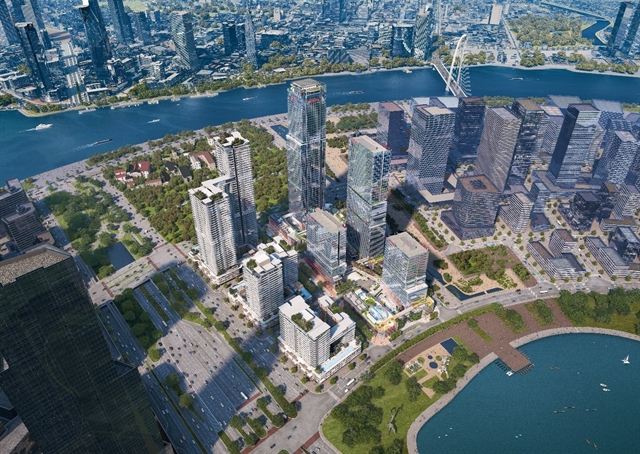
Furthermore, in the context of a strongly restructuring real estate market, he emphasised the role of International Financial Centres (IFCs) as a 'strategic puzzle piece' that helps reposition urban central business districts (CBDs) and opens up new growth drivers.
Experience from Yeouido (Seoul) and Lujiazui (Shanghai) shows that a successful IFC always converges four elements like planning, connected infrastructure, iconic buildings, and mechanisms that attract global financial institutions, according to the Batdongsan.com.vn.
When these four components are activated, cities not only form more dynamic new CBDs but also create momentum for businesses, employment, and the value of central real estate.
In Việt Nam, HCM City and Đà Nẵng must choose either developing into core central IFCs or becoming extensions of existing CBDs.
Success depends on clearly defining the IFC model, developing iconic buildings, completing interregional and inner-city infrastructure, and establishing mechanisms to attract organisations and businesses. — VNS
Economy
 Economy
 Economy
 Economy
 Economy
 Economy
 Economy
 Economy
.jpg) Economy
Economy
 Economy
 Economy
.jpg) Economy
Economy
 Economy
 Economy
.JPG) Economy
Economy