 Sci-Tech

Vietnamese, Danish FMs discuss ways to deepen bilateral ties
1.
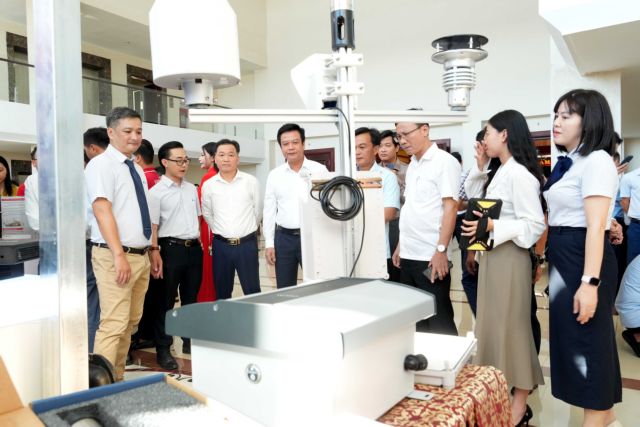 |
| Digital technology product exhibition booth of Quảng Trị Province's agricultural sector on the sidelines of the conference reviewing the province's performance on implementing Politburo Resolution 57 on August 12, 2026. — VNA/VNS Photo Tá Chuyên |
HÀ NỘI — Việt Nam is allocating about VNĐ95 trillion (US$3.6 billion) from the State budget in 2026 for science, technology, innovation and digital transformation, equivalent to three per cent of total State budget expenditure.
The increased funding reflects the Government's determination to turn strategic priorities in science, technology and digital transformation into concrete resources. But with resources significantly increased, a more fundamental challenge has emerged, which to ensure the money is allocated to the right priorities, disbursed effectively and ultimately converted into technologies, products, digital platforms and models that generate tangible value.
According to the Ministry of Science and Technology's Department of Planning and Finance, after one year and eight months of implementing Politburo Resolution No. 57-NQ/TW on breakthroughs in science, technology, innovation and national digital transformation, major bottlenecks in mechanisms and resources have been substantially addressed.
A new legal framework has largely been put in place, creating conditions for the development of these sectors. Funding for 2026 has also reached a level that provides a much stronger foundation for implementation.
However, the ministry stressed that larger resources do not automatically translate into greater efficiency.
From mechanisms to implementation
Monitoring the development of plans and disbursement, the department has identified implementation as the main bottleneck.
At some agencies and localities, concerns about making mistakes and reluctance to take responsibility remain obstacles to applying new mechanisms. Such hesitation can slow down the development and implementation of science and technology, innovation and digital transformation programmes.
The quality of task preparation is also uneven. Some proposals do not clearly define objectives, expected outputs, socio-economic impacts or funding requirements. As a result, they have to be revised repeatedly during appraisal, delaying budget allocation and disbursement.
In addition, the capacity of some ministries, sectors and localities to implement large-scale programmes has not kept pace with the requirements. In some cases, resources have been allocated but the ability to absorb and effectively use the funding remains limited.
These problems mean that the next stage of implementing Resolution No. 57-NQ/TW must focus less on creating additional mechanisms and more on making existing mechanisms work effectively.
From procedural compliance to accountability for results
To address the bottlenecks, the Ministry of Science and Technology advised the Prime Minister to issue Directive No. 29/CT-TTg on accelerating the implementation of science, technology, innovation and digital transformation tasks in 2026.
According to the Department of Planning and Finance, the directive's core focus is not to introduce more mechanisms, but to strengthen implementation discipline.
It calls for a comprehensive review of task portfolios, faster allocation and disbursement of funds, and decisive action on delayed tasks. It also links the responsibility of leaders to implementation results, aiming to tackle the tendency to avoid responsibility or shift it between agencies.
The ministry said the success of Resolution No. 57-NQ/TW should not be measured simply by how much funding has been allocated. The more important questions are how many new technologies have been developed, how many innovative businesses have been supported, how many digital platforms have been put into operation and how much these investments contribute to economic growth.
This requires a shift from a mindset focused on being “correct in terms of procedures” to one centred on accountability for outcomes.
Concentrating resources where they can have the greatest impact
From now until the end of 2026, the Ministry of Science and Technology will focus on implementing existing policies effectively, putting the mechanisms established under Resolution No. 57-NQ/TW into practice and producing measurable results.
A key priority will be removing bottlenecks in implementation, particularly delays in proposing tasks, allocating resources and organising implementation caused by concerns about risks and responsibility.
The ministry will work with ministries, sectors and localities to implement Directive No. 29/CT-TTg, strengthen inspection and supervision, and link the responsibility of leaders to implementation progress and disbursement results.
Resources will also be concentrated on key programmes and projects capable of generating broad spillover effects.
These include strategic technologies, key laboratories, digital infrastructure, databases, shared digital platforms and products that directly serve citizens and businesses.
The principle is that resources should not be spread thinly across too many tasks, investment should focus on urgent priorities with clearly defined outputs and the potential to create new growth drivers.
Financial and investment management will also be reformed towards a results-based approach. The Ministry of Science and Technology will coordinate with the Ministry of Finance and other ministries, sectors and localities to review the entire portfolio of tasks and closely monitor progress.
Where necessary, resources will be shifted from slow-moving tasks to those with stronger implementation capacity and a greater ability to absorb funding effectively.
At the same time, the quality of planning will be improved to ensure that investment resources are used efficiently from the outset. — VNS
Sci-Tech
 Sci-Tech
 Sci-Tech
 Sci-Tech
 Sci-Tech
 Sci-Tech
 Sci-Tech
 Sci-Tech
 Sci-Tech
 Sci-Tech
 Sci-Tech
 Sci-Tech
 Sci-Tech
 Sci-Tech
 Sci-Tech